
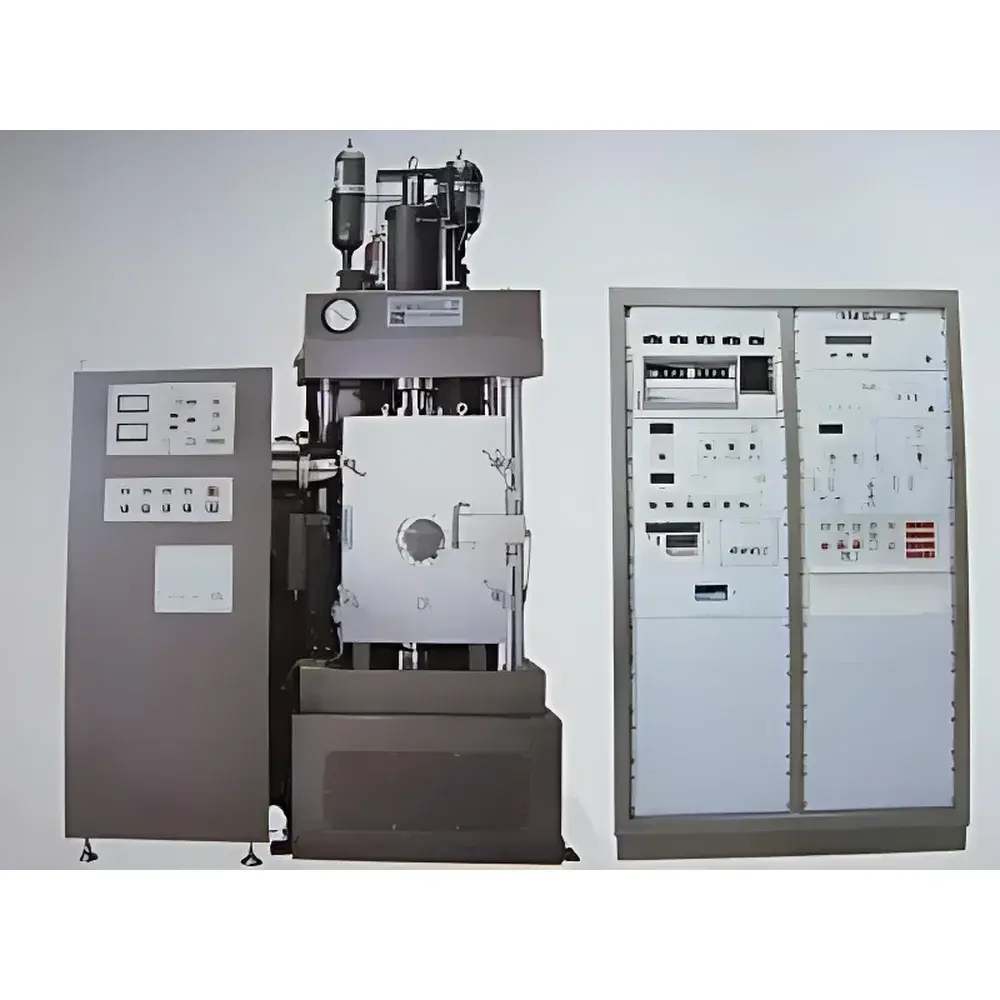
Thermemcmastor-Z Single-Axis Dynamic Thermal Simulator, 300 kN Capacity
| Origin | Japan |
|---|---|
| Manufacturer Type | Authorized Distributor |
| Origin Category | Imported |
| Model | Thermemcmastor-Z, 300 kN, 1000 mm/s |
| Max. Load | 300 kN |
| Max. Strain Rate | 1 × 10⁻³ to 1 × 10³ mm/s |
| Heating Methods | High-Frequency (HF) Induction + Low-Frequency (LF) Direct Resistance |
| Temperature Range | RT to 1600 °C (material-dependent) |
| Cooling Media | He, Ar, N₂, or Water |
| Max. Cooling Rate | 500 °C/s (water, φ8×12 mm specimen) |
| Expansion Measurement | Non-contact GaN LED shadow method, ±3 µm accuracy |
| Atmosphere Control | Vacuum (≤5 × 10⁻² Torr), inert gas, or ambient air |
| Control Precision | ±0.1 mm (displacement), ±3 °C (temperature), ±2 kgf/mm² (load) |
Overview
The Thermemcmastor-Z is a high-precision single-axis dynamic thermal simulator engineered for quantitative thermomechanical processing simulation under tightly controlled thermal and mechanical boundary conditions. It integrates dual-mode heating—high-frequency (HF) induction and low-frequency (LF) direct resistance heating—to enable independent thermal profiling across specimen geometry while maintaining uniform temperature distribution during deformation. The system operates on the principle of controlled uniaxial compression at variable strain rates (1 × 10⁻³ to 1 × 10³ mm/s), synchronized with rapid, programmable heating and cooling cycles. Real-time non-contact expansion measurement via GaN LED shadow detection captures dimensional changes with ±3 µm resolution, enabling accurate determination of phase transformation kinetics (e.g., austenite–ferrite, martensite start) and thermal strain evolution. Designed for metallurgical process modeling, it supports generation of stress–strain (S–S) curves, continuous cooling transformation (CCT) diagrams, and time–temperature–transformation (TTT) data essential for alloy development, hot rolling simulation, and thermo-mechanical treatment (TMT) optimization.
Key Features
- Dual-heating architecture: HF induction enables rapid, surface-localized heating (up to 70 °C/s for φ8×12 mm specimens); LF resistance heating ensures bulk thermal uniformity (±10 °C over 20 mm zone), minimizing thermal gradients during deformation.
- High-fidelity thermal control: Programmable heating/cooling profiles with ±3 °C accuracy; real-time thermocouple welding (R-type) ensures stable, repeatable temperature measurement across specimen cross-sections.
- Dynamic mechanical actuation: Electro-hydraulic servo-controlled loading system delivers up to 300 kN static load with displacement resolution of ±0.1 mm (at 10 mm stroke) and response latency < 0.02 s between deformation passes.
- Multi-medium quenching capability: Integrated gas (He, Ar, N₂) and water cooling nozzles allow precise control of cooling rates from 2 °C/s (N₂, controlled) to 500 °C/s (water, quench), supporting both continuous cooling and interrupted quench protocols.
- Fully automated atmosphere management: Rotary vacuum pump + Pirani gauge achieves ≤5 × 10⁻² Torr base pressure; programmable gas purging and pressure regulation (up to 0.02 MPa) ensure reproducible inert or reactive environments per ASTM E290 and ISO 6892-2.
- Synchronized non-contact metrology: GaN LED shadow-based expansion sensor operates vertically (plane-strain) or horizontally (uniaxial compression), tracking specimen thickness or diameter within 1 s post-deformation—critical for capturing transient phase volume changes.
Sample Compatibility & Compliance
The Thermemcmastor-Z accommodates standard metallurgical specimens including plane-strain (20 × 20 mm, 30 × 30 mm), rectangular (10 × 20 mm), and uniaxial compression (φ8 × 12 mm) geometries. Specimen mounting employs bolted end-fixtures (LF), pin-supported configurations (HF), or build-up compression setups with Si₃N₄ tooling—ensuring minimal constraint-induced artifacts. All thermal, mechanical, and atmospheric subsystems comply with IEC 61000-6-2 (EMC immunity) and ISO 12100 (functional safety). Data acquisition meets FDA 21 CFR Part 11 requirements for electronic records and signatures when paired with validated software modules. System validation documentation supports GLP/GMP audit readiness per ISO/IEC 17025 and ASTM E4.
Software & Data Management
The integrated control suite provides closed-loop synchronization of thermal ramping, mechanical deformation sequencing, atmosphere conditioning, and expansion data capture. Users define multi-step thermomechanical programs—including dwell times, strain increments, cooling media selection, and gas flow rates—via intuitive graphical workflow editors. Raw sensor streams (load, displacement, temperature, expansion, pressure) are timestamped with microsecond precision and stored in HDF5 format for traceability. Post-acquisition analysis tools generate S–S curves with true stress/strain correction, construct CCT diagrams using dilatometric inflection points, and export calibrated datasets to MATLAB, Thermo-Calc, or JMatPro for microstructural modeling. Audit trails record all parameter modifications, operator logins, and system alarms—fully compliant with 21 CFR Part 11 electronic signature and retention mandates.
Applications
This instrument serves core R&D and quality assurance functions in advanced materials development: hot deformation behavior of high-strength steels, aluminum alloys, titanium grades, and nickel-based superalloys; recrystallization kinetics quantification under industrial rolling schedules; weld thermal cycle simulation (HAZ characterization); solid-state phase transformation mapping (e.g., bainite formation, precipitation hardening); and thermo-mechanical fatigue life prediction. It is routinely deployed in national laboratories (e.g., NIMS, MPIE), steelmakers’ central R&D centers, and university metallurgy departments conducting ISO 10810-compliant hot tensile/compression testing and ASTM E209-22 thermomechanical processing studies.
FAQ
What specimen geometries are supported?
Standard configurations include plane-strain (20 × 20 mm, 30 × 30 mm), rectangular (10 × 20 mm), and uniaxial compression (φ8 × 12 mm) specimens. Custom tooling can be engineered for specialized geometries upon request.
Can the system replicate industrial hot-rolling thermal cycles?
Yes—the combination of programmable heating rates (up to 70 °C/s), precise cooling control (2–500 °C/s), and synchronized 300 kN deformation enables faithful replication of multi-pass rolling schedules, including interpass time, reduction ratio, and finish temperature profiles.
Is dilatometric phase transition detection validated against reference standards?
The GaN LED expansion system has been cross-verified against certified NIST SRM 720 (Invar) and ASTM E228 linear expansion standards, demonstrating ±3 µm repeatability across RT–1250 °C operating range.
How is data integrity ensured during long-duration tests?
All acquired parameters are written to redundant SSD storage with cyclic checksum verification; system logs capture hardware status, environmental deviations, and operator interventions—supporting full forensic reconstruction per ISO/IEC 17025 clause 7.7.
Does the system support remote operation and monitoring?
Yes—secure TLS 1.3-enabled web interface allows real-time visualization of live sensor streams, program execution status, and alarm notifications from off-site locations, with role-based access control aligned with ISO 27001 information security policies.



