
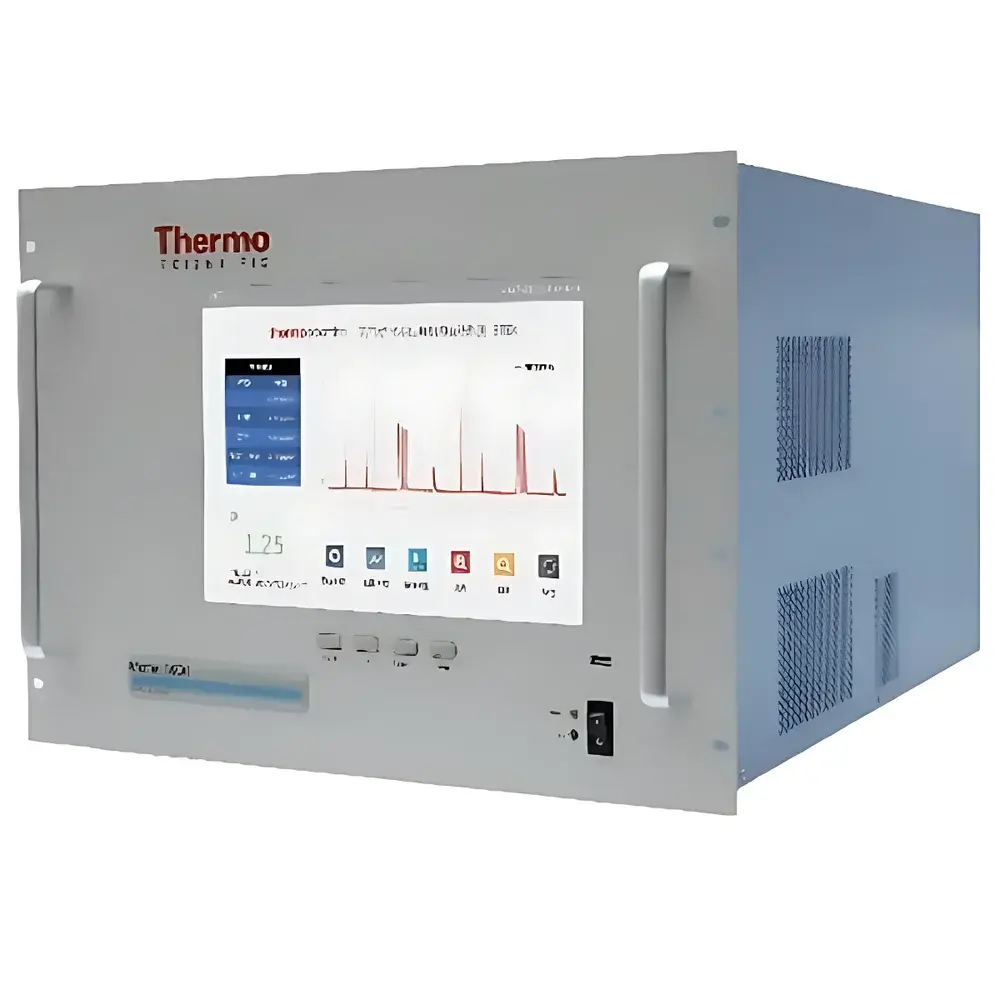
Thermo Fisher 5900-D Customized Online VOCs Monitor
| Brand | Thermo Fisher |
|---|---|
| Origin | Shanghai, China |
| Manufacturer Type | Authorized Distributor |
| Regional Classification | Domestic (China-manufactured) |
| Model | 5900-D |
| Pricing | Upon Request |
| Detection Principle | Gas Chromatography coupled with Pre-concentration and Dual Detectors (FID + FPD) |
| Instrument Type | Online Continuous Analyzer |
| Typical Configuration | Multi-Component VOC Analyzer |
| Detection Range | Direct Sampling: 0–500 / 1,000 / 2,000 / 3,000 ppm (as benzene) |
| Pre-concentrated Sampling | 0–50 / 100 / 200 / 300 / 500 ppm (as benzene) |
| Resolution | Direct Sampling (benzene-equivalent): 25 ppb (v/v) |
| Pre-concentrated Sampling (benzene-equivalent) | 30 ppt (v/v) |
| Accuracy | ≤2% (benzene) |
Overview
The Thermo Fisher 5900-D Customized Online VOCs Monitor is an industrial-grade, continuous-emission monitoring system engineered for unattended, long-term operation in demanding environmental and process environments. It implements a dual-stage analytical architecture combining automated thermal desorption pre-concentration with high-resolution gas chromatography (GC), followed by simultaneous detection using flame ionization detection (FID) and flame photometric detection (FPD). This configuration enables both quantitative measurement of total hydrocarbons and selective quantification of sulfur-containing VOCs (e.g., mercaptans, sulfides) — critical for regulatory compliance in petrochemical, semiconductor, pharmaceutical, and municipal wastewater treatment applications. The system operates on a fixed-cycle analysis protocol (typically 15–60 min per cycle, configurable), delivering real-time concentration data with trace-level sensitivity and metrological traceability to NIST-traceable standards.
Key Features
- Modular pre-concentration unit with programmable trap temperature ramping and cryo-focusing capability, enabling sub-ppt(v/v) detection limits for aromatic and aliphatic VOCs
- Dual-detector GC platform: FID for universal hydrocarbon response (C1–C12) and FPD tuned for sulfur-selective detection with linear dynamic range exceeding 10⁵
- Integrated sample conditioning system featuring heated stainless-steel lines (up to 180 °C), particulate filtration, moisture removal via Nafion™ membrane or chilled trap, and pressure-regulated mass flow control
- Automated valving architecture with inert fused-silica capillary columns (e.g., DB-VRX or equivalent), optimized for C2–C12 separation under isothermal or temperature-programmed conditions
- Ruggedized enclosure rated IP54, designed for deployment in outdoor shelters or process skids; operating ambient temperature range: −20 °C to +50 °C
- Self-diagnostic firmware with real-time status logging for carrier gas pressure, detector baselines, column oven stability, and valve actuation cycles
Sample Compatibility & Compliance
The 5900-D accepts gaseous samples from ambient air, stack effluents, biogas streams, or cleanroom exhaust ducts. It complies with core methodological frameworks including U.S. EPA Methods TO-15 (for ambient air), Method 18 (for source testing), and EN 13649-1/2 (for industrial emissions). Its design supports audit-ready data integrity per FDA 21 CFR Part 11 requirements when deployed in GMP-regulated facilities, incorporating electronic signatures, user-access tiers, and immutable audit trails for calibration events, method changes, and alarm logs. All hardware components meet RoHS 3 and CE marking directives; optional ATEX/IECEx certification kits are available for Zone 1/21 hazardous area installations.
Software & Data Management
The embedded Thermo Fisher VOC-Link™ software provides full remote instrument control via Ethernet (TCP/IP) or optional 4G/LTE. It supports scheduled method sequencing, automatic baseline correction, peak integration using iterative Gaussian deconvolution, and multi-point calibration with internal standard compensation. Raw chromatograms and processed results are stored locally on a redundant SSD array (≥3 years at default logging intervals) and exported in ASTM E1797-compliant .csv or .xml formats. Integration with enterprise SCADA, DCS, or cloud-based environmental data management systems (EDMS) is achieved through OPC UA or MQTT protocols, with TLS 1.2 encryption for secure telemetry transmission.
Applications
- Continuous monitoring of fugitive emissions from tank farms, loading racks, and flare stacks in refineries and chemical plants
- Real-time tracking of VOC breakthrough in activated carbon or zeolite adsorption beds during regeneration cycles
- Compliance reporting for local air quality management districts requiring hourly averaged benzene, toluene, ethylbenzene, and xylene (BTEX) concentrations
- Process optimization support in semiconductor fab abatement systems, where sub-ppb detection of chlorinated solvents (e.g., TCE, PCE) informs scrubber efficiency metrics
- Odor investigation support for wastewater treatment plants, leveraging FPD’s selective response to volatile sulfur compounds (VSCs) such as H₂S, methyl mercaptan, and dimethyl sulfide
FAQ
What sample introduction methods does the 5900-D support?
It supports direct sampling (for high-concentration applications) and automated thermal desorption pre-concentration (for trace-level analysis), both configurable via software-defined method templates.
Can the system be calibrated using certified gas standards?
Yes — it accepts EPA-certified permeation tubes, dynamic dilution calibrators (e.g., Brooks 5850E), and compressed gas standards traceable to NIST SRM 1860 or equivalent.
Is remote diagnostics and firmware updates supported?
Yes — secure SSH and HTTPS interfaces enable remote troubleshooting, log retrieval, and over-the-air firmware upgrades without on-site intervention.
Does the analyzer require routine consumables beyond carrier gas?
Annual replacement of GC columns, FID jet assemblies, and pre-concentrator traps is recommended; all consumables are cataloged with Thermo Fisher part numbers and shelf-life tracking.
How is data validation performed for regulatory reporting?
The system executes daily zero/span checks, multi-point linearity verification, and retention time locking (RTL) against internal surrogates — all logged with timestamps and operator IDs per GLP/GMP record-keeping requirements.







