
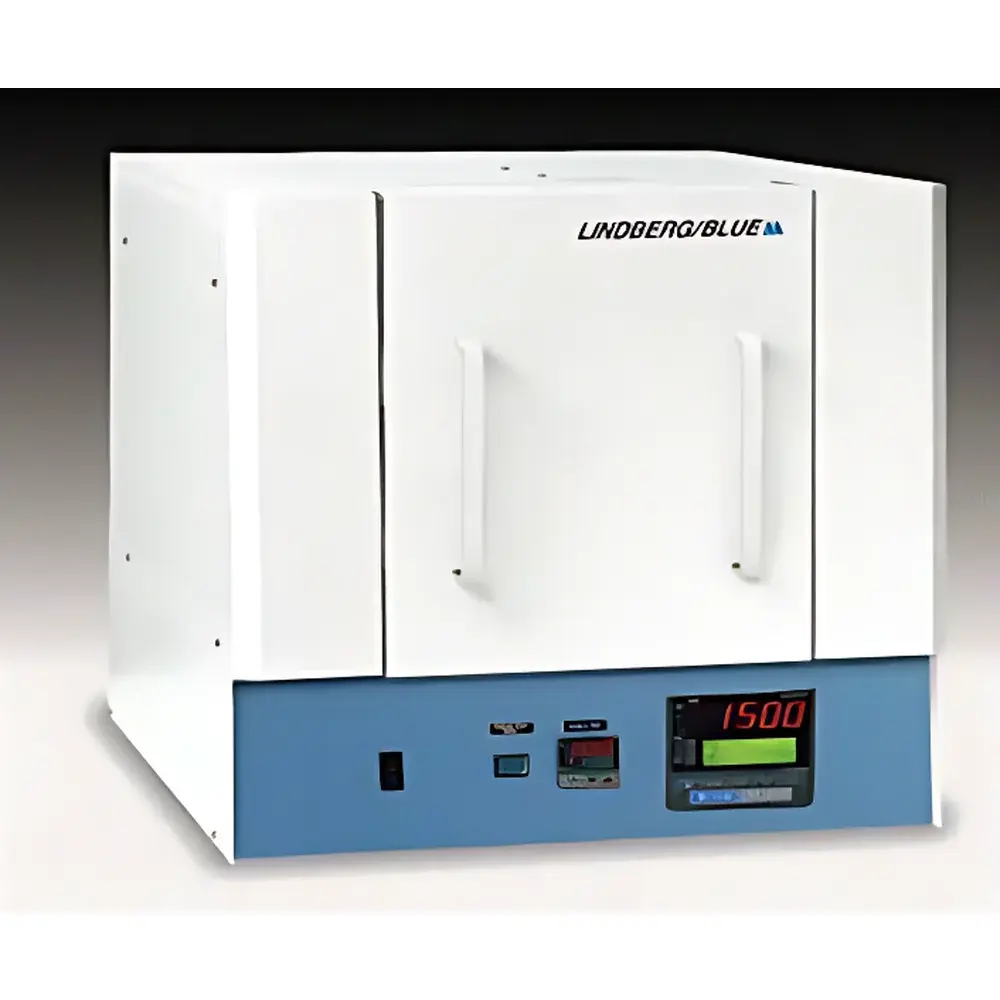
Thermo Fisher Lindberg/Blue M BF51433C-1 1500°C Benchtop Box Furnace
| Brand | Thermo Fisher |
|---|---|
| Origin | USA |
| Manufacturer | Thermo Fisher Scientific |
| Product Type | Box Furnace |
| Maximum Temperature | 1500°C |
| Temperature Uniformity | ±2–4°C |
| Rated Power | 6400 W |
| Heating Rate (to 1500°C) | 6–12°C/min |
| Heating Element | Silicon Carbide (SiC) Rods |
| Internal Chamber Dimensions | 127 × 304.8 × 152.4 mm (H × D × W) |
| External Dimensions | 660.4 × 736.6 × 635 mm (H × D × W) |
| Voltage/Frequency | 208–240 V, 50/60 Hz |
| Net Weight | 91 kg |
| Controller | Multi-segment Single-Program Digital Controller |
| Thermocouple Type | Type R (Platinum/Rhodium), Rear-Mounted |
| Door Configuration | Vertical Lift |
| Insulation | Moldatherm® High-Density Ceramic Fiber |
| Safety Features | Interlocked Door Switch, Over-Temperature Protection (optional models) |
Overview
The Thermo Fisher Lindberg/Blue M BF51433C-1 is a precision-engineered benchtop box furnace designed for demanding high-temperature laboratory applications requiring stable thermal profiles up to 1500°C. Built upon the legacy of Lindberg and Blue M—two historically respected names in thermal instrumentation now unified under Thermo Fisher Scientific—the BF51433C-1 employs resistive heating via silicon carbide (SiC) rods, delivering robust, repeatable performance across materials synthesis, heat treatment, ashing, sintering, and calcination workflows. Its chamber operates under atmospheric conditions with no requirement for controlled atmosphere accessories unless externally integrated. The furnace utilizes a rear-mounted Type R thermocouple (Pt–13% Rh / Pt), compliant with ASTM E230 and IEC 60584 standards, ensuring traceable temperature measurement within the operational range of 500–1500°C. Dual-wall construction with Moldatherm® high-density ceramic fiber insulation minimizes thermal mass while maximizing energy efficiency and reducing external surface temperatures—critical for safe integration into shared lab environments.
Key Features
- High-stability silicon carbide heating elements rated for continuous operation at 1500°C, offering extended service life and low thermal drift over time
- Dual-layer steel enclosure with Moldatherm® insulation enabling rapid heating (6–12°C/min to maximum temperature) and efficient cooldown without auxiliary cooling
- Interlocked vertical-lift door switch that de-energizes heating elements immediately upon opening—meeting UL 746C and CSA C22.2 No. 107.1 safety requirements
- Digitally programmable multi-segment single-program controller with real-time setpoint tracking, ramp/soak capability, and manual override
- Moldatherm® furnace floor plate protects the chamber base from direct sample contact and thermal degradation during repeated high-temperature cycles
- Compliance-ready design supports GLP/GMP documentation needs through stable thermal uniformity (±2–4°C across usable zone) and reproducible heating profiles
Sample Compatibility & Compliance
The BF51433C-1 accommodates crucibles, boats, and trays made from alumina, silicon carbide, quartz (below 1100°C), or molybdenum disilicide—compatible with inert, oxidizing, and mildly reducing atmospheres when used with optional gas inlet kits. It conforms to key international safety and electromagnetic compatibility directives, including UL 61010-1, CSA C22.2 No. 61010-1, and CE marking per 2014/30/EU (EMC) and 2014/35/EU (LVD). While not intrinsically rated for hazardous locations, its construction meets NFPA 86 Class B requirements for non-explosive industrial ovens. Temperature uniformity validation follows ASTM E220 and ISO/IEC 17025-aligned protocols, supporting audit readiness for regulated QA/QC labs.
Software & Data Management
This model features a standalone digital controller without native Ethernet or USB connectivity; however, analog output (0–10 V or 4–20 mA) is available on select configurations for integration with external data loggers or SCADA systems. For laboratories requiring electronic records compliance under FDA 21 CFR Part 11, Thermo Fisher recommends pairing the BF51433C-1 with validated third-party acquisition hardware and software platforms capable of generating secure, time-stamped, and user-auditable thermal logs. Optional over-temperature protection modules (e.g., BF51433BC-1 variant) provide independent hardware cutoff at user-defined thresholds—enhancing system-level fault tolerance.
Applications
- Thermal gravimetric analysis (TGA) sample preparation and pre-conditioning
- Metallurgical annealing, stress relieving, and homogenization of alloys and ceramics
- Ash content determination per AOAC 942.05, ASTM D3174, and ISO 1171
- Sintering of oxide and non-oxide ceramics, including ZrO₂, Al₂O₃, and SiC compacts
- Calibration of thermocouples and reference materials in metrology labs
- Pre-firing and binder burnout in advanced manufacturing prototyping
FAQ
What is the recommended maintenance interval for the silicon carbide heating elements?
Under normal usage (≤12 h/day at ≤1400°C), SiC rods typically require inspection every 6–12 months; replacement is advised when resistance increases by >20% or visible cracking occurs.
Can this furnace be operated under vacuum or inert gas?
The standard BF51433C-1 is not vacuum-rated; however, optional gas purge fittings (NPT 1/4″) are available for inert gas blanketing—consult Thermo Fisher’s application engineering team for compatibility with specific process gases.
Is Type R thermocouple calibration traceable to NIST?
Yes—when calibrated using accredited procedures, Type R sensors meet NIST-traceable requirements per ISO/IEC 17025; Thermo Fisher offers factory calibration certificates upon request.
Does the controller support password-protected parameter changes?
The standard single-program controller does not include user-level access control; for audit-trail functionality, upgrade to the BF51433PBC-1 multi-program variant with configurable security settings.
What is the typical thermal recovery time after door opening?
From 1200°C, full recovery to setpoint requires approximately 8–15 minutes depending on ambient conditions and load mass—consistent with ASTM E1142 thermal recovery test methodology.
Related Products



