
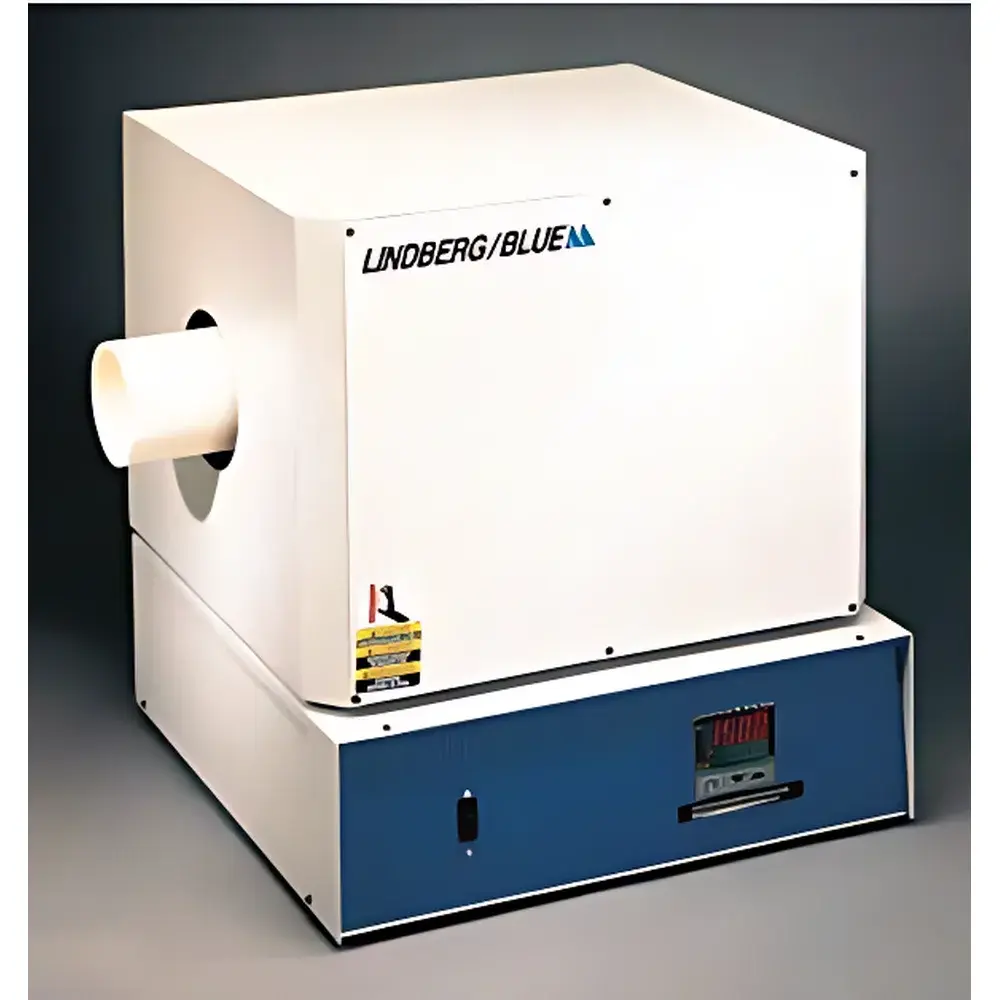
Thermo Fisher Lindberg/Blue M STF55433C-1 1500°C Horizontal Tube Furnace
| Brand | Thermo Fisher |
|---|---|
| Origin | USA |
| Manufacturer | Thermo Fisher Scientific |
| Product Type | Horizontal Tube Furnace |
| Model | STF55433C-1 |
| Max Temperature | 1500°C |
| Temperature Uniformity | ±2–4°C |
| Max Power | 6000 W |
| Ramp Rate (to Max Temp) | 6–12°C/min |
| Heating Element | Silicon Carbide (SiC) Rods |
| Internal Chamber Dimensions | 482.6 × 406.4 × 863.6 mm (W × H × L) |
| External Dimensions | 481.8 × 482.6 × 584.2 mm (H × D × W) |
| Voltage/Frequency | 208/240 V, 50/60 Hz |
| Net Weight | 123 kg |
| Controller | Single-Point Multi-Step PID Microprocessor |
| Thermocouple Type | Type R (Platinum/Rhodium) |
| Compatible Tube OD | 25.4–76.2 mm (1–3 inch) |
| Heating Zone Length | 304.8 mm |
| Operating Temp Range | 500–1500°C |
Overview
The Thermo Fisher Lindberg/Blue M STF55433C-1 is a horizontal, front-loading tube furnace engineered for high-temperature thermal processing in research and industrial laboratories. Designed around a robust silicon carbide (SiC) heating element architecture, it delivers stable, repeatable operation across a continuous temperature range of 500°C to 1500°C. Its core measurement and control principle relies on closed-loop proportional-integral-derivative (PID) regulation, with feedback from a calibrated Type R platinum/rhodium thermocouple embedded within the heating zone—ensuring precise spatial temperature uniformity (±2–4°C at setpoint) and minimizing thermal overshoot. The furnace’s horizontal orientation and modular tube interface support controlled-atmosphere experiments when paired with gas inlet/outlet ports and compatible quartz or ceramic work tubes (OD 25.4–76.2 mm). Unlike muffle furnaces, this design enables axial sample insertion, dynamic gas flow management, and integration into multi-stage synthesis or annealing workflows—making it suitable for materials science, catalysis, solid-state chemistry, and thin-film processing applications where thermal history and ambient control are critical.
Key Features
- High-stability silicon carbide (SiC) rod heating elements mounted along the top and bottom of the furnace chamber for symmetrical heat distribution and extended service life.
- Type R thermocouple integrated directly into the hot zone for real-time, high-accuracy temperature monitoring and feedback control.
- Microprocessor-based single-point, multi-step PID controller with programmable ramp-soak profiles, over-temperature protection, and auto-tuning capability.
- Front-access horizontal configuration with removable flange and sealed door gasket—enabling rapid tube loading/unloading and compatibility with vacuum or inert gas manifolds.
- Optimized heating zone length of 304.8 mm ensures consistent thermal exposure across standard 1–3 inch OD work tubes without requiring custom fixtures.
- Robust steel enclosure with double-wall insulation and passive cooling channels to maintain external surface temperatures below 60°C under full-load operation.
Sample Compatibility & Compliance
The STF55433C-1 accommodates cylindrical work tubes made from fused quartz, high-purity alumina, or recrystallized silicon carbide—each selected based on required atmosphere (oxidizing, reducing, inert, or vacuum), maximum process temperature, and chemical compatibility. Tube diameters ranging from 25.4 mm (1″) to 76.2 mm (3″) are supported without adapter modification. The furnace meets UL 61010-1 and CSA C22.2 No. 61010-1 safety standards for laboratory electrical equipment. Its controller firmware supports audit-ready operation per GLP/GMP guidelines when configured with optional data logging modules; while not inherently 21 CFR Part 11 compliant, it interfaces with validated third-party software platforms that provide electronic signature, user access control, and immutable record retention.
Software & Data Management
The built-in microprocessor controller offers local programming via membrane keypad and LED display, supporting up to 16 segments per program with independent ramp rates, soak times, and hold conditions. Optional RS-485 or USB-to-serial adapters enable connection to PC-based SCADA systems or LabVIEW environments. Thermo Fisher provides generic communication protocols (ASCII command set) for integration into custom automation frameworks. When paired with certified data acquisition hardware, temperature profiles can be timestamped, exported as CSV, and archived in accordance with ISO/IEC 17025 documentation requirements for calibration traceability and method validation.
Applications
- Controlled-atmosphere sintering of advanced ceramics and metal oxides.
- Thermal annealing of semiconductor wafers and 2D material precursors (e.g., MoS₂, graphene oxide).
- Catalyst activation and regeneration under flowing H₂, N₂, or forming gas.
- Thermogravimetric pre-treatment prior to XRD or SEM analysis.
- Solid-state reaction synthesis of battery cathode materials (e.g., LiCoO₂, NMC).
- Calibration of high-temperature reference standards traceable to NIST SRMs.
FAQ
What tube materials are recommended for use at 1500°C?
Fused quartz is limited to ~1100°C; for full-range operation, high-purity alumina (Al₂O₃) or recrystallized silicon carbide (R-SiC) tubes are required.
Can this furnace operate under vacuum?
Yes—when equipped with a compatible vacuum-rated flange, O-ring seal, and diffusion pump system; maximum operating vacuum depends on tube integrity and sealing performance.
Is the temperature uniformity specification valid across the entire chamber length?
The ±2–4°C uniformity applies within the defined 304.8 mm heating zone; gradients increase beyond this region, especially near cold ends.
Does the controller support remote start/stop via digital I/O?
Not natively—but optional relay output modules (sold separately) enable integration with PLCs or building management systems for interlocked startup sequences.
What maintenance intervals are recommended for SiC heating elements?
Under normal atmospheric use, SiC rods typically retain functional integrity for >5,000 hours; visual inspection every 500 cycles is advised to detect cracking or resistive drift.



