
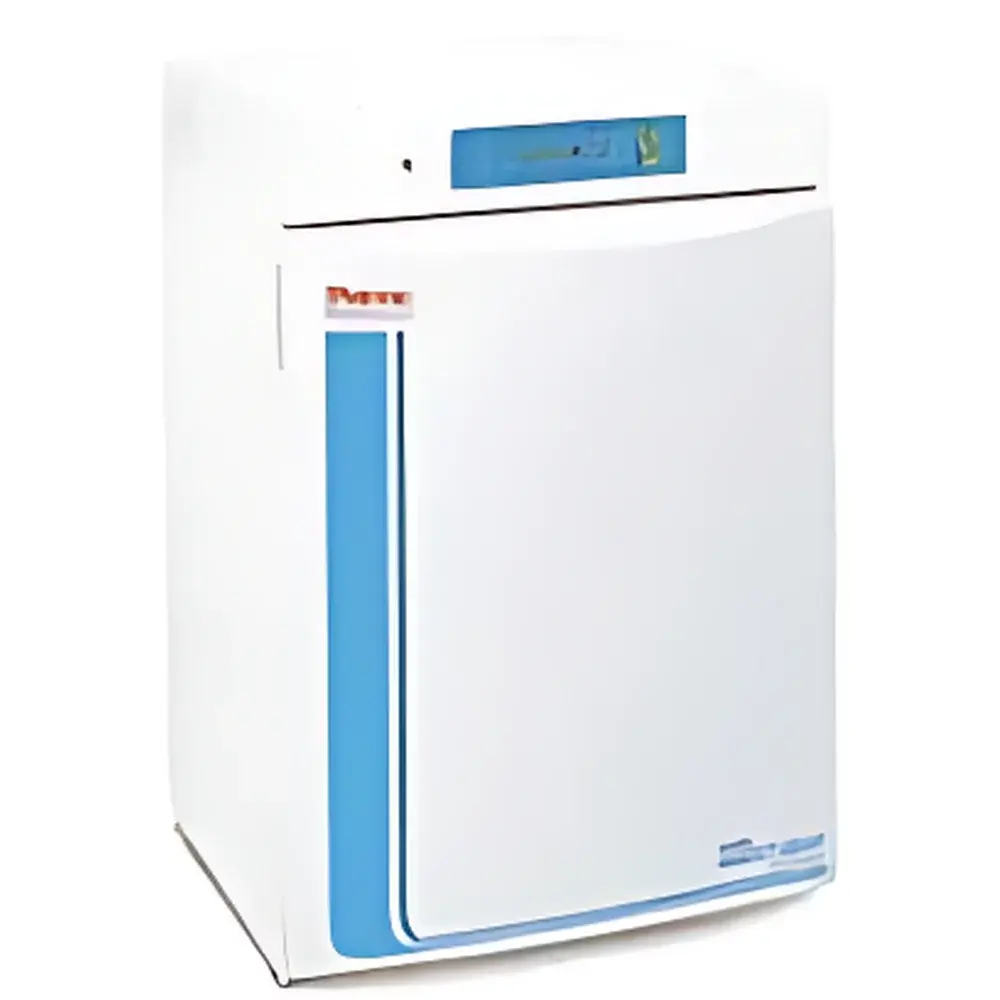
Thermo Fisher Scientific 310 Series Direct-Heat CO₂ Incubator
| Brand | Thermo Fisher Scientific |
|---|---|
| Origin | USA |
| Model | 310 Series |
| Temperature Range | 5°C above ambient to 50°C |
| Temperature Uniformity (at 37°C) | ±0.2°C |
| Temperature Accuracy | ±0.1°C |
| CO₂ Range | 0–20% |
| CO₂ Control Accuracy | Better than ±0.1% |
| Relative Humidity (at 37°C) | Ambient RH to 95% |
| Humidification Pan Capacity | 3.0 L (standard) |
| Internal Volume | 184.1 L |
| Internal Dimensions (W×H×D) | 544 × 681 × 508 mm |
| External Dimensions (W×H×D) | 663 × 978 × 627 mm |
| Input Pressure | 15 PSIG |
| CO₂ Sensor Type | Thermal Conductivity (T/C) or Infrared (IR) |
| Standard/Maximum Shelving | 4 / 17 shelves |
| Net Weight | 96 kg |
| Air Filtration | HEPA Filter, Class 100 Internal Environment |
| Control System | Enviro-Scan™ Microprocessor-Based Environmental Monitoring and Control System |
Overview
The Thermo Fisher Scientific 310 Series Direct-Heat CO₂ Incubator is engineered for precision cell culture applications requiring stringent environmental control, reproducible thermal stability, and contamination-free operation. Unlike traditional water-jacketed incubators, the 310 Series employs a six-sided direct-heating architecture—where heating elements fully encircle the outer chamber wall and transfer thermal energy uniformly via high-efficiency glass-fiber insulation. This design eliminates reliance on water reservoirs, thereby removing risks associated with evaporation, condensation, leakage, or inconsistent heat distribution inherent in single-point or water-based heating systems. The absence of water also reduces overall unit mass (96 kg net), enhancing mobility within shared lab spaces without compromising structural rigidity or thermal inertia. Integrated Enviro-Scan™ microprocessor control continuously monitors and adjusts temperature, CO₂ concentration, and relative humidity in real time, ensuring compliance with critical cell culture parameters across extended incubation periods.
Key Features
- Six-face direct heating system with perimeter-mounted heating elements and glass-fiber thermal conduction layer for rapid warm-up and exceptional temperature uniformity (±0.2°C at 37°C).
- No-water design eliminates maintenance overhead related to filling, draining, or monitoring water levels—reducing risk of microbial ingress and operational downtime.
- Class 100 internal environment maintained by a patented HEPA filtration system with continuous recirculation, providing ISO 5-equivalent air quality inside the chamber.
- High-accuracy CO₂ regulation using either thermal conductivity (T/C) or infrared (IR) sensing technology, delivering control stability better than ±0.1% across the full 0–20% range.
- Enviro-Scan™ microprocessor platform enables simultaneous monitoring and closed-loop feedback control of temperature, CO₂, and humidity—with programmable setpoints, alarm thresholds, and event logging.
- Modular shelving configuration supports up to 17 stainless-steel shelves (standard: 4), optimized for compatibility with standard tissue culture flasks, dishes, and multiwell plates.
Sample Compatibility & Compliance
The 310 Series accommodates a broad range of primary and immortalized mammalian cell lines, stem cells, and co-culture systems under physiologically relevant conditions. Its humidity management—capable of sustaining 95% RH at 37°C using a 3.0 L humidification pan—minimizes medium evaporation during long-term assays. All materials in contact with the chamber interior are non-toxic, non-leaching, and autoclavable where applicable. The system meets key regulatory expectations for GxP environments: data integrity is supported through audit-trail-capable firmware (aligned with FDA 21 CFR Part 11 principles), and routine performance verification aligns with ISO 13485 and ASTM E1958 guidance for incubator qualification. Optional validation documentation packages support IQ/OQ/PQ protocols required for GLP and GMP laboratories.
Software & Data Management
While the 310 Series operates as a standalone instrument with intuitive front-panel interface, it supports optional RS-232 or Ethernet connectivity for integration into centralized lab monitoring networks. Logged environmental data—including timestamped temperature, CO₂, and humidity readings—can be exported in CSV format for traceability and trend analysis. The Enviro-Scan™ system records alarm events (e.g., door open duration, sensor drift, power interruption) with persistent memory retention. Firmware updates are performed via secure USB interface, maintaining version control and cybersecurity best practices per IEC 62443-3-3 recommendations for medical-grade laboratory equipment.
Applications
- Long-term maintenance of sensitive stem cell lines requiring stable pH (via precise CO₂ control) and minimal thermal fluctuation.
- High-throughput drug screening workflows where inter-batch consistency depends on uniform chamber conditions across multiple units.
- Regenerative medicine labs performing 3D organoid culture, where humidity stability prevents desiccation of extracellular matrix scaffolds.
- Contract research organizations (CROs) conducting GLP-compliant toxicology studies requiring documented environmental continuity throughout exposure periods.
- Academic core facilities supporting shared-use infrastructure with configurable access controls and usage logging capabilities.
FAQ
Does the 310 Series require external CO₂ gas supply?
Yes—it is designed for connection to a regulated CO₂ source delivering 15 PSIG input pressure; no internal gas generation is provided.
Can the incubator operate without CO₂ for ambient-air applications?
Yes—CO₂ control can be disabled while retaining full temperature and humidity regulation functionality.
Is remote monitoring available out-of-the-box?
Remote monitoring requires optional communication module installation and third-party SCADA or LIMS integration; no cloud-based dashboard is embedded.
What calibration standards apply to the CO₂ sensor?
Both T/C and IR sensor variants support user-performed zero/span calibration using certified reference gases traceable to NIST standards.
How often does the HEPA filter require replacement?
Under typical use (8 hrs/day, 5 days/week), Thermo Fisher recommends annual replacement; frequency increases in high-traffic or high-particulate environments.



