
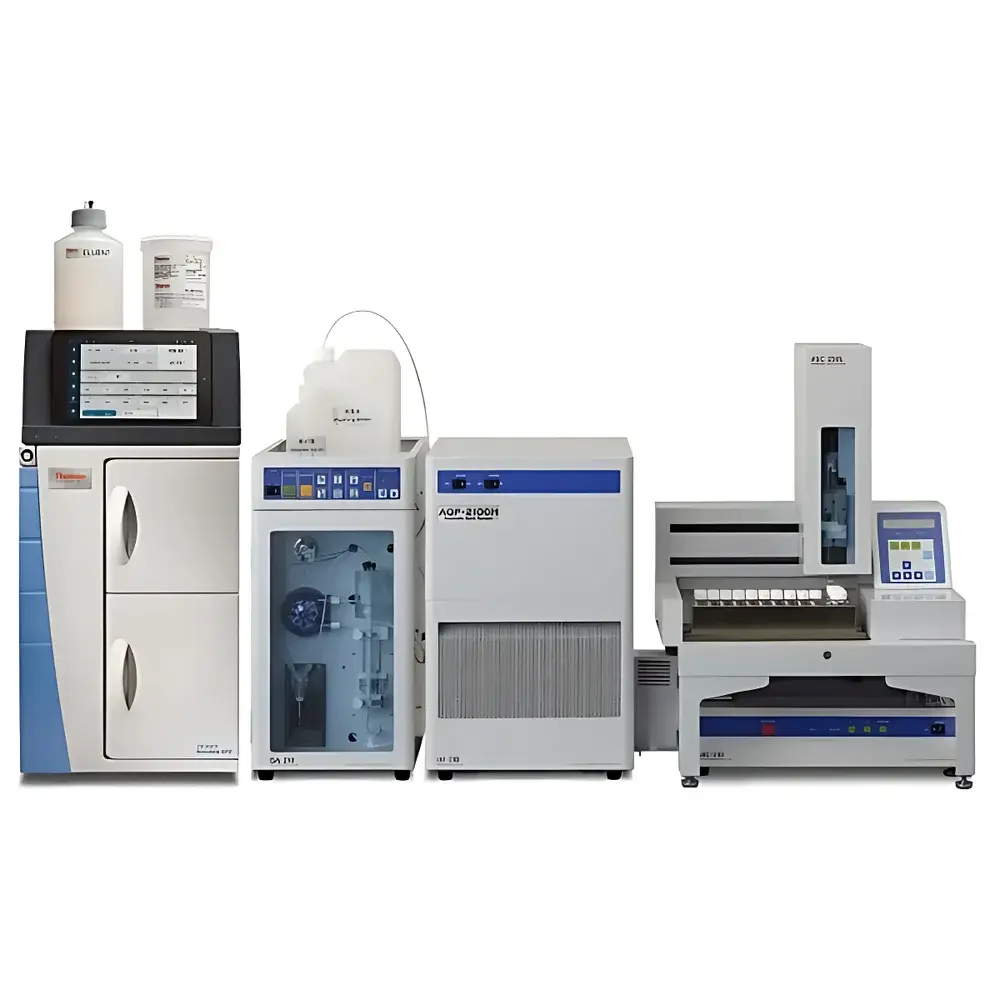
Thermo Fisher Scientific Cindion Combustion Ion Chromatography System
| Brand | Thermo Fisher Scientific |
|---|---|
| Origin | Shanghai, China |
| Manufacturer Type | Authorized Distributor |
| Origin Category | Domestic (China-manufactured under Thermo Fisher technology transfer) |
| Model | IQLAAAGADHFAMJMBIQ |
| Pricing | Available upon Request |
Overview
The Thermo Fisher Scientific Cindion Combustion Ion Chromatography (CIC) System is an integrated analytical platform engineered for the quantitative determination of total halogens (F⁻, Cl⁻, Br⁻, I⁻) and total sulfur in complex, non-aqueous, and matrix-rich samples. Unlike conventional ion chromatography (IC), which requires labor-intensive extraction, acid digestion, or solvent partitioning—procedures often compromised by incomplete recovery, analyte loss, or interferences—the Cindion system employs high-temperature oxidative combustion (up to 1100 °C) followed by aqueous absorption and direct IC analysis. This principle—based on controlled pyrolysis in a pure oxygen environment—converts organically bound and inorganic halogen/sulfur species quantitatively into their respective ionic forms (e.g., HBr, HCl, HF, SO₂ → absorbed as Br⁻, Cl⁻, F⁻, SO₄²⁻), enabling matrix-independent measurement with high stoichiometric fidelity. The system is designed for laboratories operating under ISO/IEC 17025, ASTM D7359 (halogens in hydrocarbons), ASTM D808 (chlorine in petroleum products), USP / (elemental impurities), and EPA Method 5050 (total halogen content in solids).
Key Features
- Complete Automation: Integrated sample introduction, combustion, absorption, and IC injection—no manual transfer or intermediate handling reduces contamination risk and operator variability.
- Matrix-Tolerant Quantification: Delivers accurate total halogen and sulfur results regardless of sample physical state (solid, liquid, gas) or organic complexity (e.g., polymers, pharmaceutical excipients, crude oils, coal, soils).
- Sub-mg/L Detection Capability: Optimized absorption efficiency and low-noise conductivity detection enable reliable quantitation down to 0.1 mg/kg (ppb-level in solid matrices) with RSD <3% (n=6) for Cl in polyethylene standards.
- Hazard-Free Sample Preparation: Eliminates use of concentrated acids (HNO₃, H₂SO₄), oxidants (K₂S₂O₈), or organic solvents required in wet-chemistry methods—reducing lab safety risks and hazardous waste generation.
- Morphological Separation Ready: Coupled with high-resolution anion-exchange columns (e.g., Thermo Scientific™ IonPac™ AS23), the system supports speciation analysis—resolving fluoride, chloride, bromide, and iodide in a single run with retention time stability <0.02 min over 100 injections.
- Robust Thermal Architecture: Dual-zone furnace with independent temperature control ensures complete oxidation of refractory compounds (e.g., PTFE, PVC, sulfonated aromatics) without carbon carryover or memory effects.
Sample Compatibility & Compliance
The Cindion system accepts solid samples up to 1.0 g (powders, pellets, granules), liquids up to 500 µL (LPG, lubricants, solvents), and gases via calibrated loop injection. Certified reference materials (CRMs) including NIST SRM 1640a (trace elements in water), BAM MM 101 (chlorine in PVC), and ERM-EC680 (bromine in polymer) are routinely used for method validation. Data integrity complies with FDA 21 CFR Part 11 requirements through Thermo Scientific™ Chromeleon™ Chromatography Data System (CDS) v7.3+, supporting electronic signatures, audit trails, and role-based access control. All calibration curves meet ICH Q2(R2) linearity criteria (r² ≥ 0.999) across three orders of magnitude.
Software & Data Management
Chromeleon CDS provides full workflow automation—from method setup and sequence definition to peak integration, speciation identification, and report generation. Built-in compliance tools include automatic recalibration alerts, detector drift monitoring, and raw data archiving with SHA-256 hash verification. Batch processing supports IQ/OQ/PQ documentation templates aligned with GMP/GLP environments. Export formats include PDF/A-2, CSV, and XML for LIMS integration (ASTM E1467-compliant). All instrument parameters (combustion temperature, O₂ flow, absorption volume, IC gradient) are logged with timestamps and user IDs in immutable audit trails.
Applications
- Halogen screening in plastic recyclates (Cl, Br per IEC 61249-2-21)
- Total sulfur in jet fuel and diesel (ASTM D5453)
- Residual chloride in active pharmaceutical ingredients (APIs) and excipients (USP <232>)
- Fluoride content in aluminum powders and ceramics (ISO 12927)
- Bromine speciation in flame-retardant-treated textiles
- Sulfur and chlorine in coal and coke (ASTM D3177, D4294)
- Organic chlorine in epoxy resins and adhesives
- F, Br, I in environmental soil and sediment extracts (EPA 3050B + CIC)
FAQ
Does the Cindion system require separate calibration for each halogen species?
No—single-point calibration using mixed standard solutions (F⁻/Cl⁻/Br⁻/I⁻/SO₄²⁻) is sufficient due to consistent combustion yield and linear detector response across the anion range.
Can it analyze samples containing high concentrations of metals or silica?
Yes—ash-free quartz boats and ceramic combustion tubes minimize metal carryover; optional alkali trap prevents silica interference during absorption.
Is method transfer possible from legacy combustion analyzers?
Yes—Chromeleon supports import of legacy peak tables and integration parameters; combustion ramp profiles and absorption volumes are fully configurable to match historical protocols.
What maintenance intervals are recommended for routine operation?
Daily: check O₂ purity and absorption solution level; weekly: inspect quartz components and replace absorption vials; quarterly: validate furnace temperature uniformity and perform system suitability testing with CRM.







