
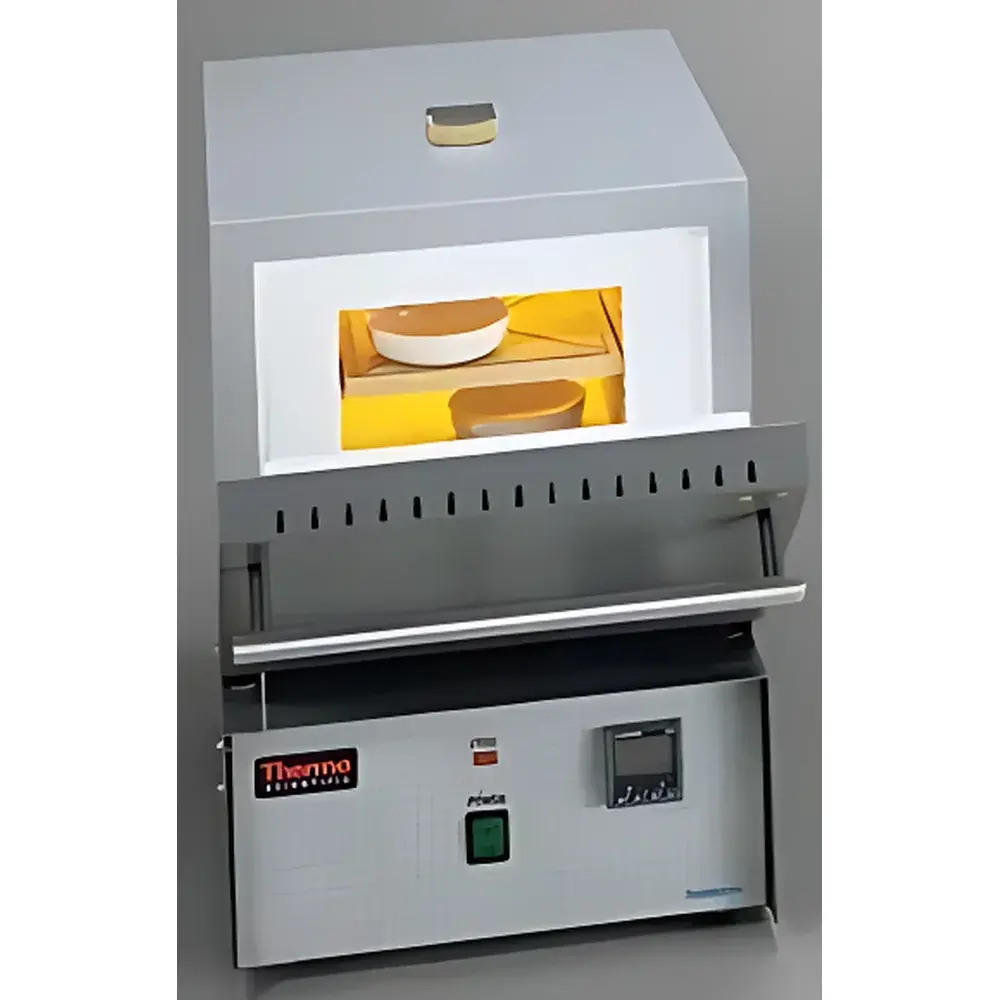
Thermo Fisher Scientific F47900 / F48000 Benchtop Muffle Furnace
| Brand | Thermo Fisher Scientific |
|---|---|
| Origin | USA |
| Manufacturer | Thermo Fisher Scientific |
| Product Type | Imported Benchtop Muffle Furnace |
| Model | F47900 / F48000 |
| Instrument Category | Box-Type Muffle Furnace |
| Max Temperature | 1200 °C |
| Temperature Uniformity (at 1000 °C) | ±4.8 °C (F47900) / ±3.6 °C (F48000) |
| Temperature Stability (at 1000 °C) | ±0.4 °C (F47900) / ±0.2 °C (F48000) |
| Operating Range | 100–1200 °C |
| Control Accuracy | ±2–4 °C |
| Max Power | 1000 W (F47900) / 1560 W (F48000) |
| Ramp Rate to Max Temp | 6–12 °C/min |
| Heating Method | Resistance Wire (Ni-Cr Alloy) |
| Internal Dimensions | 137 × 100 × 150 mm (F47900) / 180 × 130 × 250 mm (F48000) |
| Chamber Volume | 2 L / 5.8 L |
| External Dimensions (W×H×D, mm) | 285 × 470 × 390 / 560* (F47900, *door-open) / 340 × 490 × 500 / 685* (F48000, *door-open) |
| Net Weight | 18.5 kg / 27.2 kg |
| Power Supply | 240 V, 50/60 Hz |
| Current Draw | 4.2 A / 6.5 A |
| Standard Exhaust Port | Ø9.5 mm rear port |
| Optional Accessories | Ceramic shelf kit (dual-layer loading), independent thermocouple feedthrough |
Overview
The Thermo Fisher Scientific F47900 and F48000 benchtop muffle furnaces are precision-engineered box-type thermal processing instruments designed for routine ashing, calcination, heat treatment, and controlled-atmosphere annealing in analytical, quality control, and research laboratories. These furnaces operate on the principle of radiant and convective heating within a thermally insulated chamber, isolating samples from combustion byproducts via a sealed, double-walled muffle structure. The furnace chamber is lined with high-purity, pre-fired ceramic fiber insulation—optimized for thermal retention, low thermal mass, and long-term dimensional stability at temperatures up to 1200 °C. Dual-side mounted Ni-Cr resistance heating elements ensure symmetrical heat distribution and support rapid, reproducible ramp rates of 6–12 °C/min to maximum operating temperature. Each model is certified for continuous operation between 100 °C and 1200 °C, with documented temperature uniformity and stability validated per ASTM E220 and ISO/IEC 17025 traceable calibration protocols.
Key Features
- Two chamber configurations: compact 2 L (F47900) and expanded 5.8 L (F48000) volumes, accommodating diverse sample throughput requirements without compromising thermal performance.
- Ceramic fiber insulation pre-conditioned at >1000 °C to eliminate outgassing and minimize thermal drift during extended dwell cycles.
- Integrated Ø9.5 mm rear port enabling real-time monitoring of chamber or sample temperature using external thermocouples (e.g., Type K or S), supporting method validation and GLP-compliant process documentation.
- Dual-layer ceramic shelf option increases effective loading capacity by ~100%, maintaining uniform airflow and minimizing cross-contamination risk between stacked samples.
- Standard rear exhaust vent facilitates passive removal of moisture, volatile organics, and acidic fumes—preserving heater integrity and extending service life of internal sensors and insulation.
- Four programmable controller variants (A1, B1, C1, and optional D1) compliant with IEC 61000-4 electromagnetic immunity standards; all include mechanical overtemperature cut-off relays rated to 1250 °C for fail-safe operation.
Sample Compatibility & Compliance
These furnaces accommodate standard crucibles (alumina, porcelain, platinum, and quartz), ceramic boats, and metal trays up to 120 mm in height. The inert muffle environment supports ASTM D3174 (ash content in coal), USP <231> (heavy metals testing), and ISO 1171 (determination of ash in solid mineral fuels). Chamber geometry and thermal profile meet requirements for EPA Method 2540E (total suspended solids ignition) and AOAC 942.05 (crude ash in animal feed). All models are CE-marked, comply with UL 61010-1 and EN 61000-6-3 emission limits, and support 21 CFR Part 11–ready data logging when paired with Thermo Fisher’s optional PC interface module (sold separately).
Software & Data Management
While the base controllers operate independently, the C1 and D1 variants support USB-based configuration and data export via Thermo Fisher’s proprietary FurnaceControl Suite (v3.2+). This Windows-compatible application enables creation, storage, and audit-trail logging of multi-segment thermal profiles—including ramp rate, soak time, cooling rate, and hold conditions—with timestamped event records. All temperature logs include metadata (operator ID, sample ID, instrument serial number) and support CSV export for integration into LIMS or ELN platforms. Firmware updates preserve calibration constants and maintain traceability to NIST-traceable reference standards.
Applications
- Residue and ash quantification in environmental, food, and pharmaceutical matrices per regulatory compendia (USP, EP, JP).
- Preparation of catalyst supports and ceramic precursors requiring precise thermal decomposition under air or inert gas purge.
- Calibration of thermocouples and RTDs using fixed-point references (e.g., Al, Zn, Ag freezing points) in metrology labs.
- Heat treatment of metallurgical specimens for microstructure stabilization prior to SEM/EDS analysis.
- LOI (Loss on Ignition) determination in cement, soil, and geological samples per ASTM C114 and ISO 11358.
FAQ
What safety certifications do the F47900 and F48000 models carry?
Both models are CE-certified, UL 61010-1 listed, and conform to RoHS 2011/65/EU and REACH SVHC regulations.
Can these furnaces be operated under inert or reducing atmospheres?
Yes—when used with optional gas inlet fittings and flow controllers, they support nitrogen, argon, or forming gas (5% H₂/95% N₂) purging; however, hydrogen concentrations above 5% require additional explosion-proof modifications per IEC 60079.
Is temperature uniformity verified across the entire chamber volume?
Yes—uniformity maps are provided in the factory acceptance test report (FATR), measured at 1000 °C using a 9-point thermocouple array per ASTM E220 Annex A3.
How often does the furnace require recalibration?
Annual verification against a NIST-traceable reference thermometer is recommended; full calibration (including sensor replacement and PID tuning) is advised every 24 months or after 2000 operating hours.
Are spare parts and service support available globally?
Thermo Fisher maintains regional service centers in North America, EMEA, and APAC; OEM spare parts—including heating elements, ceramic liners, and controller modules—are stocked and ship within 48 hours of order confirmation.



