
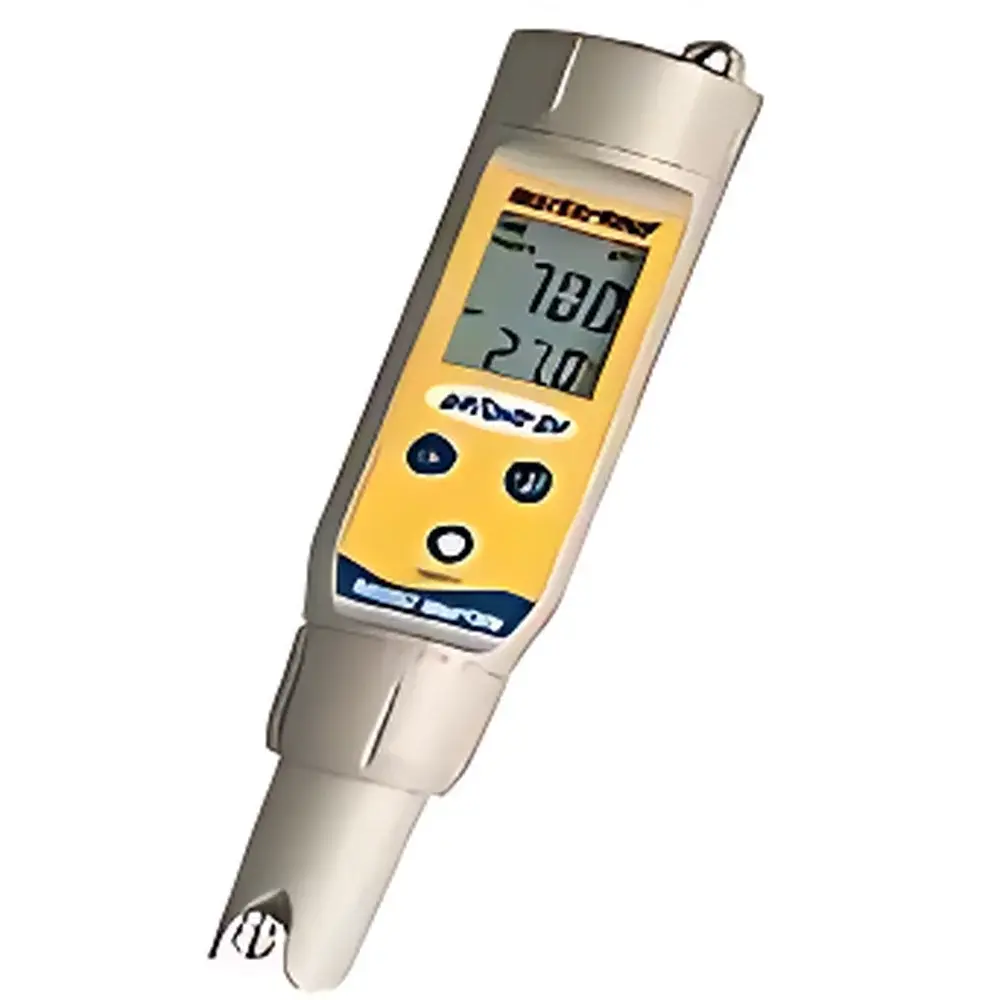
Thermo Fisher Scientific PHTestr 30 Waterproof pH Pen Meter
| Brand | Thermo Fisher Scientific |
|---|---|
| Model | PHTestr 30 |
| Origin | USA |
| Type | Waterproof Portable pH/Temp Pen Meter |
| Measurement Range | pH –1.00 to 15.00, Temperature 0 to 50 °C |
| Resolution | 0.01 pH / 0.1 °C |
| Accuracy | ±0.01 pH / ±0.5 °C |
| Calibration | Auto 3-point with USA (4.01, 7.00, 10.01) or NIST (4.01, 6.86, 9.18) buffers |
| Temperature Compensation | Automatic (ATC) |
| Electrode Design | Double-junction Ag/AgCl reference system with high-capacity gel electrolyte |
| Auto-off | After 8.5 minutes of inactivity |
| Display | Dual-line LCD (2.1 × 2.7 cm) |
| Power | 4 × 1.5 V button cells (LR44) |
| Battery Life | >500 hours |
| Operating Temperature | 0–50 °C |
| Dimensions (Instrument) | 16.5 × 3.8 cm |
| Weight (Instrument) | 90 g |
| Packaging Dimensions | 18.5 × 6.5 × 5 cm |
| Weight (Packaged) | 200 g |
Overview
The Thermo Fisher Scientific PHTestr 30 is a precision-engineered, waterproof portable pH pen meter designed for rapid, reliable field and benchtop pH and temperature measurements in diverse chemical, environmental, educational, and quality control applications. Built upon potentiometric measurement principles, it employs a double-junction Ag/AgCl reference electrode architecture with an integrated high-capacity gel electrolyte—enabling stable potential output and minimizing liquid junction potential drift. Its extended pH range (–1.00 to 15.00) supports analysis across strongly acidic, neutral, and highly alkaline media, including industrial cleaning solutions, wastewater effluents, and aggressive process streams. The instrument complies with fundamental electrochemical metrology practices aligned with ISO 8655-5 (volumetric apparatus calibration) and ASTM D1293 (standard test method for pH of water), and its design facilitates traceable calibration under GLP-compliant workflows when used with certified reference buffers.
Key Features
- Double-junction reference system with reinforced gel electrolyte—reduces contamination risk from heavy metals, sulfides, or proteins, extending electrode service life and maintaining measurement integrity in challenging matrices.
- Auto 3-point calibration with selectable buffer standards (USA or NIST traceable), ensuring alignment with regional regulatory expectations and laboratory SOPs.
- Automatic temperature compensation (ATC) using an integrated thermistor, eliminating manual correction and improving reproducibility across variable ambient conditions.
- Waterproof housing rated to IP67—enabling safe use in humid environments, splash-prone workspaces, or outdoor sampling without risk of ingress-related failure.
- Energy-efficient dual-line LCD display (2.1 × 2.7 cm) with high contrast and wide viewing angle for legibility under varied lighting; auto-off after 8.5 minutes minimizes unnecessary battery drain.
- Modular electrode design—allows field replacement of the sensing module without instrument recalibration or service downtime, reducing total cost of ownership.
Sample Compatibility & Compliance
The PHTestr 30 is validated for aqueous and low-viscosity non-aqueous samples compatible with standard pH electrodes (e.g., dilute acids/bases, buffer solutions, tap water, surface water, nutrient solutions, and food extracts). It is not intended for use with organic solvents, viscous suspensions, or samples containing particulates that may clog the junction. Its double-junction construction meets IUPAC-recommended practices for minimizing reference electrode poisoning in complex matrices. While not FDA 21 CFR Part 11–certified as a standalone device, its calibration logs (when recorded externally) support audit-ready documentation in GMP/GLP environments where electronic records are governed by SOP-defined procedures.
Software & Data Management
The PHTestr 30 operates as a standalone handheld instrument with no onboard data logging or Bluetooth connectivity. All measurement values are displayed in real time only; users must manually record results or interface with external systems via visual transcription. For laboratories requiring digital data capture, Thermo Fisher recommends pairing the PHTestr 30 with validated third-party logging tools or integrating it into broader QC workflows using calibrated reference electrodes traceable to NIST SRMs. Firmware updates are not applicable—hardware stability and long-term repeatability are ensured through rigorous factory calibration and sealed internal electronics.
Applications
- Environmental monitoring: Field assessment of pH in rivers, lakes, stormwater runoff, and soil leachates per EPA Method 150.1.
- Education labs: Student experiments involving acid-base titrations, buffer preparation, and equilibrium studies—leveraging intuitive operation and robust build quality.
- Food & beverage QA: Spot-checking rinse water, brine solutions, and product contact surfaces to verify sanitation compliance (e.g., USDA-FSIS guidelines).
- Pool & spa maintenance: Routine verification of disinfectant efficacy through pH and temperature correlation.
- Hydroponics & aquaculture: Monitoring nutrient solution stability and aquatic habitat health with sub-0.01 pH resolution.
FAQ
What buffer standards does the PHTestr 30 support for calibration?
It supports both USA (pH 4.01, 7.00, 10.01) and NIST (pH 4.01, 6.86, 9.18) certified reference buffers—allowing flexibility for international labs or those adhering to specific regulatory frameworks.
Is the electrode replaceable without recalibration?
Yes—the modular electrode assembly is designed for user replacement; however, post-replacement calibration is required to ensure measurement accuracy and traceability.
Can this meter be used in seawater or high-salinity samples?
It is suitable for short-term seawater measurements, but prolonged exposure may accelerate junction clogging; regular cleaning with KCl solution and storage in electrode storage solution is recommended.
Does the PHTestr 30 meet ISO/IEC 17025 requirements?
While the instrument itself is not accredited, its performance characteristics—when used with certified buffers, documented calibration procedures, and periodic verification—can support compliance within an ISO/IEC 17025-accredited laboratory’s uncertainty budget.
What is the expected lifetime of the electrode under typical lab use?
With proper storage, routine cleaning, and avoidance of harsh contaminants, the double-junction electrode typically delivers 12–18 months of reliable service before sensitivity drift exceeds ±0.02 pH.





