
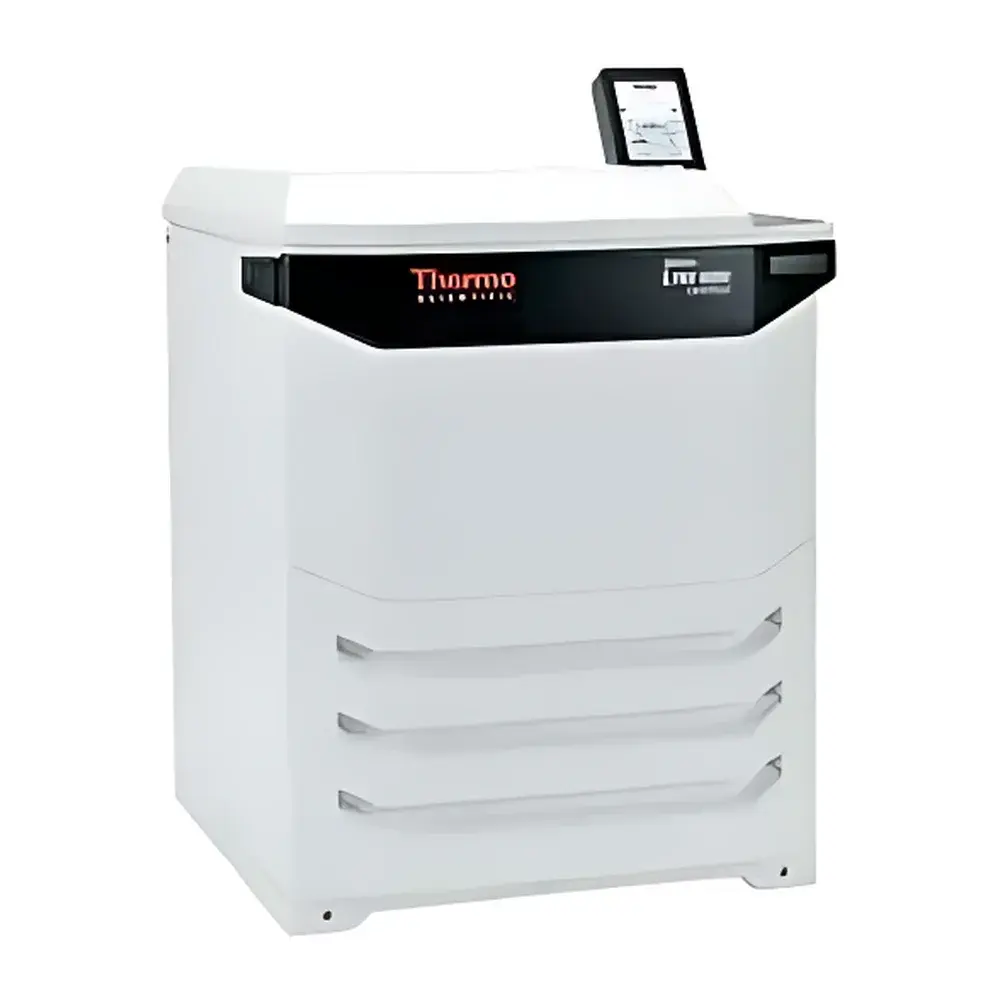
Thermo Fisher Sorvall LYNX 6000 Ultracentrifuge
| Brand | Thermo Fisher |
|---|---|
| Origin | USA |
| Manufacturer Type | Original Equipment Manufacturer (OEM) |
| Product Category | Imported Instrument |
| Model No. | 75006590 |
| Instrument Type | Floor-standing Centrifuge |
| Speed Class | Ultrahigh-speed Centrifuge (>30,000 rpm) |
| Cooling Function | Refrigerated Centrifuge |
| Configuration | Fixed-angle Rotor System |
| Maximum Capacity | 6 L |
| Maximum RCF | 100,605 × g |
| Rotor Interface | Auto-ID Enabled |
| Display | Centri-Touch High-Visibility Touchscreen |
| Connectivity | Centri-Vue Mobile App (Local & Networked Control) |
| Compliance | GLP/GMP-Ready Data Management, FDA 21 CFR Part 11 Compatible Audit Trail Support |
| Safety | Integrated HEPA Filtration Option, Non-bolted Door Mechanism, Automatic Lid Locking |
Overview
The Thermo Fisher Sorvall LYNX 6000 Ultracentrifuge is an engineered platform for high-performance density-based separation in demanding life science and bioprocessing environments. Operating on the principle of sedimentation equilibrium and rate-zonal centrifugation, it delivers precise control over rotational force (RCF), temperature, and vacuum conditions to resolve subcellular organelles, macromolecular complexes, viruses, exosomes, and nucleic acid fractions with reproducible resolution. Designed for laboratories requiring scalability from discovery research to cGMP-aligned process development, the LYNX 6000 supports continuous operation under refrigerated conditions (–10 °C to +40 °C) and maintains ultra-high vacuum integrity to minimize rotor windage heating and ensure thermal stability during extended runs—critical for preserving labile biological structures.
Key Features
- Maximum relative centrifugal force of 100,605 × g, enabling separation of particles down to ~5 nm (e.g., ribosomal subunits, small RNA complexes)
- 6 L total capacity supported across a modular rotor portfolio—including fixed-angle, swinging-bucket, continuous-flow, and zonal rotors—each validated for mechanical integrity under full-load operational stress
- Auto-Lock rotor engagement system: achieves secure mechanical coupling in ≤3 seconds without tools; eliminates misalignment risk and reduces setup time by up to 40% versus manual bolt-torque procedures
- Auto-ID rotor recognition: embedded RFID tags communicate rotor geometry, maximum speed, RCF limits, and calibration history directly to the controller, preventing parameter override errors and enforcing safety interlocks
- Centri-Touch interface: 10.4-inch capacitive touchscreen with anti-glare coating, haptic feedback, and multilingual UI; stores ≥1,000 user-defined protocols with timestamped execution logs
- Energy-optimized vacuum architecture: intelligent pump modulation reduces power draw by 22% per run compared to legacy ultracentrifuges while maintaining <10 mTorr base pressure
- Fiberlite carbon-fiber rotor construction: corrosion-resistant, fatigue-tested to >100,000 cycles; backed by a 15-year structural warranty—validated per ISO 21501-4 and ASTM F2118 standards
Sample Compatibility & Compliance
The LYNX 6000 accommodates a broad spectrum of sample formats via interchangeable rotor systems: standard 50 mL conical tubes, 250–500 mL bottles, 96-well microplates (with adapter trays), and 1 L processing vessels. Optional continuous-flow rotors support pilot-scale clarification of mammalian cell culture harvests at flow rates up to 120 mL/min. All rotors undergo third-party validation for sterility assurance when used with optional HEPA-filtered exhaust systems. The instrument complies with IEC 61010-1 (Safety Requirements for Electrical Equipment), ISO 13485 (Medical Device Quality Management), and supports audit-ready documentation per FDA 21 CFR Part 11 through encrypted electronic signatures, role-based access control, and immutable audit trails for all parameter changes and run records.
Software & Data Management
Centri-Vue software enables remote monitoring and synchronized control of up to 100 LYNX units across local networks or secure cloud gateways. It provides real-time telemetry (RCF, temperature, vacuum level, rotor vibration amplitude), predictive maintenance alerts based on cumulative rotor hours and bearing diagnostics, and export of raw run data in .csv and .xml formats compliant with laboratory information management systems (LIMS). Onboard storage retains ≥2 years of compressed event logs with SHA-256 hash verification. User authentication uses AES-256 encryption; password policies enforce minimum length, complexity, and expiration intervals aligned with NIST SP 800-63B guidelines.
Applications
- Subcellular fractionation: isolation of mitochondria, lysosomes, and synaptic vesicles using differential and density-gradient protocols
- Virology & gene therapy: purification of AAV, lentiviral, and adenoviral vectors with recovery yields >85% and aggregation reduction ≥30% versus benchtop alternatives
- Exosome & extracellular vesicle research: sucrose/D2O gradient separation with post-run characterization compatibility for NTA and TEM
- Protein complex analysis: native PAGE-compatible pelleting of multi-subunit assemblies (e.g., spliceosome, proteasome) without denaturation
- Biopharmaceutical downstream processing: scalable harvest clarification and intermediate purification steps supporting QbD-based process validation
FAQ
What is the minimum required clearance around the instrument for ventilation and service access?
A minimum of 30 cm (12 in) clearance on all sides and 60 cm (24 in) above the unit is required to maintain rated cooling performance and allow rotor chamber access.
Can the LYNX 6000 be integrated into a validated cleanroom environment?
Yes—when equipped with HEPA filtration, non-shedding internal surfaces, and stainless-steel exterior panels, it meets ISO 14644-1 Class 7 requirements for particle count control.
Is rotor calibration traceable to national standards?
All Fiberlite rotors ship with NIST-traceable calibration certificates documenting moment-of-inertia values, mass distribution profiles, and dynamic balance verification per ISO 1940-1 G2.5.
Does the system support 21 CFR Part 11-compliant electronic records?
Yes—the onboard controller and Centri-Vue software provide electronic signatures, audit trail generation, and data integrity safeguards validated per Annex 11 and ALCOA+ principles.
What maintenance intervals are recommended for optimal rotor lifespan?
Thermo Fisher recommends quarterly visual inspection of rotor threads and locking mechanisms, annual dynamic balancing verification, and mandatory retirement at 15 years or upon reaching the manufacturer-specified cycle limit—whichever occurs first.



