
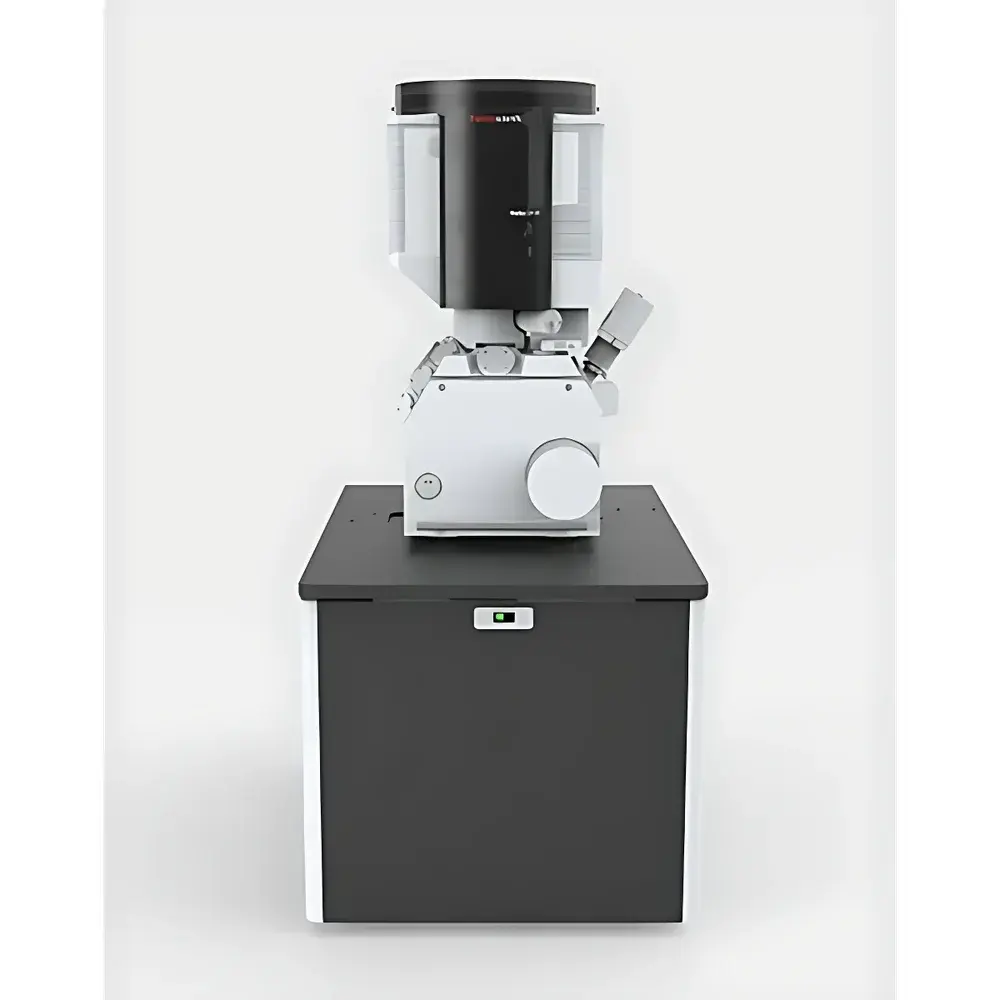
Thermo Fisher Verios 5 XHR SEM – Ultra-High-Resolution Field-Emission Scanning Electron Microscope
| Brand | Thermo Fisher |
|---|---|
| Origin | Shanghai, China |
| Manufacturer Type | Authorized Distributor |
| Product Origin | Domestic (China-manufactured under Thermo Fisher global engineering standards) |
| Model | Verios 5 XHR SEM |
| Pricing | Upon Request |
Overview
The Thermo Fisher Verios 5 XHR SEM is an ultra-high-resolution field-emission scanning electron microscope engineered for nanoscale imaging, metrology, and analytical characterization across materials science, semiconductor R&D, life sciences, and advanced manufacturing. Utilizing a patented UC+ (Ultra-Corrected) monochromated Schottky field-emission electron source combined with the Elstar electron optical column, the system delivers sub-nanometer resolution across a broad landing energy range—from 20 eV to 30 keV—enabling true surface-sensitive imaging without beam damage to delicate specimens. Its ConstantPower electromagnetic lens design, electrostatic beam scanning, and optimized signal detection architecture ensure exceptional stability, repeatability, and low-voltage performance critical for high-fidelity topographic and compositional analysis.
Key Features
- UC+ monochromated electron gun: Reduces energy spread to <0.3 eV, enabling high-contrast, low-dose imaging at 1–30 keV with verified sub-0.7 nm resolution at 1 kV and 0.6 nm at 2–15 keV.
- SmartAlign automated column alignment: Eliminates manual stigmator and alignment routines; reduces operator dependency and minimizes downtime between sessions.
- Dual high-precision piezo-driven stages: Verios 5 UC features a 5-axis motorized eucentric stage (150 × 150 mm² XY travel, ±70° tilt); Verios 5 HP offers all-piezo 5-axis stage (100 × 100 mm², ±70° tilt) with auto-load lock integration for contamination-sensitive workflows.
- Multi-detector signal acquisition: Standard in-column TLD (transmitted electrons), ETD (Everhart-Thornley), MD (mirror detector), ICD (in-lens secondary electron), beam current monitor, Nav-Cam+ navigation camera, and IR sample viewing system.
- Integrated plasma cleaner: On-board RF plasma cleaning module ensures consistent specimen surface preparation prior to imaging or analysis.
- Beam deceleration capability: Up to −4000 V bias enables precise landing energy control down to 20 eV—essential for non-destructive surface topography and insulator charge management.
Sample Compatibility & Compliance
The Verios 5 XHR accommodates diverse sample geometries—including wafers up to 200 mm, cross-sectioned TEM lamellae, biological cryo-sections, and porous battery electrodes—within its 379 mm internal diameter chamber equipped with 21 standardized ports. Its vacuum architecture meets ISO 14644-1 Class 5 cleanroom compatibility requirements. The system supports GLP/GMP-aligned operation via audit-trail-enabled software logging (AutoScript 4), compliant with FDA 21 CFR Part 11 when deployed with appropriate IT infrastructure and user access controls. All calibration procedures reference NIST-traceable standards, supporting ISO/IEC 17025-compliant laboratory accreditation for dimensional metrology applications.
Software & Data Management
Thermo Scientific AutoScript 4 provides Python-based API integration for fully automated, unattended SEM operation—including script-driven stage navigation, multi-region imaging, real-time focus/stigmation correction, and conditional decision logic. Maps software enables large-area stitching (up to 100,000×100,000 µm²), coordinate-matched correlative microscopy (e.g., SEM–EDS–EBSD–Raman), and export of georeferenced TIFF/OME-TIFF stacks. TopoMaps supports quantitative 3D surface reconstruction, false-color height mapping, roughness parameter extraction (Sa, Sq, Sz per ISO 25178), and batch image analysis with customizable thresholds and particle classification rules.
Applications
- Semiconductor process control: High-magnification defect review on EUV-patterned masks, gate-all-around nanowire transistors, and through-silicon vias (TSVs).
- Advanced battery research: In situ and ex situ analysis of SEI layer morphology, cathode cracking, and lithium dendrite growth—enabled by low-kV imaging and beam-sensitive mode optimization.
- Materials metrology: Traceable line-width measurements on SRM 2090a and NIST 1963a reference standards with <0.5 nm measurement uncertainty at 100,000× magnification.
- Life sciences: Cryo-SEM imaging of vitrified tissues, extracellular vesicles, and protein fibrils using beam deceleration and low-dose acquisition protocols.
- Geosciences & catalysis: Nanoparticle dispersion analysis, pore network quantification, and elemental phase mapping via integrated EDS/EBSD/WDS modules.
FAQ
What is the minimum achievable landing energy, and how is it stabilized?
The Verios 5 XHR supports landing energies as low as 20 eV via beam deceleration, with active electrostatic compensation and real-time current monitoring to maintain dose consistency.
Does the system support automated drift correction during long acquisitions?
Yes—AutoScript 4 includes dynamic drift compensation algorithms that adjust stage position and focus in real time based on feature tracking across sequential frames.
Can the Verios 5 XHR be integrated into a multi-instrument workflow platform?
It supports standard SECS/GEM and OPC UA protocols for factory automation interfaces, and its Python API allows bidirectional data exchange with LIMS, MES, and third-party analytics platforms.
Is the UC+ electron source replaceable in-house, or does it require field service?
The UC+ source is a sealed, factory-aligned module; replacement requires certified Thermo Fisher Field Service Engineers and post-installation optical recalibration per ISO 16700.
How does the chamber design accommodate future analytical upgrades?
With 21 standardized ports (including 8 × 100 mm Ø, 4 × 63 mm Ø, and 9 × 40 mm Ø), the chamber supports simultaneous installation of EDS, EBSD, CL, and micro-XRF detectors without compromising vacuum integrity or mechanical stability.





