
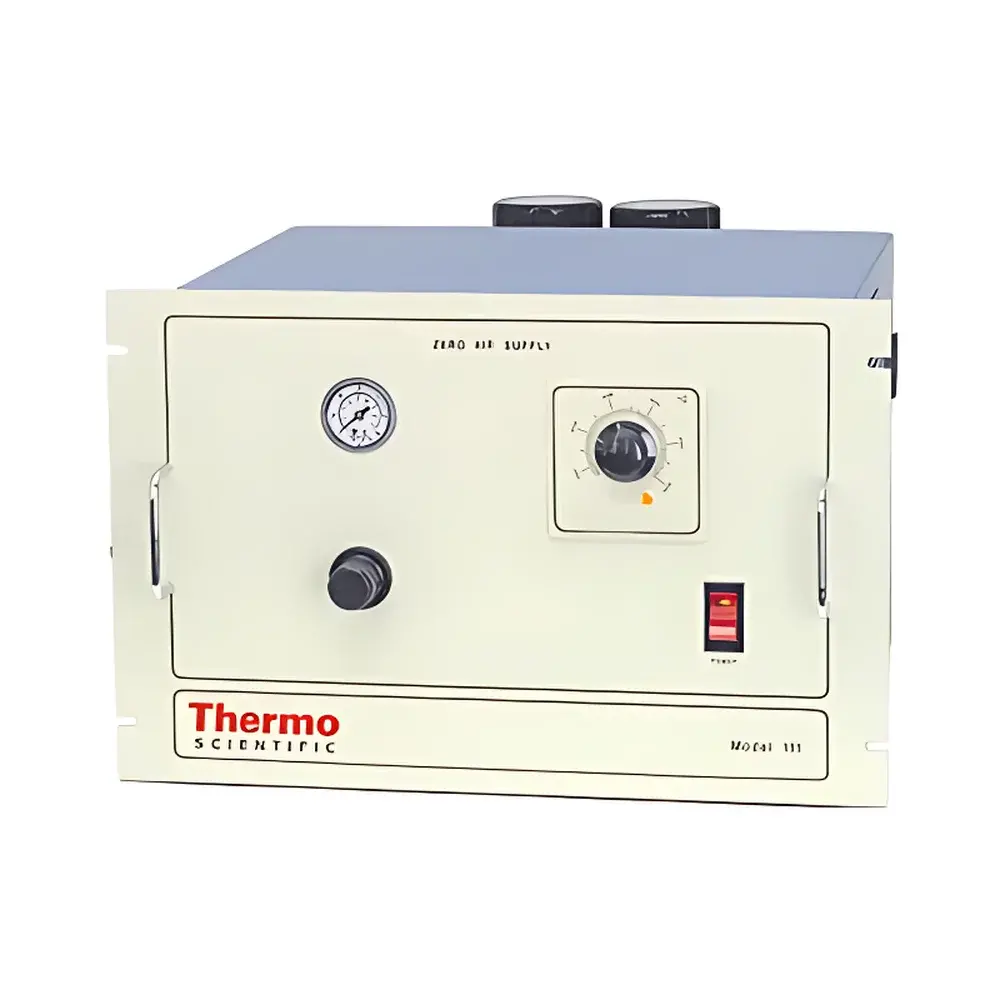
Thermo Scientific 111 Zero Air Generator
| Brand | Thermo Fisher |
|---|---|
| Origin | USA |
| Manufacturer Type | Original Equipment Manufacturer (OEM) |
| Import Status | Imported |
| Model | Thermo Scientific 111 |
| Zero Air Purity | SO₂ ≤ 0.5 ppb, NO ≤ 0.5 ppb, NO₂ ≤ 0.5 ppb, O₃ ≤ 0.5 ppb, CO ≤ 0.1 ppm, HC ≤ 0.1 ppm |
| Flow Rate | 5, 10 (standard), or 20 SLPM |
| Output Pressure | 10–30 PSI |
| Dew Point | 0 °C |
| Flow Measurement Accuracy | ±2% of reading (0–10 SLPM range) |
Overview
The Thermo Scientific 111 Zero Air Generator is a laboratory- and field-deployable, OEM-engineered source of ultra-pure synthetic zero air, specifically designed to serve as the calibration and purge gas standard in ambient air quality monitoring systems. It operates on a multi-stage purification architecture: compressed ambient air—supplied by an external oil-free compressor—is sequentially treated through catalytic oxidation (to convert CO and hydrocarbons to CO₂ and H₂O), high-efficiency particulate filtration, activated carbon adsorption (for residual VOCs and ozone), and precision chemical scrubbing (targeting NO, NO₂, SO₂, and trace oxidants). The resulting zero air meets stringent regulatory requirements for reference-grade background gas in photometric (e.g., UV fluorescence, chemiluminescence) and electrochemical analyzers used in EPA-compliant continuous emission monitoring systems (CEMS) and ambient air quality networks.
Key Features
- Triple-stage catalytic + adsorptive + chemical purification train ensures consistent removal of reactive trace contaminants across all critical interferents (NOx, SO2, O3, CO, HC)
- Selectable flow output at 5, 10 (standard), or 20 SLPM—configurable via integrated mass flow controller with digital setpoint interface
- Stable pressure regulation (10–30 PSI) compatible with downstream analyzers requiring positive-pressure supply, including ozone generators and dilution calibrators
- Dew point maintained at ≤0 °C via integrated refrigerated dryer, preventing condensation in sensitive optical paths and sampling lines
- Flow measurement accuracy certified to ±2% of reading over the 0–10 SLPM range, traceable to NIST standards
- Modular design separates generator head from external oil-free air compressor—reducing vibration transmission and enabling flexible system integration in mobile labs or fixed monitoring stations
- Low-maintenance architecture with scheduled filter and catalyst replacement intervals exceeding 6,000 operating hours under typical ambient conditions
Sample Compatibility & Compliance
The Thermo Scientific 111 is validated for use with federal equivalent method (FEM) and reference method (FRM) analyzers compliant with U.S. EPA 40 CFR Part 53 and Part 60, as well as ISO 8573-1:2010 Class 1 compressed air purity specifications for particulate, water, and oil content. Its zero air output satisfies the trace contaminant thresholds required by ASTM D6167 (Standard Practice for Calibration of Ambient Air Analyzers), EN 14625 (ambient NOx measurement), and ISO/IEC 17025-accredited calibration laboratories performing instrument verification per IEC 61261. The unit supports GLP and GMP-aligned operation through documented maintenance logs, filter change records, and pressure/flow audit trails accessible via front-panel display.
Software & Data Management
The 111 model features an embedded microcontroller with real-time monitoring of inlet pressure, outlet flow, dew point temperature, and cumulative runtime. While it does not include proprietary PC software, all operational parameters are accessible via RS-232 serial interface (Modbus RTU protocol) for integration into SCADA or LIMS platforms. Audit-ready data export (CSV format) supports 21 CFR Part 11-compliant environments when paired with validated third-party data acquisition systems. Optional analog outputs (0–5 VDC or 4–20 mA) enable direct connection to PLCs for automated alarm triggering upon flow deviation or pressure loss.
Applications
- Primary zero air source for calibrating and zeroing ambient air analyzers measuring NO, NO₂, SO₂, O₃, CO, and non-methane hydrocarbons (NMHC)
- Purge gas for Fourier-transform infrared (FTIR) spectrometers and cavity ring-down spectroscopy (CRDS) systems requiring sub-ppb baseline stability
- Carrier and diluent gas in dynamic dilution calibrators (e.g., Thermo Scientific 146i-D) and permeation tube ovens
- Blank matrix gas in method validation studies per EPA Method TO-14A, TO-15, and ASTM D5502 for VOC analysis
- Reference air supply in cleanroom environmental monitoring and semiconductor fab tool qualification
FAQ
What compressor specifications are required for optimal performance?
An oil-free, desiccant-dried, and particle-filtered air source delivering 30–50 PSIG at ≥25 SLPM is recommended. Inlet air must meet ISO 8573-1 Class 2:2:2 (oil, water, particles) to prevent premature catalyst deactivation.
Can the 111 be operated continuously for extended periods?
Yes—the unit is rated for unattended 24/7 operation with automatic thermal shutdown and pressure-loss interlock; mean time between failures (MTBF) exceeds 12,000 hours under nominal load conditions.
Is the zero air output suitable for ozone generator feed gas?
Yes—output O₃ ≤ 0.5 ppb ensures no interference with ozone generation kinetics; the low-NOx and low-UV-absorbing hydrocarbon profile prevents unwanted side reactions in UV-based ozone synthesis.
How often must consumables be replaced?
Pre-filters: every 6 months or 4,000 hours; activated carbon cartridge: every 12 months or 8,000 hours; oxidation catalyst: every 24 months or 16,000 hours—dependent on inlet air quality and duty cycle.
Does the 111 comply with EU CE marking requirements?
Yes—it conforms to the Electromagnetic Compatibility Directive 2014/30/EU and Low Voltage Directive 2014/35/EU, with full technical documentation available upon request for Notified Body assessment.
Related Products







