
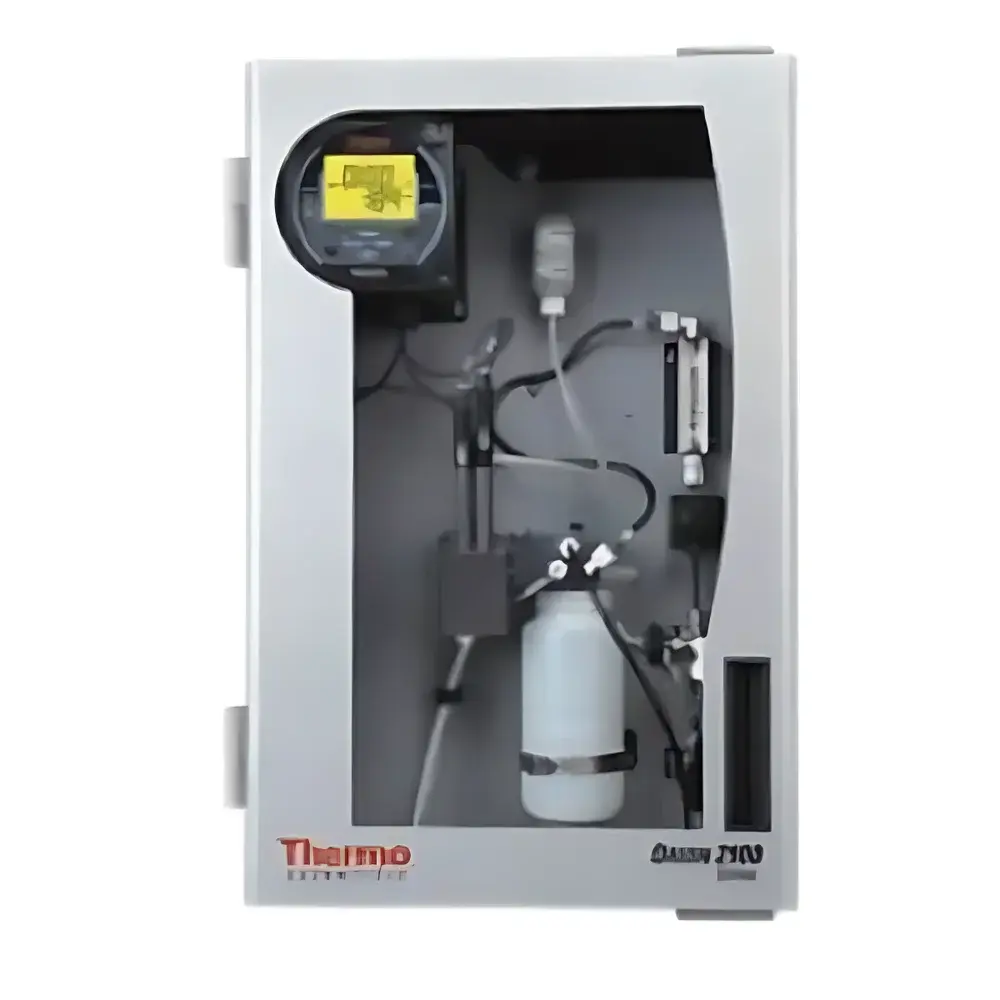
Thermo Scientific 2117LL Microchlorine Analyzer
| Brand | Thermo Fisher Scientific |
|---|---|
| Origin | USA |
| Model | 2117LL |
| Detection Limit | 1.5 ppb Cl⁻ |
| Measurement Principle | Potentiometric Chloride-Selective Electrode (CSE) |
| Calibration | Dynamic 1–3-point calibration with integrated pH adjustment |
| Compliance | Designed for continuous online monitoring in high-purity water systems |
| Application Environment | Semiconductor-grade UPW, boiler feedwater, RO permeate, condensate, seawater-cooled condenser leak detection |
Overview
The Thermo Scientific 2117LL Microchlorine Analyzer is an online, potentiometric chloride measurement system engineered for ultra-trace chlorine ion detection in high-purity and ultrapure water (UPW) streams. It employs a solid-state chloride-selective electrode (CSE) operating on the Nernstian principle, delivering stable, drift-free response to chloride activity across a dynamic range from 1.5 ppb to 1000 ppb Cl⁻. Unlike amperometric or colorimetric analyzers, the 2117LL requires no reagents, membranes, or consumable electrodes—eliminating analytical interferences from oxidants, bromide, iodide, or residual disinfectants. Its design targets applications where chloride-induced stress corrosion cracking (SCC), pitting, or steam cycle contamination poses critical risk—particularly in power generation, semiconductor manufacturing, and pharmaceutical water systems. The analyzer integrates seamlessly into distributed control systems (DCS) and PLC architectures via 4–20 mA analog output and Modbus RTU/ASCII protocols.
Key Features
- Ultra-low detection limit of 1.5 ppb Cl⁻—validated per ASTM D808 and ISO 9297 for trace chloride quantification in low-conductivity matrices
- Chloride-selective electrode with proprietary solid-contact polymer membrane—exhibits 12-month operational stability under continuous flow conditions
- Integrated dynamic pH conditioning module—automatically adjusts sample pH to 6.5–7.2 using CO₂-saturated water or dilute phosphoric acid (user-selectable), ensuring optimal CSE response and minimizing hydroxide interference
- No moving parts, peristaltic pumps, or liquid reagent delivery systems—reducing mean time between failures (MTBF) to >36 months
- Onboard 1–3 point calibration routine with auto-verification; full calibration cycle completed in <90 seconds without manual intervention
- Self-diagnostic firmware with real-time electrode impedance monitoring, temperature-compensated slope validation, and signal noise assessment
- IP66-rated stainless steel enclosure with optional explosion-proof (ATEX/IECEx) configuration for hazardous area deployment
Sample Compatibility & Compliance
The 2117LL is validated for continuous analysis of deionized water, reverse osmosis permeate, turbine condensate, boiler feedwater, and ultrapure water meeting ASTM D5127 Class I and SEMI F63 specifications. It operates reliably at sample conductivities from 0.055 to 1 µS/cm and temperatures from 5 to 45 °C. All wetted materials—including the flow cell, electrode housing, and pH conditioning manifold—are constructed from PFA, EPDM-free fluorocarbon elastomers, and 316L SS to prevent leaching or adsorption artifacts. The analyzer meets requirements for GLP-compliant data integrity per FDA 21 CFR Part 11 when paired with Thermo Fisher’s optional TraceFinder™ Data Logger, which provides electronic audit trails, user access controls, and calibrated timestamped event logging.
Software & Data Management
The 2117LL features embedded firmware with configurable alarm thresholds (high/low, rate-of-change), trend buffering (72-hour rolling history), and diagnostic event logging. Optional integration with Thermo Fisher’s AquaTrack™ SCADA interface enables centralized configuration, remote calibration initiation, and predictive maintenance alerts based on electrode impedance trends. All measurement data—including raw mV output, temperature-corrected concentration, calibration history, and fault codes—is exportable in CSV or XML format compliant with ISA-88 and ISA-95 data models. Firmware updates are performed via secure HTTPS-based OTA (over-the-air) protocol with SHA-256 signature verification.
Applications
- Semiconductor fab UPW loops: Real-time detection of chloride ingress from ion exchange resin degradation or piping corrosion
- Power plant steam cycles: Monitoring condensate return lines for seawater leakage in coastal plants with once-through cooling systems
- RO system performance assurance: Quantifying chloride breakthrough during membrane fouling or seal failure
- Pharmaceutical purified water (PW) and WFI distribution networks: Supporting USP and EU GMP Annex 1 water quality surveillance
- Pulp and paper mill process water: Preventing chloride-induced corrosion in stainless steel digesters and bleach towers
FAQ
What is the recommended sample flow rate for optimal accuracy?
A laminar flow of 15–30 mL/min is required to maintain consistent boundary layer conditions at the electrode surface while minimizing pressure drop across the PFA flow cell.
Does the 2117LL require temperature compensation?
Yes—integrated Pt1000 RTD measures sample temperature in real time and applies Nernst equation correction per ISO 10523; factory-calibrated from 5 to 45 °C.
Can the analyzer be used in high-silica or high-organic-content water?
Silica concentrations up to 100 ppb do not interfere; however, dissolved organic carbon (DOC) >500 ppb may cause slow electrode fouling—recommended use of pre-filtration (0.45 µm) in such cases.
Is third-party validation support available for regulatory submissions?
Thermo Fisher provides IQ/OQ documentation packages aligned with ASTM D808, USP , and ISO/IEC 17025 test methods, including certified reference material traceability to NIST SRM 3123a.







