
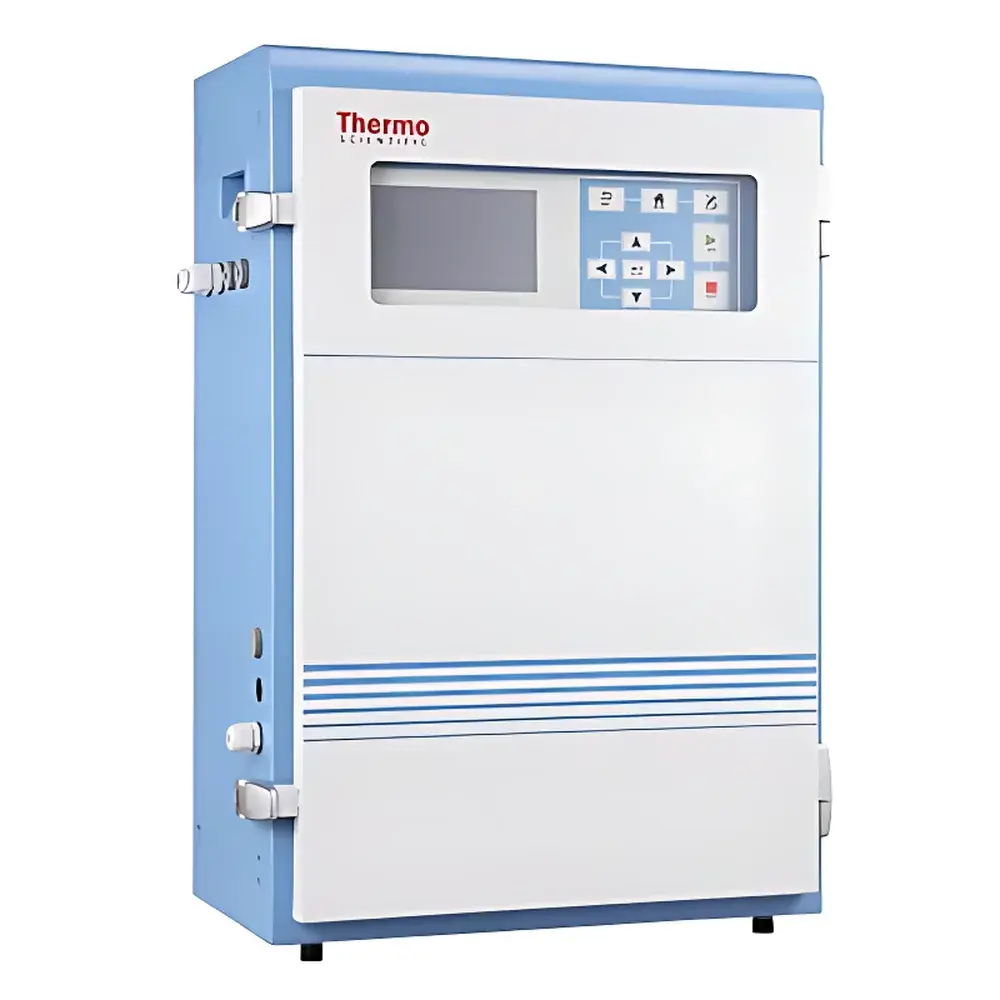
Thermo Scientific 2240 Ammonia Nitrogen Online Analyzer
| Brand | Thermo Fisher |
|---|---|
| Origin | Shanghai, China |
| Manufacturer Type | Original Equipment Manufacturer (OEM) |
| Product Category | Domestic |
| Model | 2240 |
| Instrument Type | Online Analyzer |
| Measurement Principle | Ammonia Gas-Sensing Electrode Method |
| Range | 0–50.0 mg/L (as N) |
| Accuracy | ±5% of reading or ±0.10 mg/L, whichever is greater |
| Detection Limit | 0.001 mg/L |
| Analysis Time | <10 min |
| Calibration Time | <10 min |
| Resolution | 0.001 mg/L |
| Repeatability | ≤5% RSD |
| Calibration Mode | Automatic Two-Point Calibration |
| Sample Volume per Analysis | ~70 mL |
| Reagent Consumption per Analysis | ~0.5 mL |
| Output Signals | 4–20 mA, RS-232, RS-485 |
| Enclosure Mounting Options | Wall-Mounted or Freestanding |
| Dimensions (W×H×D) | 510 × 775 × 330 mm |
| Weight | ~25 kg (without reagents), ~40 kg (fully configured) |
Overview
The Thermo Scientific 2240 Ammonia Nitrogen Online Analyzer is a fully automated, continuous-monitoring instrument engineered for precise, real-time quantification of ammonia nitrogen (NH₃-N) in aqueous environmental matrices. It employs the selective ammonia gas-sensing electrode method—a well-established electrochemical technique grounded in the principles of potentiometric ion detection and the Nernst equation. In alkaline conditions (pH ≥ 11), ammonium ions (NH₄⁺) in the sample are converted to gaseous ammonia (NH₃), which diffuses selectively through a hydrophobic, ion-impermeable membrane integrated into the sensor assembly. This diffusion induces a measurable change in hydrogen ion activity within the internal electrolyte layer, detected by a high-stability pH glass indicator electrode. The resulting potential shift exhibits a logarithmic linear relationship with the logarithm of free ammonia concentration—enabling robust, matrix-resistant quantification when combined with standard addition calibration. Designed for unattended operation in demanding field environments, the 2240 delivers stable performance across fluctuating temperature, conductivity, and turbidity conditions typical of wastewater influent, effluent, surface water, and industrial discharge streams.
Key Features
- Patented fluidic architecture with corrosion-resistant, chemically inert tubing and valve manifolds—certified for long-term exposure to caustic reagents (e.g., NaOH) and aggressive wastewater matrices
- Integrated self-diagnostic system providing real-time status monitoring of pump function, electrode response stability, membrane integrity, and reagent level
- Configurable automatic maintenance routines—including scheduled electrode cleaning, two-point calibration, and blank correction—to minimize manual intervention and ensure data continuity
- Dual-language (English/Chinese) graphical user interface with intuitive navigation, parameter logging, and event-driven alarm management
- Modular design supporting flexible installation: wall-mounted or freestanding configurations with standardized footprint and service access points
- Compliant with IEC 61000-6-2 (immunity) and IEC 61000-6-4 (emissions) for industrial electromagnetic environments
Sample Compatibility & Compliance
The 2240 analyzer is validated for use with raw sewage, secondary-treated effluent, river and lake water, cooling tower blowdown, and industrial process streams containing suspended solids up to 100 mg/L and chloride concentrations ≤5,000 mg/L. Its standard addition quantification mode compensates for ionic strength variations and common interferences (e.g., potassium, sodium, calcium), ensuring compliance with ISO 14911:1998 (water quality—determination of ammonium—ammonia-selective electrode method) and EPA Method 350.1 (ammonia—ion selective electrode). The system supports audit-ready data integrity through time-stamped records of all analyses, calibrations, maintenance events, and error logs—fully traceable for GLP and ISO/IEC 17025 laboratory accreditation requirements.
Software & Data Management
Data acquisition and instrument control are managed via embedded firmware compliant with IEC 62443-3-3 cybersecurity standards. All measurement results, calibration coefficients, diagnostic flags, and alarm triggers are timestamped and stored locally on non-volatile memory (retention ≥12 months). Standard communication interfaces include isolated RS-232 (for local PC connection), RS-485 (Modbus RTU protocol), and analog 4–20 mA output (NAMUR-compliant). Optional integration with SCADA, DCS, or cloud-based environmental data platforms is supported through configurable Modbus TCP or MQTT protocols. Full audit trail functionality satisfies FDA 21 CFR Part 11 requirements for electronic records and signatures when deployed in regulated wastewater compliance applications.
Applications
- Continuous compliance monitoring at municipal wastewater treatment plant (WWTP) influent and effluent points per national discharge permits (e.g., China’s GB 18918-2002, EU Urban Wastewater Treatment Directive)
- Real-time process control in nitrification/denitrification basins to optimize aeration energy consumption and carbon dosing
- Early-warning detection of ammonia breakthrough in drinking water treatment pre-chlorination stages
- Monitoring of aquaculture recirculating systems where sub-ppm NH₃ fluctuations impact fish health
- Industrial pretreatment verification for textile, food processing, and chemical manufacturing facilities subject to ammonia load limits
FAQ
What sample pretreatment is required prior to analysis?
No filtration or centrifugation is needed for samples with total suspended solids ≤100 mg/L. For higher particulate loads, optional inline 50-µm mesh filtration is recommended to prevent flow path obstruction.
How often must the ammonia electrode be replaced?
Under typical wastewater conditions and with scheduled cleaning, the gas-sensing electrode demonstrates ≥6 months operational lifetime; replacement intervals are tracked automatically and reported via the diagnostic interface.
Can the 2240 interface with third-party LIMS or regulatory reporting portals?
Yes—via Modbus TCP or custom API integration, enabling direct transfer of validated analytical results, QA/QC metadata, and calibration certificates to external environmental data management systems.
Is the instrument suitable for outdoor deployment in extreme temperatures?
The analyzer operates continuously within 5–40 °C ambient range; for unheated outdoor enclosures, an optional thermostatically controlled housing kit extends functional range to –10 to 50 °C.
Does the system support remote firmware updates and configuration changes?
Yes—secure over-the-air (OTA) updates are supported via authenticated HTTPS connections, with rollback capability and version-controlled configuration backups.







