
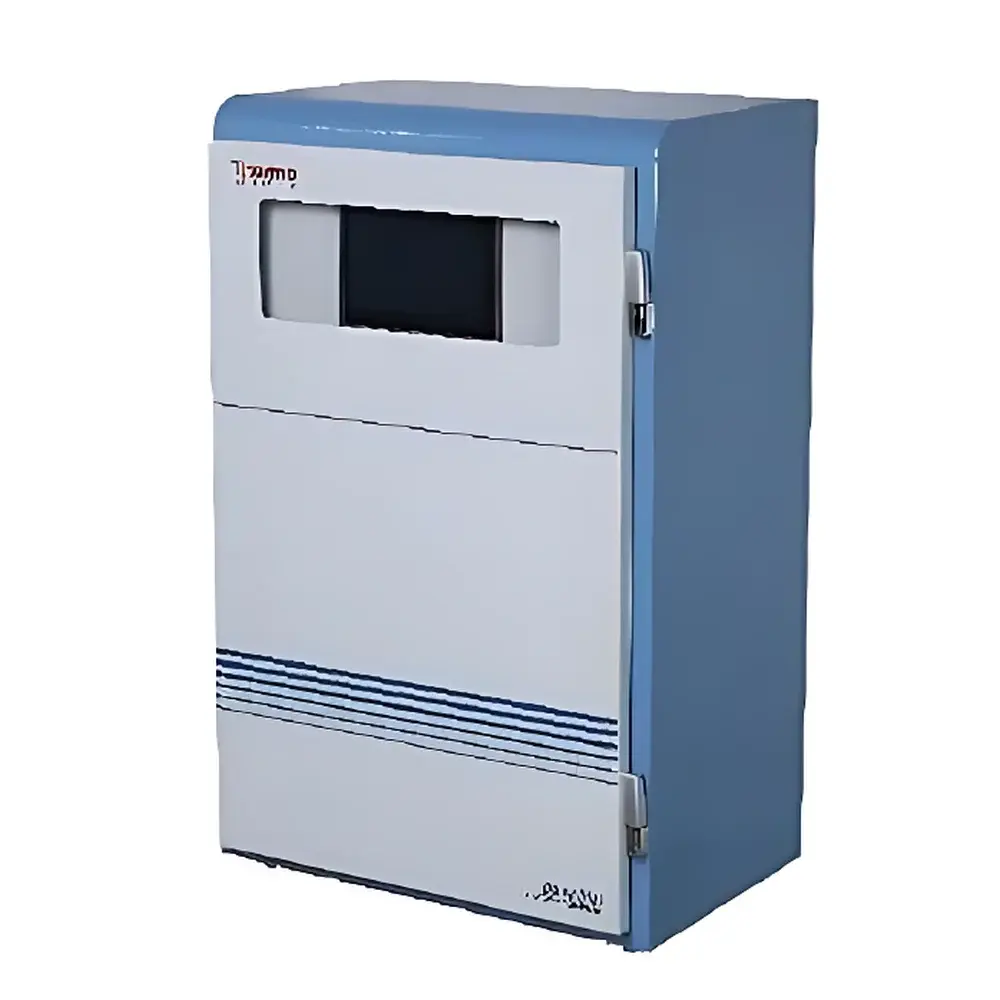
Thermo Scientific 3131 Permanganate Index Analyzer
| Brand | Thermo Fisher |
|---|---|
| Origin | USA |
| Manufacturer | Thermo Fisher Scientific |
| Product Category | Imported Instrument |
| Model | Thermo Scientific 3131 |
| Measurement Principle | Potassium Permanganate Oxidation with ORP Endpoint Detection |
| Range | 0–20 / 0–100 / 0–200 mg/L (customizable extended ranges available) |
| Repeatability | ≤ ±3% |
| Accuracy | ±3% |
| Limit of Detection (LOD) | ≤ 0.2 mg/L |
| Resolution | 0.001 mg/L |
| Analysis Time per Sample | < 60 minutes |
Overview
The Thermo Scientific 3131 Permanganate Index Analyzer is a fully automated, benchtop analytical system engineered for precise and reproducible determination of the permanganate index (CODMn) in natural waters, drinking water sources, and treated effluents. It implements the standardized chemical oxidation method based on potassium permanganate under acidic conditions—aligned with ISO 8467:1993, GB/T 5750.7–2006, and APHA Standard Methods 5210 B. The instrument performs the complete titrimetric sequence—including reagent dosing, oil-bath heating at controlled temperature (typically 100 °C), oxidation reaction (30 min), back-titration with standardized sodium oxalate, and final redox titration with KMnO4—all without manual intervention. Endpoint detection relies exclusively on real-time oxidation-reduction potential (ORP) monitoring, eliminating optical interference from turbidity, color, or suspended solids—a critical advantage over photometric or colorimetric alternatives.
Key Features
- ORP-based endpoint detection ensures robust performance across diverse water matrices, including colored, turbid, or humic-rich samples where spectrophotometric methods fail.
- Integrated oil-bath heating module provides uniform, stable thermal control during the 30-minute oxidation step—enhancing reaction completeness and inter-laboratory reproducibility.
- High-precision syringe pumps (accuracy ±0.01% full scale, resolution 0.001 mL) deliver reagents with metrological traceability; no electrode calibration required for ORP sensing.
- Modular architecture enables rapid maintenance, component replacement, and field serviceability—reducing downtime and extending service intervals.
- 7-inch capacitive touchscreen interface supports intuitive operation, multi-level user authentication (administrator, operator, auditor), and real-time visualization of titration curves and system status.
- Onboard data logging retains method parameters, calibration history, sample IDs, timestamps, and raw ORP profiles—fully compliant with GLP documentation requirements.
- Low reagent consumption (< 1.2 mL KMnO4 and < 0.8 mL Na2C2O4 per analysis) significantly reduces operational cost and hazardous waste generation.
- Power-fail recovery logic preserves active method steps and resumes analysis post-interruption—ensuring data continuity and audit-trail integrity.
Sample Compatibility & Compliance
The Thermo Scientific 3131 accepts standard 50 mL aqueous samples with minimal pretreatment—suitable for surface water, groundwater, reservoir intake water, and potable distribution systems. It complies with regulatory frameworks governing environmental monitoring in North America, Europe, and Asia, including EPA guidance for non-chlorinated oxidizability assessment and China’s HJ/T 91–2002 and CCEP certification criteria. Its ORP-driven methodology satisfies ISO/IEC 17025:2017 requirements for measurement uncertainty estimation and method validation. All firmware and data handling routines support ALCOA+ principles (Attributable, Legible, Contemporaneous, Original, Accurate) and are compatible with 21 CFR Part 11-compliant LIMS integration via Ethernet or USB export.
Software & Data Management
Instrument control and data acquisition are managed by Thermo Scientific AnalyzeIQ™ v3.x firmware—an embedded, real-time operating system with deterministic timing for titration kinetics. Raw ORP signals (mV vs. Ag/AgCl) are sampled at 10 Hz and processed using first-derivative peak detection to identify the inflection point with sub-mL reagent precision. All analytical records—including audit trails, user actions, method versions, and electronic signatures—are stored in encrypted SQLite databases. Export formats include CSV (for Excel and statistical packages), PDF analytical reports (with embedded titration curves), and XML for enterprise LIMS ingestion. Remote diagnostics and firmware updates are supported via secure HTTPS connection.
Applications
- Regulatory compliance monitoring of source water quality per national drinking water standards (e.g., China’s GB 5749–2022, EU Directive 98/83/EC).
- Trend analysis of organic load in rivers, lakes, and reservoirs—supporting eutrophication studies and watershed management programs.
- Performance evaluation of drinking water treatment processes, especially pre-oxidation and filtration stages.
- Method validation and reference analysis in certified environmental testing laboratories accredited to ISO/IEC 17025.
- Research applications requiring high-precision, low-interference CODMn quantification in humic acid solutions, algal blooms, or wastewater-impacted surface waters.
FAQ
What standards does the Thermo Scientific 3131 comply with?
It conforms to ISO 8467:1993, GB/T 5750.7–2006, APHA 5210 B, and has obtained CCEP certification for use in Chinese environmental monitoring networks.
Can the instrument handle highly turbid or colored samples?
Yes—the ORP endpoint detection mechanism is inherently insensitive to optical interference, making it suitable for peat-stained, algae-laden, or industrial-impacted waters.
Is method validation documentation provided?
Yes—each unit ships with a Factory Acceptance Test (FAT) report, certificate of conformance, and a comprehensive validation package including LOD/LOQ, linearity, precision, and spike recovery data.
How is data integrity ensured for regulatory submissions?
All data operations adhere to ALCOA+ principles; audit trails are immutable, time-stamped, and include user identity, action type, and contextual metadata—fully traceable for FDA or CNAS inspections.
What maintenance is required for long-term reliability?
Routine tasks include monthly cleaning of syringe valves and tubing, quarterly verification of oil-bath temperature uniformity, and annual calibration of pump volumes against gravimetric standards—documented in the included Preventive Maintenance Logbook.







