
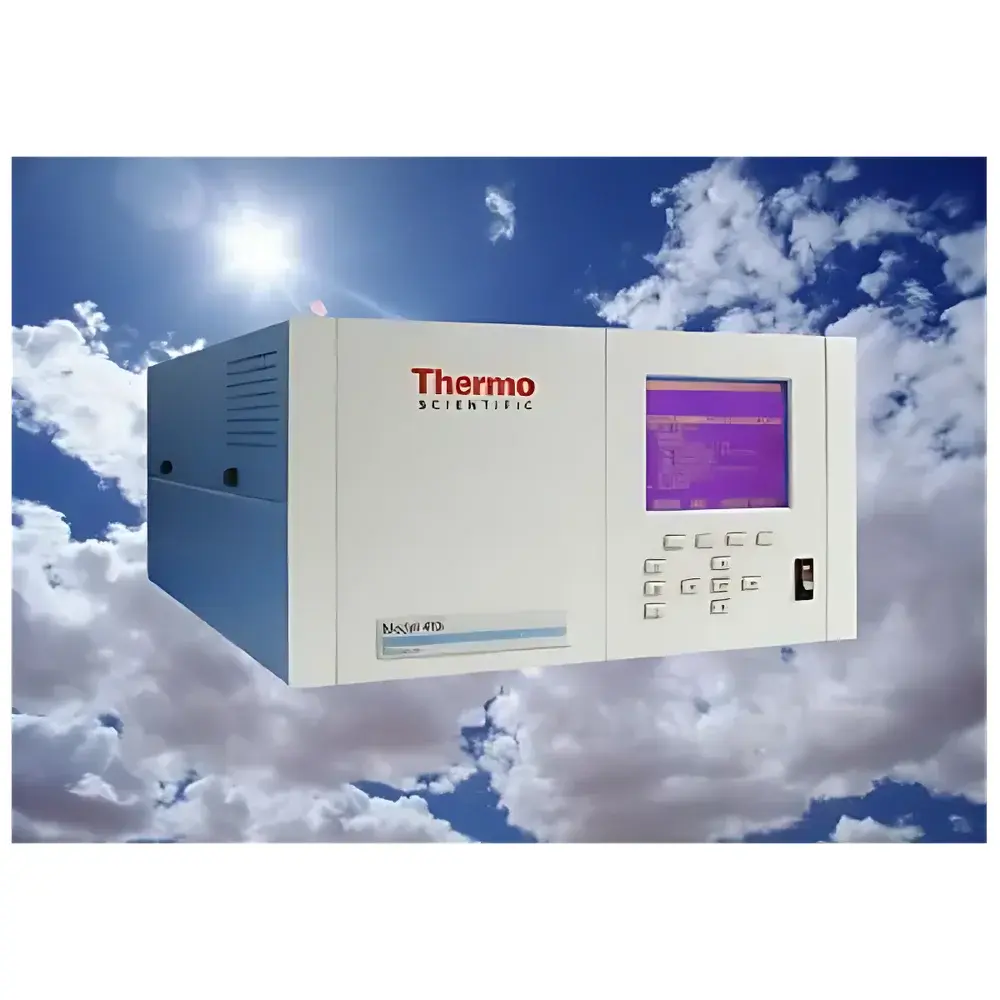
Thermo Scientific 410i Carbon Dioxide (CO₂) Analyzer
| Brand | Thermo Scientific |
|---|---|
| Origin | USA |
| Model | 410i |
| Instrument Type | In-situ Online Gas Analyzer |
| Detection Principle | Nondispersive Infrared (NDIR) Spectroscopy with Fixed Bandpass Interference Filter and Quantum-Well Infrared Photodetector (QWIP) |
| Measurement Range (D-type) | 0–10,000 ppm CO₂ |
| Measurement Range (E-type) | 0–25% CO₂ |
| Zero Noise (D-type) | 0.1 ppm RMS (300 s averaging) |
| Zero Noise (E-type) | 10 ppm RMS (60 s averaging) |
| MDL (D-type) | 0.2 ppm |
| MDL (E-type) | 20 ppm |
| Zero Drift (7 days, D-type) | <0.20 ppm |
| Zero Drift (24 h, E-type) | <40 ppm |
| Span Drift (7 days) | <1% reading (D-type), <2% reading (E-type) |
| Operating Temperature Range | –20 °C to +50 °C |
| Compliance | ASTM D6522, EPA Method 3A, ISO 12039, EN 15267-3 (for certified configurations), Supports 21 CFR Part 11 audit trail (with optional software license) |
Overview
The Thermo Scientific 410i Carbon Dioxide (CO₂) Analyzer is an in-situ, online gas monitoring instrument engineered for continuous, high-stability measurement of carbon dioxide concentration in industrial flue gas, combustion exhaust, and ambient air streams. It employs a refined nondispersive infrared (NDIR) spectroscopic architecture, combining a fixed bandpass interference filter with a quantum-well infrared photodetector (QWIP) to isolate the characteristic 4.26 µm absorption band of CO₂. This optical configuration eliminates moving parts and spectral drift associated with grating-based systems, delivering long-term baseline stability and minimal maintenance requirements. The analyzer supports both extractive direct-pumping and dilution sampling protocols—fully configurable to meet ASTM D6522 (for CO₂ in stationary source emissions), EPA Method 3A (for CO₂ in stack gas), and ISO 12039 (for CO₂ in flue gases). Its extended operating temperature range (–20 °C to +50 °C) ensures consistent performance across seasonal field conditions without active thermal stabilization, reducing power demand and system complexity.
Key Features
- Two calibrated variants: 410i-D for trace-to-mid-range applications (0–10,000 ppm), and 410i-E for high-concentration industrial processes (0–25% CO₂)
- Factory-installed, NIST-traceable calibration curves stored in nonvolatile flash memory—enabling linear response across full scale without manual recalibration
- Low-noise QWIP detector with optimized signal-to-noise ratio: 0.1 ppm RMS zero noise (300 s average, D-type); 10 ppm RMS (60 s average, E-type)
- Robust mechanical design compliant with EN 61000-6-2 (EMC immunity) and EN 61000-6-4 (EMC emission) standards for harsh plant environments
- Front-panel 7-inch VGA touchscreen with intuitive menu-driven interface, programmable soft keys, and real-time diagnostics including optical path contamination alerts and detector saturation warnings
- Rack-mountable 19-inch chassis (4U height) with rear-access I/O terminals and dual Ethernet ports supporting Modbus TCP, EtherNet/IP, and optional OPC UA integration
Sample Compatibility & Compliance
The 410i accepts conditioned sample gas via heated stainless-steel probe lines (standard 1/4″ OD SS tubing) and accommodates inlet pressures from 80–120 kPa abs. It is compatible with standard extractive sampling systems including particulate filters (0.5 µm sintered metal), moisture removal (chilled mirror or permeation dryers), and pressure regulation modules. For regulatory reporting, the analyzer meets the performance criteria of EPA Performance Specification 3 (PS-3) when deployed with certified accessories and documented calibration procedures. Optional factory certification to EN 15267-3 (QAL1) enables use in EU Industrial Emissions Directive (IED) compliance monitoring. All firmware revisions maintain GLP/GMP-aligned data integrity: time-stamped events, user authentication logs, and immutable audit trails are retained internally for ≥12 months (expandable via external NAS).
Software & Data Management
The embedded firmware supports local data logging at user-defined intervals (1 s to 1 h) to internal 4 GB flash memory—capable of storing >10 million records. Remote access is enabled via Thermo Scientific™ Insight™ Software (v5.2+), which provides real-time visualization, alarm management (configurable high/low limits, rate-of-change triggers), and automated report generation per ISO 14064-3 verification requirements. When licensed for 21 CFR Part 11 compliance, Insight enforces electronic signature workflows, role-based permissions, and tamper-evident audit logs—including all calibration modifications, range changes, and diagnostic resets. Data export formats include CSV, XML, and PDF reports compliant with EPA 40 CFR Part 60 Subpart Da recordkeeping mandates.
Applications
- Continuous emissions monitoring (CEMS) for coal-, gas-, and biomass-fired power plants
- Carbon capture and storage (CCS) process stream verification (inlet, outlet, and purge gas CO₂ quantification)
- Incinerator and cement kiln combustion efficiency optimization via real-time CO₂/O₂ ratio trending
- Biogas upgrading facility purity control (CO₂ removal validation prior to pipeline injection)
- Research-grade flue gas characterization in ASTM E1527-compliant environmental chamber studies
- Indoor air quality (IAQ) monitoring in large-scale HVAC systems requiring UL 2075-listed CO₂ sensing
FAQ
Does the 410i require periodic optical alignment or lamp replacement?
No. The fixed-filter NDIR architecture uses a solid-state infrared source with >50,000-hour lifetime and no moving optics—eliminating routine alignment or lamp service.
Can the 410i simultaneously measure CO₂ and CO?
No. The 410i is a dedicated CO₂ analyzer. For multi-gas capability, Thermo Scientific offers the 42i-TLE series (CO/CO₂/NO/NO₂/SO₂) or paired deployment with a 48i CO analyzer using shared sample conditioning.
Is analog output available for legacy DCS integration?
Yes. Standard 4–20 mA isolated outputs (up to four channels) are configurable for primary CO₂ concentration, temperature-compensated span, fault status, and diagnostic codes.
How is zero and span calibration performed?
Zero calibration uses certified nitrogen (99.999% purity); span calibration uses certified CO₂-in-N₂ standards traceable to NIST SRM 1662a. Both can be executed manually or scheduled automatically via Insight software.
What cybersecurity features are included?
Firmware v3.1+ includes TLS 1.2 encryption for web interface, configurable password policies (minimum length, expiry, history), disabled default credentials, and secure boot with signed firmware verification.







