
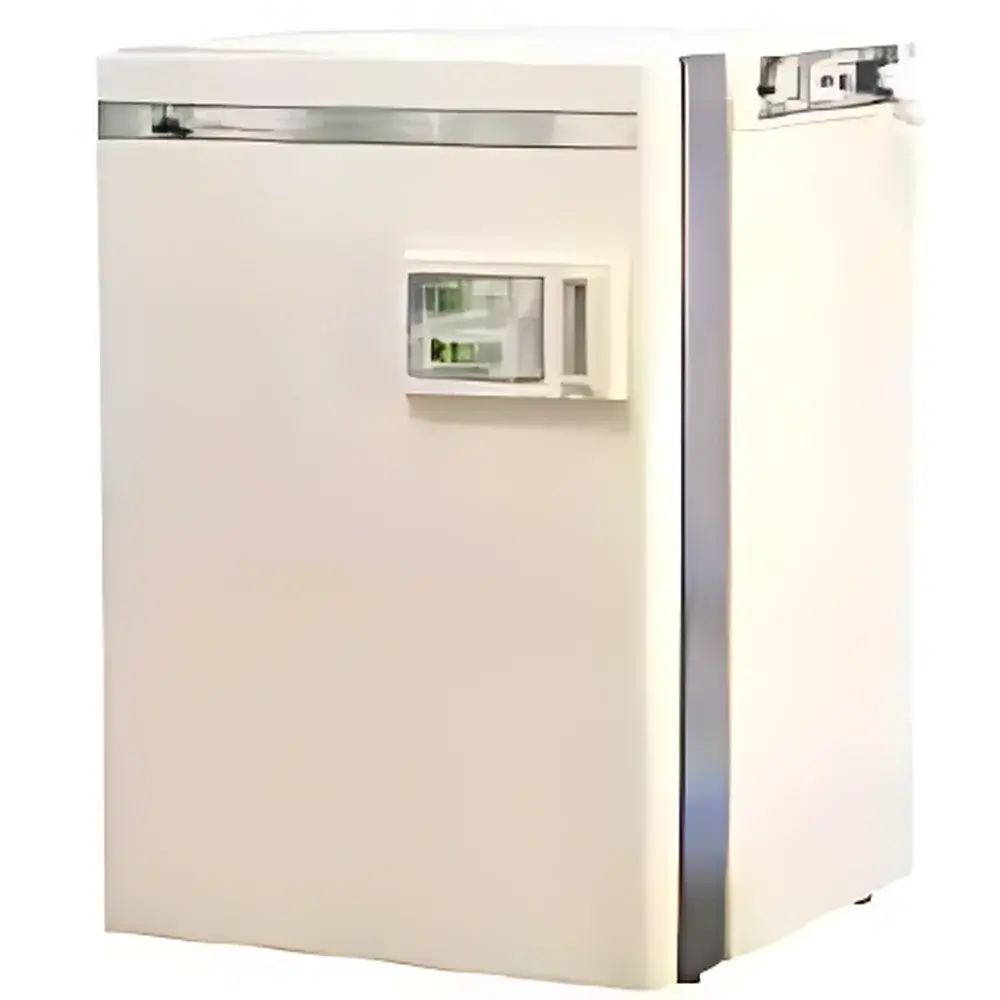
Thermo Scientific 4200 Series CO₂ Incubator
| Key | Temperature Range: Ambient +4°C to 50°C |
|---|---|
| Temperature Uniformity | ±0.2°C |
| Temperature Accuracy | ±0.1°C |
| Humidity Range | Up to 90% RH at 37°C |
| CO₂ Range | 0.3–19.9% |
| CO₂ Accuracy | ±0.15% |
| CO₂ Sensor Type | Infrared (IR) |
| Chamber Volume | 200 L |
| Internal Dimensions (W×D×H) | 630 × 510 × 665 mm |
| External Dimensions (W×D×H) | 790 × 730 × 960 mm |
| Net Weight | 112 kg |
| Shelf Capacity | 3 stainless steel shelves |
| Power Supply | 230 V, 50 Hz |
| Optional Accessory | HEPA filtration system |
Overview
The Thermo Scientific 4200 Series CO₂ Incubator is an engineered platform for reliable, long-term mammalian cell and tissue culture under tightly controlled physiological conditions. Designed around a dual-chamber architecture with independent temperature and CO₂ regulation, it employs a non-dispersive infrared (NDIR) CO₂ sensor for real-time, drift-free gas concentration monitoring—eliminating the calibration drift associated with traditional thermal conductivity sensors. Temperature control is achieved via a single stainless-steel tubular heating element coupled with a precision-balanced forced-air circulation system, ensuring rapid recovery and spatial uniformity across the entire 200 L working volume. Humidity is maintained through passive evaporation from a dedicated water reservoir combined with a heated humidity pan, achieving ≥90% RH at 37°C without condensation or localized saturation—critical for minimizing medium evaporation and preventing edge-drying in multi-well plates.
Key Features
- Microprocessor-based controller with intuitive LED interface displaying real-time values for chamber temperature, CO₂ concentration, and relative humidity
- Infrared (IR) CO₂ sensing technology offering high specificity, long-term stability, and immunity to cross-sensitivity from O₂ or water vapor
- Temperature control range from ambient +4°C to 50°C, with accuracy of ±0.1°C and uniformity of ±0.2°C across the chamber
- Humidity generation system optimized for stable operation at 37°C, delivering up to 90% RH using natural evaporation and active pan heating
- Integrated alarm system with visual and audible alerts for out-of-limit conditions including temperature excursion, CO₂ deviation, door open, and sensor failure
- Power-loss memory function preserving all user-defined setpoints and operational history during unexpected power interruption
- Robust stainless-steel interior with rounded corners and seamless welds for ease of cleaning and compliance with ISO 14644-1 Class 5 cleanroom-compatible maintenance protocols
Sample Compatibility & Compliance
The 4200 Series supports a broad spectrum of primary cultures, immortalized cell lines, stem cells, and co-culture models—including sensitive applications such as embryonic stem cell expansion and organoid development. Its chamber geometry (630 × 510 × 665 mm internal) accommodates standard T-flasks, roller bottles, multi-well plates, and Petri dishes across three adjustable stainless-steel shelves. The incubator meets essential regulatory expectations for GLP and GMP environments: its microprocessor logs timestamped event records (e.g., door openings, alarms, parameter changes), supporting audit-trail requirements under FDA 21 CFR Part 11 when paired with validated data management software. Optional HEPA filtration (99.99% @ 0.3 µm) enables use in classified laboratory zones requiring particulate control per ISO 14644-1.
Software & Data Management
While the base unit operates via standalone front-panel controls, optional connectivity modules enable RS-232 or Ethernet integration with centralized lab infrastructure. When deployed with Thermo Fisher’s IncuManager™ software suite (sold separately), users gain access to remote monitoring, automated calibration logging, configurable alarm escalation workflows, and exportable CSV reports compliant with ALCOA+ data integrity principles. All logged parameters—including CO₂ concentration trends, temperature variance maps, and humidity decay profiles—are time-stamped and digitally signed to satisfy traceability requirements in regulated bioprocessing and clinical research settings.
Applications
- Long-term maintenance of adherent and suspension mammalian cell lines under physiologically relevant CO₂ tension (typically 5%)
- High-fidelity differentiation protocols requiring precise humidity retention over multi-day timelines
- Pre-analytical sample conditioning prior to flow cytometry, qPCR, or next-generation sequencing workflows
- Quality control testing of therapeutic biologics, including monoclonal antibody-producing CHO cell banks
- Academic and industrial research involving CRISPR-edited cell pools where phenotypic consistency depends on environmental reproducibility
FAQ
What CO₂ sensing technology does the 4200 Series use, and why is IR preferred over thermal conductivity?
It uses a non-dispersive infrared (NDIR) sensor, which provides superior selectivity for CO₂ molecules, minimal drift over time, and insensitivity to ambient oxygen or humidity fluctuations—unlike thermal conductivity sensors that require frequent recalibration.
How does the incubator maintain humidity without introducing contamination risks?
Humidity is generated passively via a heated stainless-steel water pan and natural evaporation; no ultrasonic misting or external humidification lines are used, eliminating aerosol-mediated microbial dispersion pathways.
Is the 4200 Series compatible with validation protocols required for ISO 13485 or FDA submissions?
Yes—the device supports IQ/OQ documentation packages, includes hardware-level event logging, and can be integrated into electronic lab notebooks (ELNs) meeting 21 CFR Part 11 requirements when configured with approved software interfaces.
Can the incubator operate continuously at 41°C for extended periods?
Yes; the thermal architecture and fan-cooled heating element are rated for uninterrupted operation across the full specified range (ambient +4°C to 50°C), with continuous monitoring of thermal load and safety cutoffs.
What is the recommended maintenance schedule for the IR CO₂ sensor?
No routine recalibration is required; however, annual verification against a certified reference gas (e.g., NIST-traceable 5.0% CO₂ in air) is advised to confirm measurement fidelity per ISO/IEC 17025 guidelines.




