
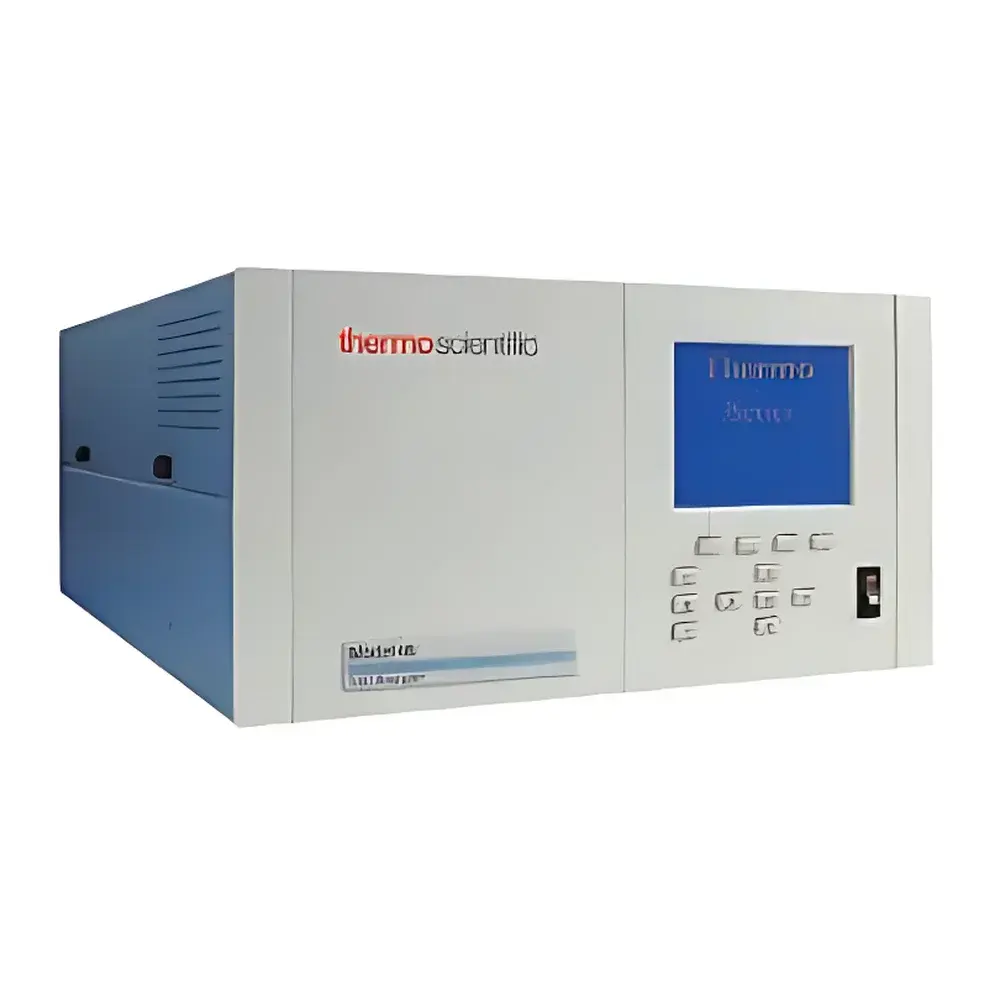
Thermo Scientific 46i N₂O Analyzer
| Brand | Thermo Fisher |
|---|---|
| Origin | USA |
| Manufacturer | Thermo Fisher Scientific |
| Product Category | Imported |
| Model | 46i Series |
| Price | Upon Request |
Overview
The Thermo Scientific™ 46i N₂O Analyzer is a high-precision, EPA-compliant trace gas analyzer engineered for continuous, real-time measurement of nitrous oxide (N₂O) in ambient air and stack emissions. It employs the Gas Filter Correlation (GFC) spectroscopic technique—a robust, interference-resistant method that leverages the unique infrared absorption signature of N₂O at ~4.5 µm. Unlike non-dispersive infrared (NDIR) or chemiluminescence systems, GFC uses a rotating filter wheel containing matched N₂O-filled and reference gas cells to modulate the optical path, enabling highly selective detection with minimal cross-sensitivity to water vapor (H₂O), carbon dioxide (CO₂), and carbon monoxide (CO). This principle ensures metrological traceability, long-term stability, and compliance with U.S. EPA Method TO-16 and ISO 14064-3 requirements for greenhouse gas (GHG) monitoring. Designed for unattended operation in regulatory-grade environmental monitoring networks, the 46i delivers certified performance across diverse climatic conditions—from urban background stations to industrial fence-line applications—supporting climate reporting under the Paris Agreement, EPA GHG Reporting Program (Subpart L, O, and AA), and EU MRV frameworks.
Key Features
- Gas Filter Correlation (GFC) optical architecture with dual-path modulation for exceptional selectivity and immunity to spectral interferences
- Factory-calibrated linear response over full dynamic range (0–50 ppm or 0–100 mg/m³), validated per ASTM D6348 and ISO 12039
- Dual-range and auto-ranging modes enable seamless transition between low-background (e.g., atmospheric monitoring) and elevated concentration (e.g., biogas or combustion effluent) applications
- Integrated pressure and temperature compensation algorithms compliant with EPA Performance Specification 18 (PS-18), ensuring accuracy across 0–45 °C and ambient pressure variations
- Ultra-low zero noise (0.01 ppm RMS, 30-s averaging) and detection limit (0.02 ppm RMS), meeting stringent data quality objectives (DQOs) for Tier 2 GHG inventories
- Robust mechanical design with shock- and vibration-damped optical bench, qualified to IEC 60068-2 environmental stress standards
- Ethernet (TCP/IP) interface supporting remote firmware updates, real-time data streaming, and secure HTTPS-based configuration via web browser
Sample Compatibility & Compliance
The 46i accepts sample gas flows between 0.5–2.0 L/min with optional integrated particulate filtration (HEPA-rated) and moisture management (Nafion™ dryer or chilled mirror dew point control). Its GFC architecture inherently suppresses interference from H₂O, CO₂, and CO—cross-sensitivity < ±0.5% of reading under typical ambient compositions (≤2% CO₂, ≤10,000 ppm H₂O). The analyzer meets U.S. EPA Conditional Acceptance for Method TO-16, carries CE marking per EN 61326-1 (EMC) and EN 61010-1 (safety), and supports 21 CFR Part 11-compliant audit trails when operated with Thermo’s optional IQ/OQ validation package. All calibration protocols adhere to ISO/IEC 17025:2017 requirements for testing laboratories.
Software & Data Management
The embedded Linux-based operating system provides intuitive menu navigation via a 5-line backlit LCD display (425 × 219 mm front panel). Programmable soft keys allow one-touch access to frequently used functions—including span/zero verification, diagnostics, and data export. Measurement data are timestamped and stored internally (≥30 days at 1-min intervals) with optional SD card logging. Communication interfaces include RS-232/RS-485 (Modbus RTU), TCP/IP (Modbus TCP), 10 configurable status relays, and standard isolated 0–20 mA or 4–20 mA analog outputs. Optional I/O expansion cards support up to six additional current outputs and eight 0–10 VDC inputs for synchronized auxiliary sensor integration (e.g., flow, pressure, temperature).
Applications
- Ambient air quality monitoring networks (EPA SLAMS, EEA AirBase)
- Industrial process emissions verification (wastewater treatment plants, cement kilns, fertilizer production)
- Soil flux chamber studies and eddy covariance systems for agricultural GHG research
- Calibration transfer standards in metrology labs accredited to ISO/IEC 17025
- Mobile monitoring platforms (vehicle-mounted or UAV-deployable configurations with optional vibration isolation)
- Verification of N₂O abatement technologies (e.g., catalytic reduction units)
FAQ
What measurement principle does the 46i use, and why is it preferred for N₂O?
It uses Gas Filter Correlation (GFC), which provides superior selectivity for N₂O in complex matrices by exploiting its distinct IR absorption band—minimizing drift and cross-interference common in broadband NDIR systems.
Does the 46i require daily calibration?
No. Its 24-hour zero drift is < 0.05 ppm and span drift is ±1% FS, enabling extended unattended operation per EPA PS-18 criteria for continuous emission monitoring systems (CEMS).
Can the 46i be integrated into existing SCADA or data acquisition systems?
Yes—via Modbus RTU/TCP, analog outputs, or Ethernet-based HTTP API; all protocols support secure authentication and time-synchronized data tagging.
Is the analyzer suitable for field deployment in extreme temperatures?
It operates continuously from 0 °C to 45 °C; performance specifications are guaranteed at 20–30 °C per EPA guidelines, with thermal management ensuring optical stability across the full range.
What validation documentation is provided for regulatory reporting?
Factory test reports, calibration certificates traceable to NIST SRMs, and optional IQ/OQ protocols aligned with FDA 21 CFR Part 11 and ISO/IEC 17025 requirements.
Related Products







