
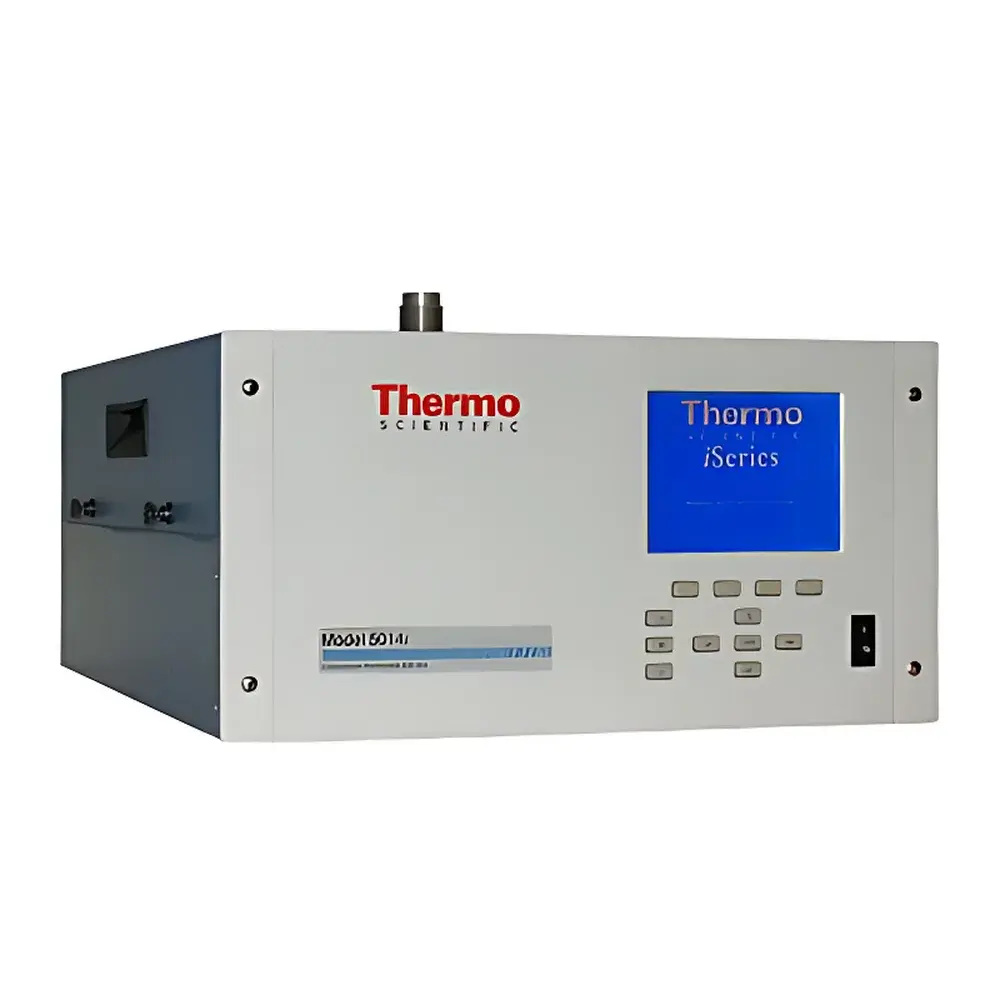
Thermo Scientific 5014i Beta Ray Continuous Particulate Matter Monitor
| Brand | Thermo Fisher |
|---|---|
| Origin | USA |
| Manufacturer | Thermo Fisher Scientific |
| Product Type | Imported Instrument |
| Model | Thermo Scientific 5014i |
| Measurement Principle | Beta Ray Attenuation |
| Measured Parameters | PM₁₀ and PM₂.₅ |
| Measurement Ranges | 0–100, 0–1,000, 0–2,000, 0–3,000, 0–5,000, 0–10,000 µg/m³ |
| Sampling Flow Rate | 1 m³/h (16.67 L/min) |
| Flow Stability | ±2% of setpoint |
| Minimum Detectable Concentration | 4 µg/m³ (1-hour average, 2σ), 1 µg/m³ (24-hour average, 2σ) |
| Accuracy (mass measurement) | ±5% against NIST-traceable filter standards |
| Precision | ±2 µg/m³ at concentrations <80 µg/m³ |
| Data Output Interval | 1 second |
Overview
The Thermo Scientific 5014i Beta Ray Continuous Particulate Matter Monitor is an EPA-equivalent, reference-grade instrument engineered for regulatory-compliant, long-term ambient air monitoring of PM₁₀ and PM₂.₅ mass concentrations. It operates on the beta ray attenuation principle: airborne particles are collected onto a precision-movement tape filter, and the attenuation of beta radiation (from a ¹⁴C source) through the deposited particulate layer is quantified to determine mass loading in real time. This method provides direct, gravimetrically traceable mass concentration data without reliance on optical proxies or empirical calibrations. The 5014i meets U.S. EPA Federal Reference Method (FRM) requirements for PM₂.₅ and PM₁₀ when operated under specified conditions and validated per 40 CFR Part 53. Its robust architecture supports unattended operation in diverse climatic environments, including high-humidity, low-temperature, and high-dust settings.
Key Features
- Dynamic heating system with programmable temperature control minimizes volatilization losses of semi-volatile compounds (e.g., ammonium nitrate, organic aerosols), ensuring improved mass recovery and measurement fidelity.
- Automated filter tape advancement synchronized with user-defined sampling intervals (e.g., hourly, daily) and event-triggered protocols—reducing manual intervention and contamination risk.
- Integrated flow control system maintains sampling flow at 1.0 m³/h (±2% stability), with real-time pressure and temperature compensation to ensure volumetric accuracy across ambient conditions.
- High-resolution analog-to-digital conversion and low-noise detector electronics yield stable 1-second data output, enabling both regulatory reporting and high-frequency aerosol dynamics analysis.
- Modular hardware design facilitates field-serviceable replacement of critical subsystems—including beta source assembly, tape drive mechanism, and flow sensor—minimizing downtime during maintenance or calibration.
- Front-panel “soft-key” interface with context-sensitive navigation and customizable function mapping improves operational efficiency for routine QA/QC tasks and troubleshooting.
Sample Compatibility & Compliance
The 5014i is compatible with standard 47-mm diameter quartz or Teflon-coated glass fiber filter tapes certified for EPA FRM use. It complies with U.S. EPA Performance Specifications for PM₂.₅ and PM₁₀ monitors (PS-11 and PS-12), ISO 10473:2001 (ambient air—determination of PM mass concentration—beta attenuation method), and EU Directive 2008/50/EC Annex VI requirements. All internal mass calibrations are traceable to NIST Standard Reference Materials (SRMs), and instrument validation reports support GLP and regulatory audit readiness. The system includes built-in diagnostics for tape tension, beta source activity decay, and flow sensor drift—each logged with timestamps for full data lineage.
Software & Data Management
Instrument operation and data acquisition are managed via Thermo Scientific’s proprietary EnviroPro™ software suite, accessible locally or remotely over Ethernet (TCP/IP). The software supports automated data export in CSV, XML, and EPA-compatible .DAT formats, with configurable alarm thresholds for flow deviation, tape exhaustion, or source decay. Audit trails record all configuration changes, calibration events, and user logins in accordance with FDA 21 CFR Part 11 requirements. Optional integration with centralized telemetry platforms (e.g., SCADA, AirWatch) enables secure cloud-based data aggregation and visualization across multi-site monitoring networks.
Applications
- Regulatory ambient air quality monitoring networks (e.g., U.S. AQS, EU EEA, China CNEMC).
- Source apportionment studies requiring high-temporal-resolution PM mass data aligned with co-located chemical speciation instruments.
- Long-term trend analysis for compliance with WHO Air Quality Guidelines and national ambient air quality standards.
- Indoor air quality assessment in sensitive environments (e.g., cleanrooms, hospitals) where volatile particle loss must be minimized.
- Method development and intercomparison studies validating optical or tapered element oscillating microbalance (TEOM) systems against gravimetric reference methods.
FAQ
How does the 5014i handle interference from naturally occurring radioactive materials (NORM) in ambient air?
The instrument employs spectral discrimination and background subtraction algorithms that distinguish signal attenuation due to particulate mass from fluctuations caused by radon progeny or other environmental radioisotopes.
Is the beta source replaceable in the field, and what is its typical half-life?
The ¹⁴C source has a nominal half-life of 5,730 years; source replacement is not required during normal instrument service life. Source activity is continuously monitored and compensated in real time.
Can the 5014i operate unattended for extended periods, and what is the maximum tape runtime?
Yes—standard filter tape cartridges support up to 30 days of continuous operation at 1-hour sampling intervals. Optional extended-capacity tapes extend this to 60 days.
Does the system support remote diagnostics and firmware updates?
Yes—via secure HTTPS-enabled web interface and SSH access, enabling remote health checks, parameter reconfiguration, and over-the-air firmware upgrades without physical site visits.
What calibration standards are recommended for routine verification?
NIST-traceable PM₂.₅ and PM₁₀ filter standards (e.g., SRM 2783) are used for annual performance audits; in-field zero/span checks utilize clean air and calibrated aerosol generators per EPA guidance.
Related Products







