
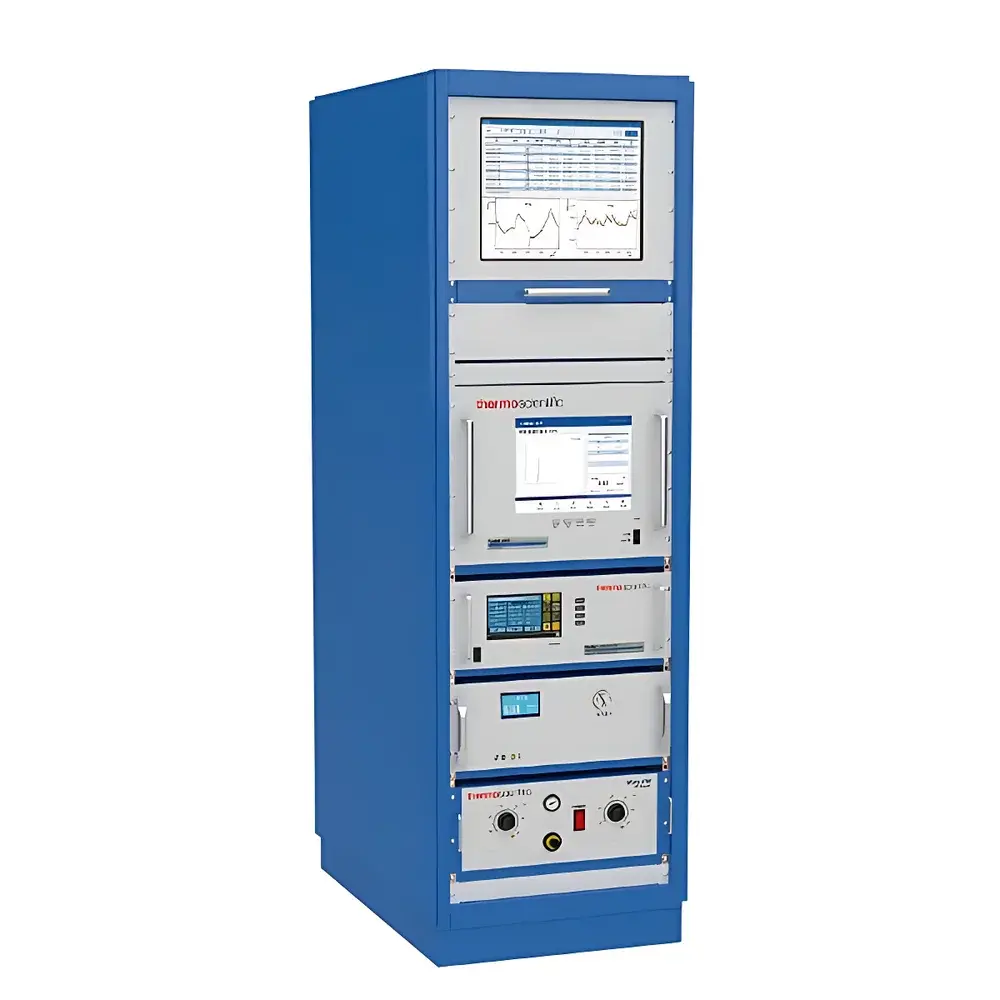
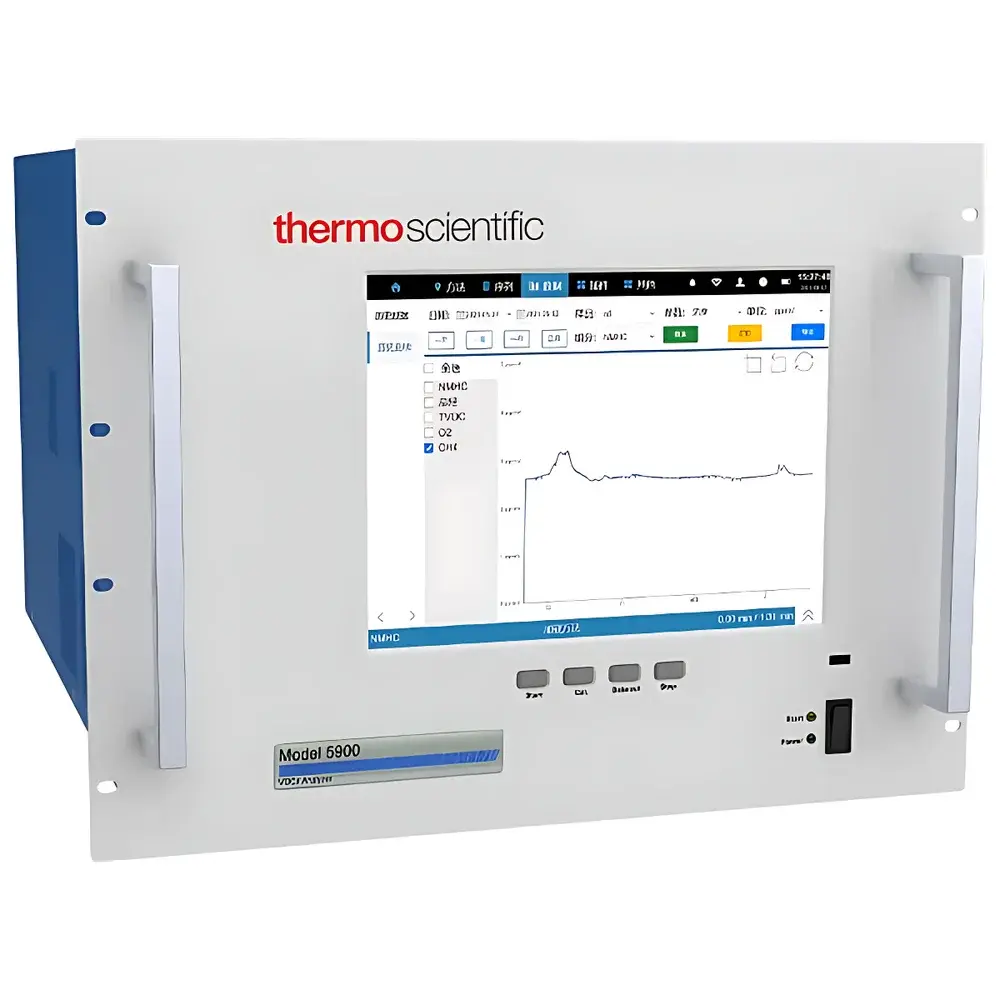
Thermo Scientific 5900 Methane and Total Non-Methane Hydrocarbons (NMHC) Online Analyzer
| Brand | Thermo Fisher Scientific |
|---|---|
| Origin | Shanghai, China |
| Model | Thermo Scientific 5900 VOCs |
| Detection Principle | Gas Chromatography with Flame Ionization Detection (GC-FID) |
| Instrument Type | Online Continuous Analyzer |
| Detection Range | NMHC 0–5 ppm |
| Accuracy | ≤ ±10% |
| Response Time | ≤ 15 min |
| Compliance | Designed for EN 13526, EPA Method 25A, ISO 11890-2, and US EPA Compendium Method TO-17 (with preconcentration) |
Overview
The Thermo Scientific 5900 Methane and Total Non-Methane Hydrocarbons (NMHC) Online Analyzer is an integrated, rack-mountable environmental monitoring system engineered for unattended, continuous quantification of methane (CH₄) and total non-methane hydrocarbons in ambient air or stack emissions. It employs gas chromatography coupled with flame ionization detection (GC-FID), a reference-grade analytical technique recognized by major regulatory frameworks including U.S. EPA Method 25A and EN 13526 for NMHC determination. Unlike indirect subtraction methods, the 5900 implements direct speciation: methane is separated on a dedicated capillary column (e.g., Al₂O₃/KCl PLOT) and quantified independently, while the residual hydrocarbon fraction—eluting after methane—is summed as total NMHC. This eliminates cumulative error from background correction and ensures traceability to primary standards. The system incorporates a thermally desorbed, cryogen-free preconcentration module that enables sub-ppb detection limits (typically < 0.1 ppb for NMHC) without liquid nitrogen dependency, supporting long-term deployment in remote or unmanned monitoring stations.
Key Features
- Integrated GC-FID architecture with dual-column configuration: one optimized for methane separation, the other for NMHC group elution and summation
- Cryogen-free thermal desorption preconcentrator with programmable trap cooling (−20 °C to +30 °C) and rapid flash-heating (≥ 400 °C/s) for high-fidelity VOC recovery
- Full-stream electronic pressure control (EPC) across sample loop, preconcentrator, column oven, and detector—ensuring < ±0.01 psi precision for retention time stability and quantitative reproducibility
- Dual-zone temperature-controlled column oven: isothermal zone for methane elution (±0.1 °C stability), and independently programmable ramp zone for NMHC resolution (up to 20 °C/min)
- Self-diagnostic hardware architecture with real-time valve position feedback, detector baseline monitoring, and FID flame status verification
- Rack-mount 19-inch chassis (4U height) compliant with IEC 60297-3-100; designed for IP54-rated enclosures in outdoor kiosks or indoor CEMS shelters
Sample Compatibility & Compliance
The 5900 accepts ambient air, ducted flue gas (dew point ≤ −20 °C), and synthetic calibration gases containing C₁–C₁₀ hydrocarbons. Integrated particulate filtration (0.5 µm sintered stainless steel) and moisture removal via Nafion™ membrane dryer ensure robust operation under variable humidity (5–95% RH, non-condensing). All wetted materials comply with ASTM D5502 and EPA Method 25A material compatibility requirements. System-level validation supports GLP/GMP data integrity per FDA 21 CFR Part 11 when paired with optional audit-trail-enabled software. Calibration traceability is maintained to NIST-traceable standard gases (certified to ISO/IEC 17025), with documented uncertainty budgets for each certified mixture.
Software & Data Management
Instrument control, sequence scheduling, peak integration, and report generation are managed via Thermo Scientific Chromeleon™ CDS (Chromatography Data System) v7.3 or higher. The embedded firmware supports Modbus TCP, OPC UA, and analog 4–20 mA output for seamless integration into SCADA or DCS platforms. Raw chromatograms, processed results (CH₄, NMHC, total VOC), and diagnostic logs are stored locally (SSD) with configurable retention (default: 90 days), and optionally synchronized to cloud-based environmental data management systems (EDMS) via TLS 1.2-encrypted HTTPS. Audit trails record all user actions—including method edits, calibration events, and manual integrations—with immutable timestamps and operator ID linkage.
Applications
- Ambient air quality monitoring networks (AQMS) for regulatory NMHC reporting under EU Directive 2008/50/EC and China’s HJ 604-2017
- Industrial fence-line monitoring at petrochemical plants, refineries, and chemical manufacturing sites per U.S. EPA LDAR protocols
- Landfill and biogas facility emissions tracking, where CH₄/NMHC ratio analysis informs oxidation efficiency and fugitive emission estimation
- Mobile laboratory deployments for source apportionment studies requiring high-temporal-resolution speciated hydrocarbon profiles
- Validation and performance auditing of optical sensing systems (e.g., FTIR, DOAS) through side-by-side intercomparison campaigns
FAQ
What regulatory methods does the 5900 comply with for NMHC measurement?
It is validated for U.S. EPA Method 25A, EN 13526:2001, and ISO 11890-2:2019, with full documentation available upon request.
Can the system operate without external hydrogen supply?
No—the FID requires ultra-high-purity hydrogen (≥ 99.999%) as fuel gas; integrated hydrogen generators meeting ISO 8573-1 Class 1 purity are recommended for fully autonomous operation.
Is dynamic calibration supported out-of-the-box?
Yes—the system is compatible with Thermo Scientific 5000 Series Dynamic Calibrators for automated multi-point span checks and zero verification without manual gas cylinder changes.
What maintenance intervals are recommended for routine operation?
FID nozzle cleaning every 90 days, preconcentrator trap replacement every 12 months, and GC column reconditioning every 6 months—based on typical ambient air sampling at 1 L/min flow rate.
Does the analyzer support remote diagnostics and firmware updates?
Yes—via secure SSH access and over-the-air (OTA) firmware deployment through Chromeleon Remote Manager, with role-based access control and session logging.
Related Products







