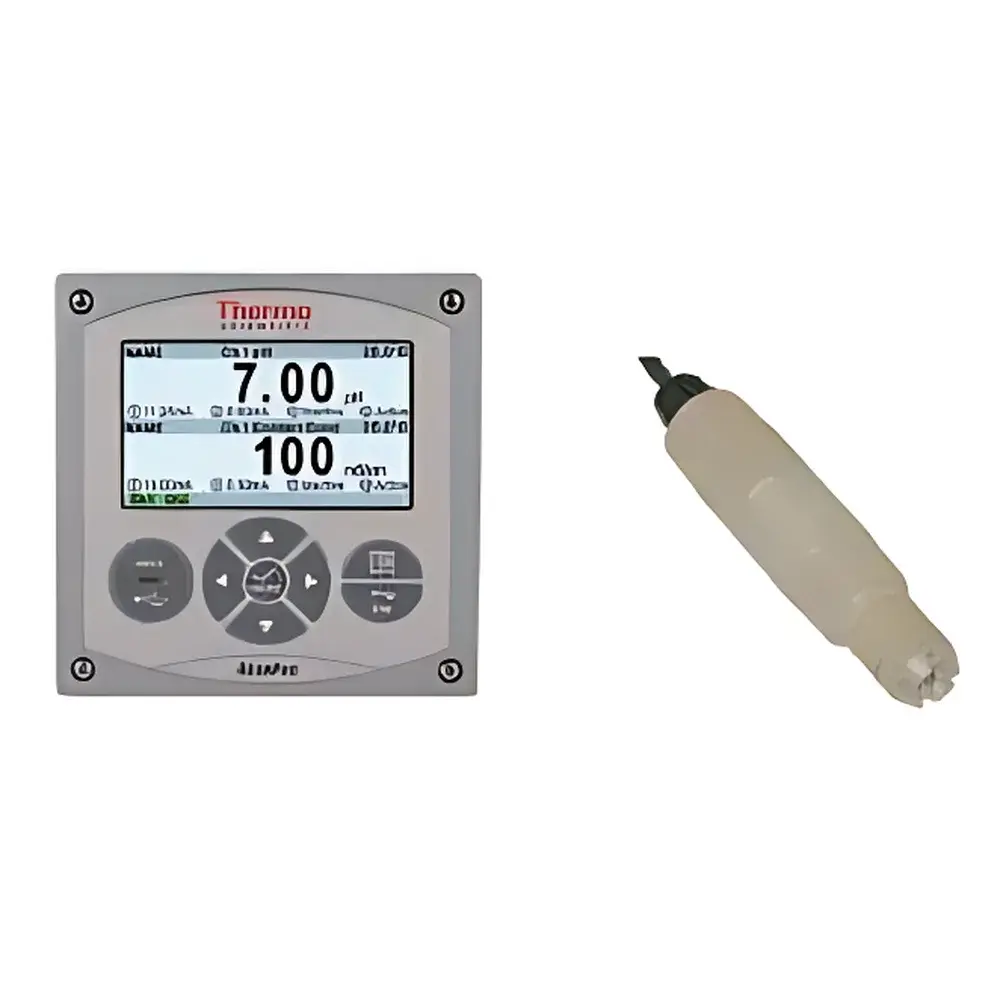
Thermo Scientific AnalogPlus pH/ORP Differential Analyzer
| Brand | Thermo Fisher |
|---|---|
| Origin | USA |
| Manufacturer Type | Original Equipment Manufacturer (OEM) |
| Origin Category | Imported |
| Model | AnalogPlus pH/ORP |
| Pricing | Available Upon Request |
Overview
The Thermo Scientific AnalogPlus pH/ORP Differential Analyzer is an industrial-grade online process analyzer engineered for high-stability, low-drift measurement of hydrogen ion activity (pH) and oxidation-reduction potential (ORP) in demanding aqueous process streams. Unlike conventional two-electrode potentiometric systems, this analyzer employs a true three-electrode differential measurement architecture—comprising a sensing electrode, a reference electrode, and a dedicated guard/reference compensation electrode. This differential configuration actively rejects common-mode interference—including ground loops, stray capacitance, cable noise, and junction potential drift—thereby delivering superior long-term stability and measurement reproducibility under fluctuating electrical or chemical conditions. The system integrates seamlessly with the AquaPro Series online controller platform, enabling centralized monitoring and control across multi-point installations in continuous 24/7 operation environments.
Key Features
- Differential three-electrode design eliminates reference electrode contamination and minimizes drift—proven to extend calibration intervals by up to 3× compared to standard pH/ORP sensors.
- Modular salt-bridge cartridge system allows field-replacement without electrode disassembly, significantly reducing downtime and total cost of ownership in aggressive media (e.g., high-sulfide wastewater, chlorinated cooling water, acidic pickling baths).
- Integrated Pt1000 or NTC temperature sensor enables automatic temperature compensation (ATC) per NIST-traceable algorithms compliant with ISO 7027 and ASTM D1293.
- AquaPro controller supports up to four independent analog input channels, configurable for pH, ORP, mV, or temperature—all simultaneously monitored and logged with synchronized timestamps.
- USB-based firmware update capability ensures future-proof adaptability to evolving regulatory requirements and communication protocols (e.g., Modbus RTU/TCP, HART 7).
- IP66/NEMA 4X-rated enclosure with optional 1″ or 1.5″ NPT mounting threads; electrode bodies available in PEEK, PVDF, or Hastelloy C-276 for chemical resistance across pH 0–14 and temperatures up to 105°C.
- Onboard data logging stores 1,000 timestamped records (pH, ORP, temp, date/time), exportable via USB mass storage mode for audit-ready traceability.
Sample Compatibility & Compliance
The AnalogPlus system is validated for use in conductive aqueous matrices with conductivity ≥50 µS/cm, including activated sludge effluents, pharmaceutical buffer solutions, refinery desalination brines, ultrapure water recirculation loops (with optional low-conductivity flow cell), food-grade CIP rinse waters, and metal finishing rinse tanks. It complies with IEC 61508 SIL 2 functional safety requirements for process shutdown integration and meets electromagnetic compatibility standards per EN 61326-1 (industrial environment). Data integrity features—including user-accessible audit trails, password-protected configuration changes, and non-volatile memory retention—support adherence to FDA 21 CFR Part 11, EU Annex 11, and GMP/GLP documentation practices.
Software & Data Management
The AquaPro controller provides embedded web server access (HTTPS-enabled) for remote configuration, real-time trend visualization, and alarm threshold management via standard browsers—no proprietary software required. Logged datasets export as CSV files compatible with LIMS, SCADA, and MES platforms. Optional Thermo Scientific Process Analytics Suite (PAS) offers advanced diagnostics, predictive maintenance alerts based on electrode impedance trending, and automated report generation aligned with ISO/IEC 17025 quality assurance frameworks.
Applications
- Wastewater treatment: Continuous monitoring of equalization basins, biological reactors, and tertiary disinfection stages to optimize coagulant dosing and chlorine residual control.
- Pharmaceutical manufacturing: In-line pH verification during buffer preparation, bioreactor harvest, and final formulation to ensure USP and compliance.
- Petrochemical refining: Corrosion mitigation in sour water strippers and amine regenerators through precise ORP tracking of sulfide oxidation states.
- Power generation: Ultrapure water cycle monitoring in condensate polishing systems to detect early-stage copper/iron leaching.
- Food & beverage processing: Sanitation validation via ORP measurement of peracetic acid and chlorine dioxide sanitants in CIP circuits.
- Electroplating and metal finishing: Real-time pH control in nickel strike baths and chromic acid anodizing tanks to maintain coating adhesion and thickness uniformity.
FAQ
What distinguishes differential pH/ORP measurement from conventional two-electrode systems?
Differential measurement uses a third electrode to actively cancel common-mode voltage errors caused by reference junction instability, cable capacitance, or ground potential differences—resulting in lower drift (<0.02 pH/day) and improved signal-to-noise ratio.
Can the AnalogPlus electrode be used in low-conductivity water applications?
Yes—with optional low-flow, high-resistance flow cells and specialized reference electrolyte formulations, it achieves stable measurements down to 1 µS/cm, suitable for UPW and boiler feedwater monitoring.
Is the system compliant with FDA 21 CFR Part 11 for electronic records?
Yes: All configuration changes, calibration events, and logged data include immutable timestamps, operator IDs, and digital signatures when paired with Thermo Scientific PAS software.
How often does the salt bridge require replacement?
Under typical industrial conditions (e.g., municipal wastewater), replacement intervals range from 6 to 12 months; extended life is achieved via adjustable electrolyte diffusion rate settings.
Does the controller support Modbus communication for PLC integration?
Yes: Native Modbus RTU over RS-485 and Modbus TCP over Ethernet are standard; configuration is accessible via web interface or ASCII command set.