
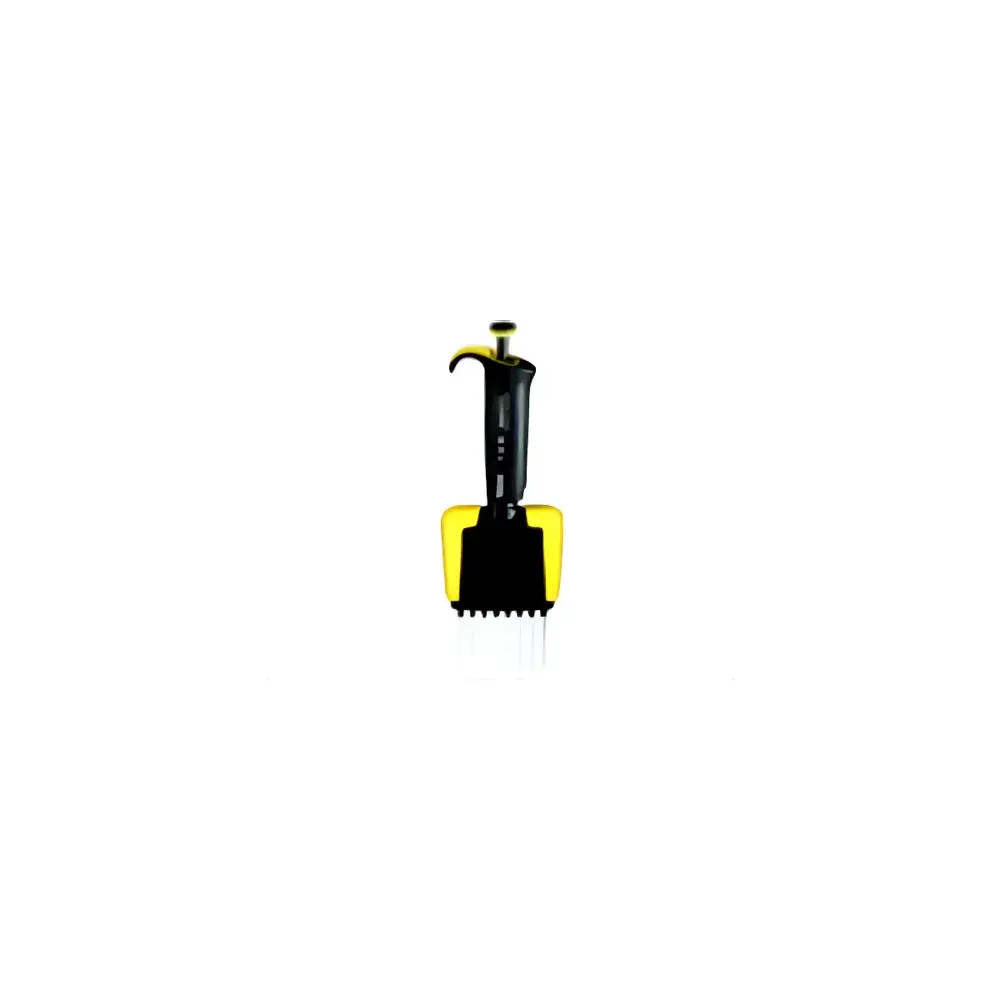
Thermo Scientific Finnpipette F2 Multichannel Pipette
| Brand | Thermo Fisher Scientific |
|---|---|
| Origin | USA |
| Model | Finnpipette F2 Multichannel Pipette |
| Channel Options | 8, 12, and 16 channels |
| Sterilization | Fully autoclavable (121 °C, 20 min) |
| Display | Ergovisio high-contrast LCD (black background, white digits) |
| Volume Adjustment | Independent dual-control volume selector with rotary cap lock |
| Blow-out Function | Enhanced piston-driven blow-out for volumes ≤50 µL |
| Ergonomics | Wide finger rest, low-force pipetting action, optimized weight distribution |
| Compliance | ISO 8655 compliant |
| Calibration | Factory-calibrated per ISO 8655-2 |
Overview
The Thermo Scientific Finnpipette F2 Multichannel Pipette is an ISO 8655–compliant precision liquid handling instrument engineered for reproducible, high-throughput multichannel dispensing in molecular biology, clinical diagnostics, drug discovery, and quality control laboratories. Designed around a robust mechanical architecture and a patented Auto-Volume-Guard (AVG) system — a self-contained, independent volume adjustment mechanism — the F2 ensures volumetric stability across repeated operations without drift or unintended setting changes. Its core operating principle relies on air displacement with a thermally stable, corrosion-resistant stainless-steel piston assembly and chemically inert PTFE seals, enabling consistent aspiration and dispensing across aqueous, viscous, and volatile liquids. Unlike modular or semi-autoclavable designs, the F2 is fully autoclavable as a single unit at 121 °C for 20 minutes, eliminating disassembly risks and maintaining metrological integrity post-sterilization.
Key Features
- Ergovisio High-Contrast Display: Large backlit LCD with black background and white numerals ensures legibility under varied lighting conditions, including laminar flow hoods and biosafety cabinets.
- Dual-Control Volume Adjustment: A primary thumbwheel and secondary rotary cap provide tactile feedback and mechanical interlock to prevent accidental volume changes during operation.
- Enhanced Blow-Out Mechanism: For volumes ≤50 µL, the F2 employs a dedicated high-torque piston stroke extension that fully evacuates residual liquid from tips — critical for low-volume assays such as qPCR setup and ELISA plate seeding.
- Full Autoclavability: All components — including shaft, tip cone, plunger, and housing — are rated for repeated steam sterilization without degradation of accuracy or seal integrity.
- Ergonomic Design: Weight distribution, wide finger rest geometry, and reduced actuation force (<15 N for full stroke) minimize operator fatigue during prolonged use, supporting GLP-compliant workflow sustainability.
- Tool-Free Calibration: Internal calibration is accessible via a sealed port; certified adjustments can be performed in-house using traceable standards, reducing downtime and external service dependency.
Sample Compatibility & Compliance
The Finnpipette F2 supports standard conical polypropylene tips (including low-retention and filtered variants) across its full volume range (model-dependent, e.g., 0.5–20 µL, 5–200 µL, or 50–1000 µL). It maintains performance with ethanol, DMSO, glycerol solutions, and serum-containing buffers, provided tip immersion depth and dwell time follow ISO 8655–recommended protocols. The device complies with ISO 8655-1 (general requirements), ISO 8655-2 (volumetric performance testing), and ISO 8655-5 (calibration procedures). Its construction materials meet USP Class VI biocompatibility standards, and the design supports audit readiness for FDA 21 CFR Part 11–aligned environments when paired with validated electronic lab notebook (ELN) integration.
Software & Data Management
While the F2 is a manual, non-electronic pipette, its calibration history, maintenance logs, and sterilization cycles are designed to integrate into laboratory quality management systems (QMS). Each unit carries a unique serial number engraved on the body and encoded in a tamper-evident QR label, enabling traceability in LIMS or paper-based SOP records. Thermo Fisher provides downloadable calibration templates aligned with ISO/IEC 17025 documentation requirements, and optional digital calibration kits (e.g., gravimetric verification modules with certified weights and analytical balances) support periodic verification in accordance with internal QA policies.
Applications
The F2 is routinely deployed in applications demanding parallel precision: 96-well and 384-well plate filling for cell culture passaging and transfection; serial dilution workflows in assay development; high-density sample preparation for NGS library construction; and QC release testing of biologics where inter-well consistency directly impacts statistical power. Its blow-out reliability at sub-10 µL volumes makes it particularly suited for CRISPR gRNA complex assembly and microfluidic chip priming. In regulated environments, its full autoclavability and ISO 8655 traceability support validation protocols required by pharmaceutical manufacturers operating under ICH Q5A and EU Annex 1 guidelines.
FAQ
Is the Finnpipette F2 compatible with third-party pipette tips?
Yes — it accepts industry-standard conical tips meeting ISO 8655 tip fit specifications; however, optimal accuracy and blow-out performance are guaranteed only with Thermo Fisher-certified Finntips.
Can the F2 be calibrated in-house without sending it to a service center?
Yes — the tool-free calibration port allows qualified personnel to perform volume adjustments per ISO 8655-5 using certified reference standards and gravimetric methods.
Does full autoclaving affect long-term accuracy?
No — the F2’s thermal expansion characteristics and material selection have been validated over 500 autoclave cycles; post-sterilization verification shows no statistically significant deviation from initial calibration (p > 0.05, n = 12 units, t-test).
What is the recommended recalibration interval?
Annual recalibration is advised for routine use; more frequent verification (e.g., quarterly) is required in GMP environments or following impact events or extended tip-ejection cycles.
How does the AVG system differ from conventional volume adjustment mechanisms?
The AVG isolates volume selection from the piston drive train, eliminating mechanical coupling between adjustment and aspiration — thereby preventing inadvertent volume shifts during tip attachment or repetitive dispensing.



