
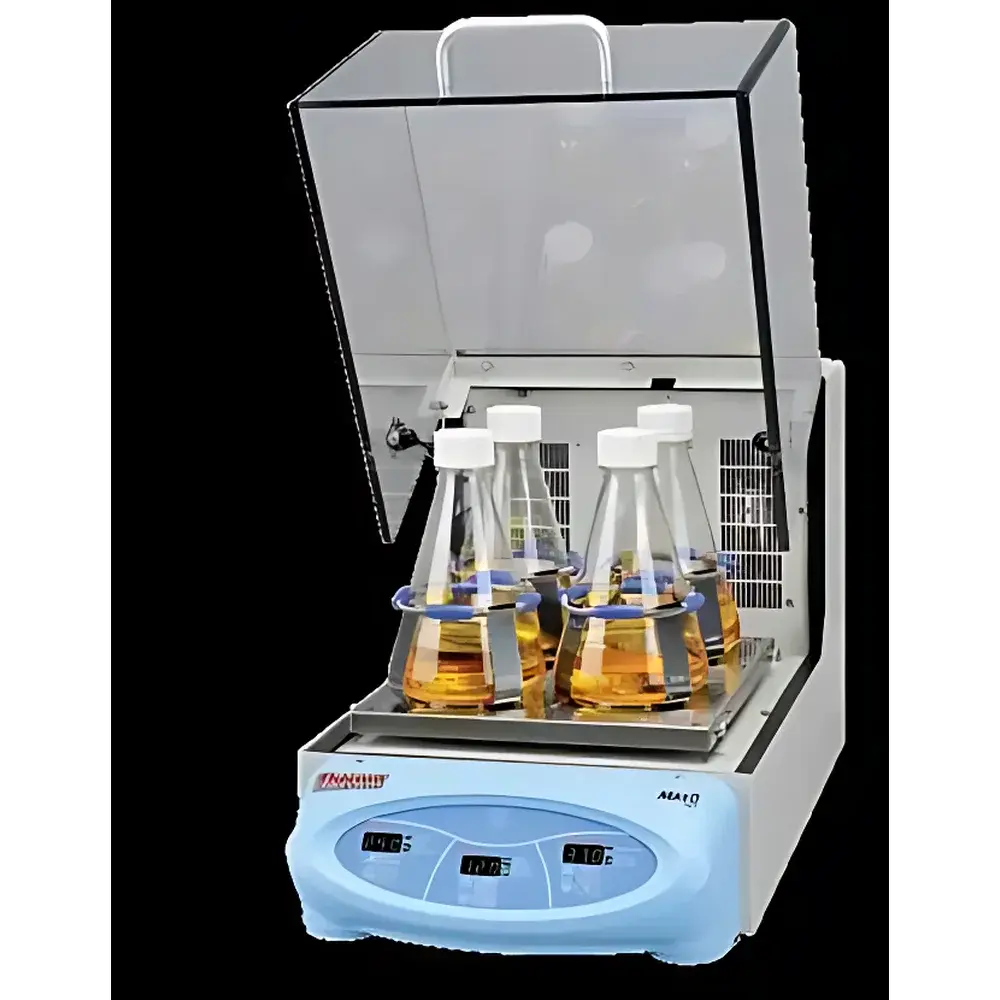
Thermo Scientific MaxQ 4450 Benchtop Refrigerated Orbital Shaker
| Brand | Thermo Fisher |
|---|---|
| Origin | USA |
| Manufacturer | Thermo Fisher Scientific |
| Product Type | Refrigerated Orbital Shaker |
| Model | MaxQ 4450 |
| Temperature Range (with cooling circulator) | 20–30 °C |
| Cooling Capability | With optional chiller coil for sub-ambient operation |
| Capacity | Up to four 1 L flasks |
| Drive Mechanism | Orbital motion |
| Footprint | Compact benchtop design |
| Viewing Window | Transparent acrylic lid |
| Compliance | Designed for GLP-compliant labs, compatible with ISO/IEC 17025 documentation workflows |
Overview
The Thermo Scientific MaxQ 4450 Benchtop Refrigerated Orbital Shaker is an engineered solution for controlled, low-footprint incubation and agitation of biological samples in research and quality control laboratories. It operates on the principle of orbital shaking—generating uniform, circular motion at precise amplitude and speed—to ensure consistent suspension, aeration, and mixing of microbial cultures, mammalian cell suspensions, and biochemical reaction mixtures. Unlike generic shakers, the MaxQ 4450 integrates temperature regulation with mechanical agitation, enabling users to maintain samples within defined thermal boundaries during dynamic incubation. Its compact footprint (approximately 40 × 45 × 28 cm) allows deployment on standard laboratory benches without requiring dedicated environmental enclosures. The unit supports both ambient and sub-ambient operation: when connected to an external recirculating chiller, it achieves stable setpoints from 20 °C to 30 °C; with the optional integrated cooling coil, it extends functionality into refrigerated ranges suitable for cold-sensitive applications such as plasmid stabilization and recombinant protein expression in E. coli.
Key Features
- Orbital drive mechanism with adjustable speed range (typically 25–300 rpm, factory-calibrated per unit specification sheet)
- Stainless steel platform with universal clamping system accommodating flask sizes from 125 mL to 1 L (up to four 1 L Erlenmeyer flasks simultaneously)
- Transparent acrylic lid providing real-time visual monitoring without compromising chamber integrity or temperature stability
- Microprocessor-controlled PID temperature regulation with ±0.5 °C accuracy across operating range
- Optional chiller coil interface compliant with standard industrial coolant loops (e.g., Thermo Scientific Polyscience 46 series chillers)
- Integrated safety features including imbalance detection, over-temperature cutoff, and automatic shutdown upon lid opening
- CE-marked and RoHS-compliant construction aligned with IEC 61010-1 safety standards for laboratory equipment
Sample Compatibility & Compliance
The MaxQ 4450 is validated for use with standard borosilicate glass and PETG culture vessels, including baffled flasks, test tubes, and deep-well microplates (with appropriate adapter plates). It supports common microbiological media (LB, TB, M9), suspension cell culture media (e.g., FreeStyle™ CHO), and enzymatic assay buffers. From a regulatory perspective, the instrument’s firmware architecture supports audit-trail-capable operation when paired with Thermo Fisher’s ChronoSync™ data logging software (sold separately), fulfilling traceability requirements under FDA 21 CFR Part 11 for electronic records. Its mechanical and thermal performance adheres to ASTM E1509–22 (Standard Practice for Performance Testing of Laboratory Shaking Incubators), and routine calibration can be documented per ISO/IEC 17025 guidelines for accredited testing laboratories.
Software & Data Management
While the MaxQ 4450 operates via intuitive front-panel controls (digital display, rotary encoder, and membrane keypad), it is designed for integration into networked lab environments. Optional RS-232 or USB-to-serial interfaces enable connection to LIMS or ELN systems for automated parameter logging. When used with ChronoSync™ software, users can schedule multi-step protocols (e.g., ramp-and-hold temperature profiles synchronized with speed changes), export timestamped CSV datasets, and generate PDF reports compliant with GLP documentation templates. All logged parameters—including actual vs. setpoint temperature, rotational speed, runtime, and error codes—are stored with user-defined metadata tags (operator ID, batch number, experiment ID).
Applications
- Bacterial and yeast culture expansion under controlled aeration and temperature
- Induction of recombinant protein expression at low temperatures (16–20 °C) to improve solubility and reduce inclusion body formation
- Plasmid DNA purification workflows requiring cold-phase lysis and neutralization steps
- Enzyme kinetics assays where substrate homogeneity and thermal consistency directly affect Vmax and Km reproducibility
- Antibiotic susceptibility testing (AST) using broth microdilution formats with continuous agitation
- Cell line adaptation studies involving gradual temperature or agitation stress exposure
FAQ
What is the maximum load capacity for unevenly distributed flasks?
The platform is rated for up to 4 kg total mass; however, optimal performance requires symmetrical loading. Imbalance >150 g per side triggers automatic deceleration and audible alert.
Can the MaxQ 4450 operate without an external chiller?
Yes—it functions as a standard ambient-orbital shaker (20–40 °C range) without cooling accessories. Sub-ambient operation requires either the internal chiller coil kit or external recirculating chiller.
Is firmware upgrade supported in-field?
Firmware updates are performed via USB flash drive using Thermo Fisher’s certified update utility; version history and validation reports are available through the Instrument Support Portal.
Does the unit meet GMP facility requirements for equipment qualification?
Yes—the MaxQ 4450 ships with IQ/OQ documentation templates and supports PQ execution per Annex 15 of EU GMP Guidelines when operated with calibrated reference thermometers and tachometers.
What maintenance intervals are recommended?
Annual verification of speed accuracy (±1 rpm tolerance) and temperature uniformity (±0.8 °C across platform) is advised; drive belt inspection every 18 months; no lubrication required for brushless DC motor.





