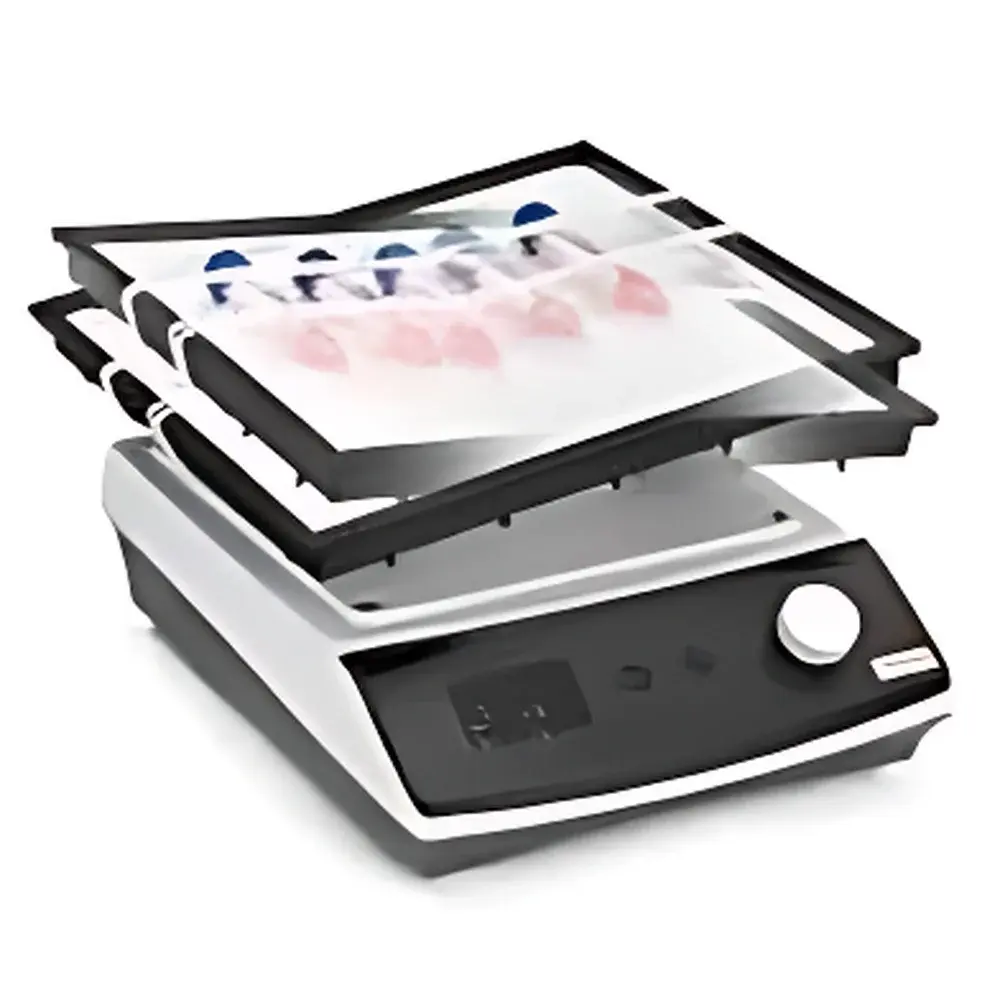
Thermo Scientific Orbital Shaker with Photoelectric Speed Control
| Brand | Thermo Fisher Scientific |
|---|---|
| Origin | South Korea |
| Manufacturer Type | Original Equipment Manufacturer (OEM) |
| Product Category | Imported Instrument |
| Model | Thermo Scientific Orbital Shaker with Photoelectric Speed Control |
| Price Range | USD 700–1,400 (FOB) |
| Instrument Type | General-Purpose Orbital Shaker |
| Timer Range | 1 min to 99 hrs 59 min or Continuous Operation |
| Oscillation Speed | 5–100 rpm |
| Tilt Angle | 7°–13° |
| Maximum Operating Temperature | ≤60 °C |
| Platform Count | 1 |
Overview
The Thermo Scientific Orbital Shaker with Photoelectric Speed Control is a precision-engineered benchtop orbital shaker designed for consistent, low-shear mixing of biological and chemical samples in incubators, cold rooms, and standard laboratory environments. Unlike conventional mechanical or potentiometer-based speed controls, this unit employs an integrated photoelectric sensor system that continuously monitors platform rotation and delivers real-time feedback to the PID (Proportional-Integral-Derivative) controller—ensuring stable rotational velocity across the full 5–100 rpm range, even under variable load conditions or ambient temperature fluctuations. Its compact footprint (W × D × H ≈ 28 × 30 × 14 cm) and shallow depth allow seamless integration into refrigerated incubators (non-CO2) and environmental chambers operating up to 60 °C, making it suitable for long-term cell culture maintenance, enzyme kinetics assays, immunoassay plate preparation, and microbial suspension homogenization.
Key Features
- PID-Controlled Photoelectric Speed Regulation: Eliminates speed drift and overshoot; maintains ±1 rpm stability over time and across varying sample volumes (10 mL–2 L).
- Adjustable Tilt Angle (7°–13°): Optimizes mixing efficiency for viscous or sediment-prone samples while minimizing splashing and foam formation in low-volume tubes and microplates.
- Wide Timer Flexibility: Programmable timer supports discrete intervals from 1 minute to 99 hours and 59 minutes—or fully continuous operation with automatic shutdown override via front-panel key lock.
- Thermally Stable Construction: Aluminum alloy chassis and reinforced polymer housing dissipate heat efficiently, enabling uninterrupted operation at ambient temperatures up to 60 °C without performance degradation.
- Modular Platform Design: Single-platform configuration includes a standard 250 × 250 mm stainless steel tray, non-slip silicone mat, and two reusable elastomeric retention rings for secure positioning of flasks, tubes, and multiwell plates.
Sample Compatibility & Compliance
This shaker accommodates a broad range of vessel formats—including Erlenmeyer flasks (up to 2 L), centrifuge tubes (15–50 mL), deep-well plates, and Petri dishes—without requiring adapter kits. The smooth orbital motion (nominal 20 mm diameter) ensures uniform suspension without vortexing or excessive shear stress, critical for maintaining viability in mammalian cell cultures and preserving antigen integrity in ELISA workflows. The device complies with IEC 61010-1:2010 for laboratory electrical equipment safety and meets electromagnetic compatibility (EMC) requirements per EN 61326-1:2013. While not certified for use inside CO2 incubators due to gas-seal interference risks, it is validated for operation in standard microbiological incubators, cold rooms (4 °C), and humidity-controlled chambers.
Software & Data Management
This is a stand-alone analog/digital hybrid instrument with no embedded software or network interface. All operational parameters are configured locally via intuitive rotary encoder and LED display. However, its precise repeatability and traceable PID calibration support GLP-compliant documentation when used in regulated environments. Users may log run parameters (speed, angle, duration, date/time) manually or integrate with external data acquisition systems via optional 0–10 V analog output (available on select configurations). For audit-trail requirements under FDA 21 CFR Part 11, external electronic lab notebook (ELN) platforms can capture timestamps and operator IDs during manual entry—consistent with routine QC/QA practices in pharmaceutical and clinical diagnostics labs.
Applications
- Maintenance of suspension-adapted mammalian and insect cell lines during passaging and transfection protocols.
- Homogenization of bacterial cultures prior to DNA extraction or protein expression induction.
- Equilibration of antibody-antigen binding reactions in sandwich ELISAs and lateral flow assay development.
- Rehydration and dispersion of lyophilized reagents, standards, and reference materials.
- Low-shear mixing of hydrogels, nanoparticle suspensions, and viscosity-modified buffers for rheological pre-conditioning.
FAQ
Can this shaker be operated inside a CO2 incubator?
No. Due to potential interference with CO2 sensor calibration and chamber seal integrity, this model is explicitly rated for non-CO2 incubators only.
Is the tilt angle adjustable during operation?
Yes—the 7°–13° inclination is manually set prior to startup using the calibrated dual-knob mechanism and remains fixed during runtime.
What is the maximum load capacity per platform?
The platform supports up to 5 kg distributed evenly; exceeding this may compromise speed accuracy and long-term motor reliability.
Does the unit include validation documentation for GxP environments?
Factory-installed calibration certificates (traceable to NIST standards) are available upon request; IQ/OQ protocols must be performed by end users per internal SOPs.
Are replacement trays or custom platform inserts available?
Yes—Thermo Fisher offers optional microplate carriers, flask clamps, and autoclavable stainless-steel trays through authorized distribution channels.