
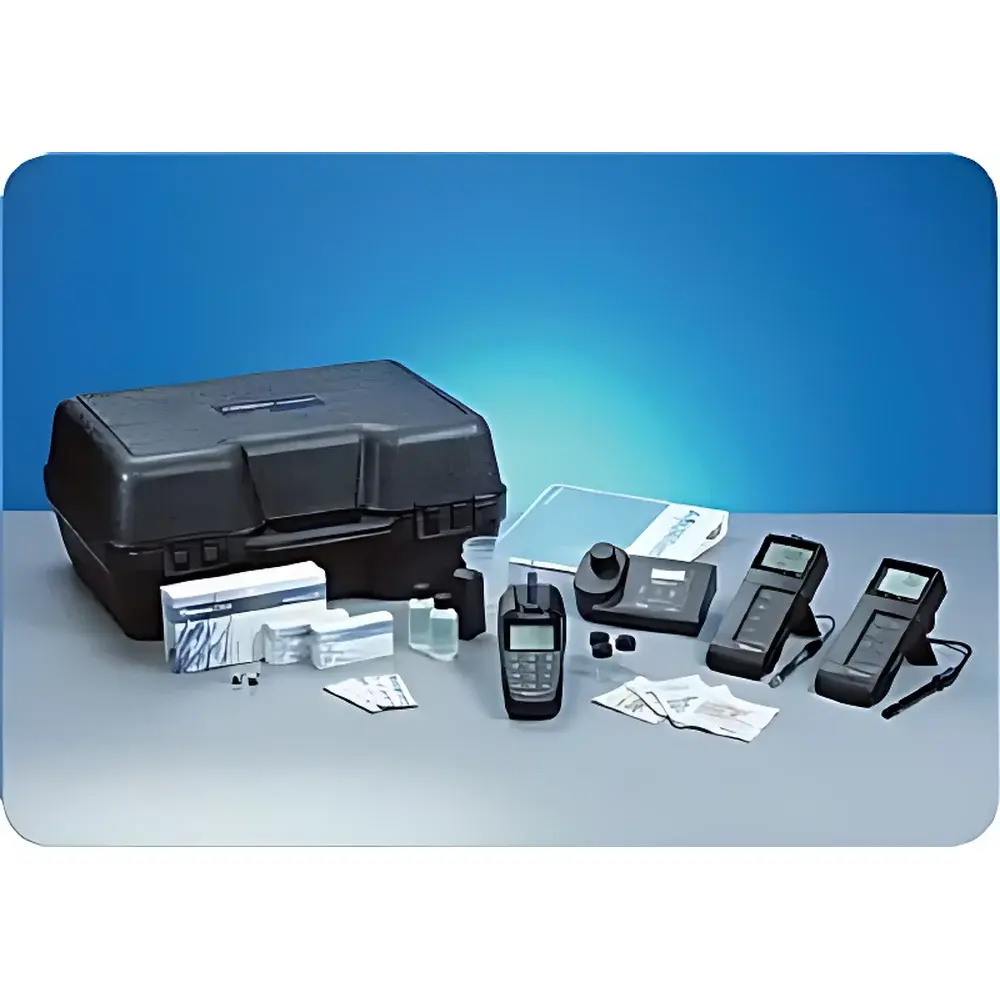
Thermo Scientific Orion AQ4EK1 Mobile Water Quality Laboratory
| Brand | Thermo Fisher Scientific |
|---|---|
| Origin | USA |
| Manufacturer Type | Original Equipment Manufacturer (OEM) |
| Product Category | Imported Instrumentation |
| Model | AQ4EK1 |
| Pricing | Available Upon Request |
| Conductivity Range | 0–20.00 / 200.0 / 2000 µS/cm |
| Conductivity Resolution | 0.01 / 0.1 / 1 µS/cm |
| Conductivity Accuracy | ±1% of Full Scale |
| pH Range | 0.00–14.00 pH |
| pH Resolution | 0.01 pH |
| pH Accuracy | ±0.01 pH |
| pH Electrode Slope | 80–120% |
| mV Range | –1000 to +1000 mV |
| mV Resolution | 1 mV |
| mV Accuracy | ±2 mV |
| Temperature Range (pH/Conductivity) | –10.0–110.0 °C (Conductivity), 0.0–100.0 °C (pH) |
| Temperature Resolution/Accuracy | 0.1 °C / ±0.5 °C |
| Temperature Compensation | Automatic or Manual (0–50 °C for conductivity |
| Cell Constant Options | 0.1, 1.0, 10.0 cm⁻¹ |
| Reference Temperature Options | 20.0 °C or 25.0 °C |
| Conductivity Calibration Points | Up to 1 per range, max 5 total |
| pH Calibration Points | 1–3 points |
| Buffer Standards | USA (pH 4.01, 7.00, 10.01), NIST (pH 4.01, 6.88, 9.18), Pb (pH 4.10, 6.97) |
| Auto-Range Switching | Yes |
| Data Hold Function | Yes |
| Auto-Power-Off | 17 min (pH/mV), 20 min (conductivity) |
| Low-Battery Indicator | Yes (“LO” display) |
| Power Supply | 4 × AAA alkaline batteries |
| Battery Life | >500 h (pH/mV mode), >100 h (conductivity mode) |
| Dimensions | 14 × 7 × 3.5 cm |
| Weight | 200 g |
| Interface | BNC (conductivity sensor), needle-type thermistor port (temperature probe) |
| Display | Custom monochrome LCD |
Overview
The Thermo Scientific Orion AQ4EK1 Mobile Water Quality Laboratory is a purpose-built, field-deployable analytical platform engineered for environmental monitoring professionals, municipal water operators, and regulatory compliance personnel requiring rapid, reliable, and standardized measurements in non-laboratory settings. Unlike conventional single-parameter handheld meters, the AQ4EK1 integrates four core measurement modules—pH, conductivity, turbidity (via optional AQUAMate integration), and colorimetric multi-parameter analysis (via the AQ4000 spectrophotometric platform)—into a unified, ruggedized system housed in a portable carrying case. Its architecture follows the principles of electrochemical potentiometry (for pH and mV), conductimetry (for conductivity and TDS), and absorbance-based photometry (for colorimetric assays), all calibrated and validated against traceable reference standards. Designed for GLP-aligned workflows, the system supports audit-ready data capture and meets foundational requirements for field testing under EPA Methods 120.1 (pH), 123.1 (conductivity), and 180.1 (turbidity), as well as ASTM D1129 and ISO 7888.
Key Features
- Integrated dual-function instrumentation: Simultaneous operation of high-accuracy pH/conductivity meter (Orion AQ4000 base unit) and dedicated colorimetric analyzer (AQ4000 optical module) within one ergonomic chassis.
- Field-optimized calibration management: Pre-programmed buffer recognition for USA, NIST, and Pb-standard pH buffers; auto-detection eliminates manual standard selection errors.
- Multi-range conductivity capability with selectable cell constants (0.1, 1.0, 10.0 cm⁻¹), enabling precise low-conductivity (e.g., ultrapure water) and high-conductivity (e.g., brackish effluent) measurements without sensor swaps.
- Temperature-compensated readings across full operational range (–10.0 to 110.0 °C for conductivity; 0.0 to 100.0 °C for pH), with user-selectable reference temperatures (20.0 or 25.0 °C) and adjustable linear compensation coefficients (0.0–3.0 %/°C).
- Ruggedized design compliant with IP67 ingress protection when closed, shock-absorbing housing, and low-power electronics optimized for extended battery life (>500 hours in pH mode).
- Expandable assay library: Firmware-upgradable method database via USB or optional Wi-Fi dongle; supports over 30 EPA- and ISO-compliant colorimetric methods including chlorine, nitrate, phosphate, iron, fluoride, and sulfate.
Sample Compatibility & Compliance
The AQ4EK1 accommodates liquid samples from diverse matrices—including raw surface water, treated drinking water, wastewater effluents, groundwater, and industrial process streams—with minimal pretreatment. Sample volumes range from 5 mL (for vial-based colorimetry) to direct immersion (for pH/conductivity probes). All included reagents (e.g., AC4070 for free/total chlorine, AC4095 for orthophosphate) are manufactured under ISO 13485-certified processes and supplied with lot-specific certificate of analysis. The system supports 21 CFR Part 11–compliant electronic records when paired with Thermo Fisher’s TraceFinder software suite (optional add-on), enabling signature-capable audit trails, user access control, and secure data export in CSV or PDF formats. It conforms to US EPA guidance for field-portable instruments used in Unregulated Contaminant Monitoring Rule (UCMR) sampling and State Revolving Fund (SRF) reporting protocols.
Software & Data Management
Data acquisition is managed through the embedded AQ4000 firmware, supporting on-device storage of up to 500 measurement records with timestamp, operator ID, location tag (via optional Bluetooth GPS pairing), and method identifier. Export options include micro-USB transfer to Windows-based desktop software (Orion LabLink Pro), direct printing via Bluetooth thermal printers, and cloud synchronization using Thermo Fisher’s Connect Platform (subscription required). Firmware updates preserve calibration history and user-defined method configurations. All stored data includes metadata fields required for ISO/IEC 17025 accreditation—such as instrument ID, sensor serial numbers, calibration dates, and uncertainty estimates derived from certified reference materials.
Applications
- Municipal water utility field verification: Rapid assessment of disinfectant residual (free/total chlorine), pH stability, conductivity-derived TDS, and turbidity at distribution points or hydrant flush sites.
- Environmental site assessments: On-site screening for heavy metals (copper, iron, manganese), nutrients (nitrate, phosphate), and anions (sulfate, fluoride) during Phase I/II ESA investigations.
- Wastewater treatment plant troubleshooting: Real-time monitoring of influent/effluent alkalinity, ammonia nitrogen, and sulfide levels to support biological process control.
- Educational and training deployments: Modular configuration enables pedagogical use across environmental science curricula, emphasizing method validation, matrix interference evaluation, and QA/QC practice (e.g., spike recovery, duplicate analysis).
- Emergency response scenarios: Rapid deployment for post-disaster water safety evaluation following floods, chemical spills, or infrastructure failure—validated for use in WHO Emergency Response Protocols.
FAQ
Is the AQ4EK1 compliant with drinking water regulations such as the U.S. Safe Drinking Water Act (SDWA)?
Yes—the instrument’s measurement protocols align with EPA-approved methods referenced in 40 CFR Part 141, and its calibration traceability supports compliance documentation for state primacy agencies.
Can the AQ4EK1 be used for saline or seawater samples?
Conductivity measurements are supported up to 200 mS/cm using the 10.0 cm⁻¹ cell constant; however, chloride interference in colorimetric assays (e.g., nitrate, phosphate) requires matrix-matched calibration or dilution for seawater applications.
Does the system support GLP audit requirements?
When configured with password-protected user accounts, electronic signatures, and enabled audit trail logging, the AQ4EK1 meets core GLP principles for field instrumentation per OECD Series on Principles of Good Laboratory Practice.
What is the warranty coverage and service support structure?
Thermo Fisher provides a standard 2-year limited warranty covering parts and labor; extended service plans with next-business-day on-site technician dispatch are available through authorized regional service centers in North America, EMEA, and APAC.
Are replacement electrodes and sensors available with NIST-traceable calibration certificates?
Yes—all Orion pH electrodes (e.g., ROSS Ultra), conductivity cells, and temperature probes ship with individual CoA referencing NIST SRM 1912a (pH) and NIST SRM 3194 (conductivity).
Related Products







