
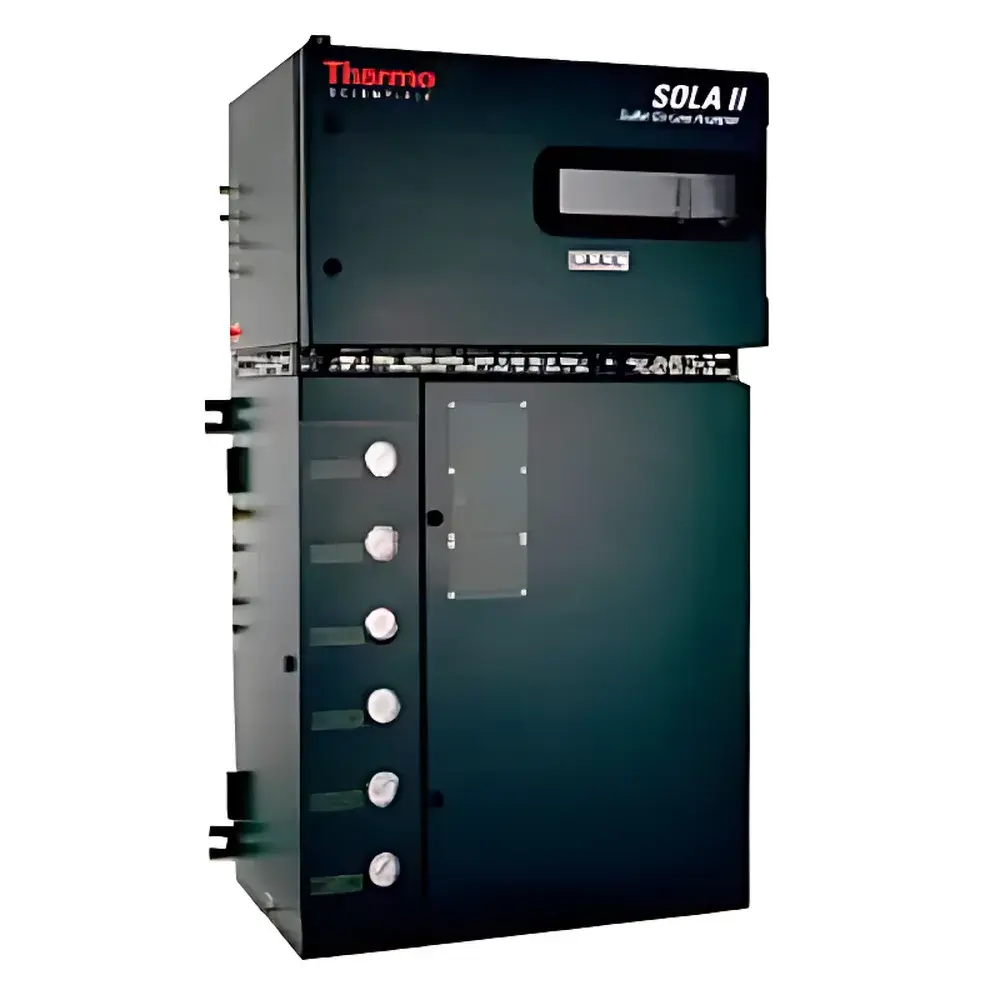
Thermo Scientific SOLA II Online Total Sulfur Analyzer
| Brand | Thermo Fisher |
|---|---|
| Origin | USA |
| Model | SOLA II |
| Measurement Principle | Pulsed UV Fluorescence (PUVF) |
| Detection Range | 0.25–9000 ppm S (standard), down to 25 ppb S (Trace variant) |
| Response Time | T90 ≤ 3–5 min |
| Sample Types | Liquid hydrocarbons (e.g., gasoline, diesel, naphtha), gaseous streams (e.g., flare gas, refinery off-gas) |
| Output Signals | 4–20 mA, Modbus RTU/TCP, semi-continuous I/O |
| Density Compensation | Yes (via external densitometer input, e.g., Sarasota FD910) |
| Auto-Calibration | Yes |
| Diagnostic Capabilities | Valve leak detection, UV lamp intensity feedback control, PMT health monitoring, real-time system diagnostics |
| Compliance | ASTM D5453, ISO 20846, USP <621>, GLP/GMP-ready data integrity features (audit trail, user access control, electronic signatures via SOLAWeb) |
Overview
The Thermo Scientific SOLA II Online Total Sulfur Analyzer is an industrial-grade process analytical instrument engineered for continuous, real-time quantification of total sulfur content in liquid and gaseous hydrocarbon streams. It employs Pulsed Ultraviolet Fluorescence (PUVF) spectroscopy—a rigorously validated physicochemical measurement principle—where sulfur-containing compounds are thermally cracked at 1100 °C to generate SO2, which is then excited by pulsed UV light (hν1) and emits characteristic fluorescence (hν2) proportional to sulfur concentration. This method delivers high specificity, minimal interferences, and long-term baseline stability due to active UV source intensity regulation via photodiode feedback. Designed for unattended operation in demanding refinery, petrochemical, and fuel blending environments, the SOLA II replaces discrete laboratory sampling with deterministic, traceable online measurement—enabling closed-loop process control, catalyst protection, regulatory compliance reporting, and real-time emissions monitoring.
Key Features
- Pulsed UV Fluorescence (PUVF) detection with 25 ppb lower detection limit (SOLA II Trace variant) and linear dynamic range spanning 0.25–9000 ppm S
- No pure oxygen requirement—eliminates combustion-related safety hazards associated with alternative oxidative methods
- Integrated density compensation capability via analog or Modbus input from certified densitometers (e.g., Sarasota FD910), enabling accurate wt/wt % → ppmS conversion for liquid fuels
- Automatic valve leak detection and mitigation protocol: real-time assessment of sample loop integrity; automatic purge initiation upon fault detection to prevent detector fouling
- Self-regulating UV lamp intensity control using closed-loop photodiode feedback—ensures signal stability over extended calibration intervals
- Onboard auto-calibration with dual standard gases or liquids, supporting scheduled or event-triggered recalibration without manual intervention
- Proven field reliability: >99% uptime in multi-year refinery deployments under ambient temperature fluctuations, vibration, and variable sample matrix conditions
Sample Compatibility & Compliance
The SOLA II accommodates a broad spectrum of process streams including straight-run gasoline, hydrotreated diesel, reformate, naphtha, LPG, natural gas, and flare gas—with no sample conditioning required beyond standard filtration and moisture removal. Its performance has been independently verified against reference methods per ASTM D5453 (UV fluorescence), ISO 20846 (automotive fuels), ASTM D6313 (lead acetate colorimetry), and WDXRF protocols. The analyzer meets functional safety requirements for hazardous area installation (Class I, Div 1/Zone 1), supports 21 CFR Part 11-compliant data handling when used with SOLAWeb, and provides full audit trail functionality—including user login history, parameter change logs, calibration records, and alarm timestamps—to satisfy GLP and GMP validation requirements.
Software & Data Management
SOLAWeb is a browser-based, zero-installation HMI that communicates with the analyzer via standard Ethernet (TCP/IP). It provides full remote access to all operational parameters—including PMT voltage, UV lamp current, detector temperature, raw fluorescence signal amplitude, carrier gas flow rate, and diagnostic flags—without requiring proprietary client software. Users can export 24-hour trend data (with sub-minute resolution), configure alarm thresholds, schedule calibrations, and generate PDF reports compliant with internal QA documentation standards. When deployed behind corporate firewalls or connected via secure modem links, SOLAWeb enables Tier-2 technical support personnel to perform root-cause analysis remotely—reducing mean time to repair (MTTR) by up to 70% compared to traditional site visits. All configuration changes and data exports are timestamped and digitally signed to ensure ALCOA+ data integrity principles.
Applications
- Fuel desulfurization control: Real-time monitoring of hydrotreater effluent to maintain product sulfur below regulatory limits (e.g., ULSD at ≤15 ppm S)
- Catalyst protection: Trace-level sulfur monitoring (<100 ppb) of feedstocks entering sensitive catalytic units (e.g., reformers, isomerization reactors) to extend catalyst life and reduce unplanned shutdowns
- Flare gas compliance: Dynamic measurement across 10 ppm–95% H2S/SO2 range for EPA Title V and EU IED reporting
- Batch blending verification: Dual-stream analysis mode allows simultaneous monitoring of inlet and outlet streams during tank farm blending operations
- Crude assay support: Correlation of online sulfur trends with lab assays to refine crude valuation models and optimize distillation cut points
FAQ
What is the minimum detectable sulfur concentration for the standard SOLA II configuration?
The base model achieves a method detection limit of 0.25 ppm S; the SOLA II Trace variant extends sensitivity to 25 ppb S through optimized optical path design and low-noise signal processing.
Does the SOLA II require daily maintenance or consumables?
No routine consumables are required. The system operates continuously with only quarterly preventive maintenance recommended—primarily consisting of filter inspection, leak verification, and calibration verification.
Can SOLA II be integrated into a DCS using Modbus TCP?
Yes. The analyzer supports both Modbus RTU (RS-485) and Modbus TCP/IP natively, enabling direct integration with Emerson DeltaV, Honeywell Experion, Yokogawa CENTUM VP, and Siemens PCS7 systems without gateway hardware.
How does density compensation improve accuracy for liquid fuel analysis?
Since sulfur concentration in fuels is regulated on a mass basis (ppmw/w), volumetric measurements must be corrected for density variations caused by temperature, composition, or blending. SOLA II applies real-time density inputs to convert measured ppmv/v to legally compliant ppmw/w values.
Is SOLAWeb compatible with modern web browsers and mobile devices?
SOLAWeb is HTML5-compliant and fully responsive—it functions identically on Chrome, Edge, Firefox, Safari, and iOS/Android tablets without plugins or app downloads.





