
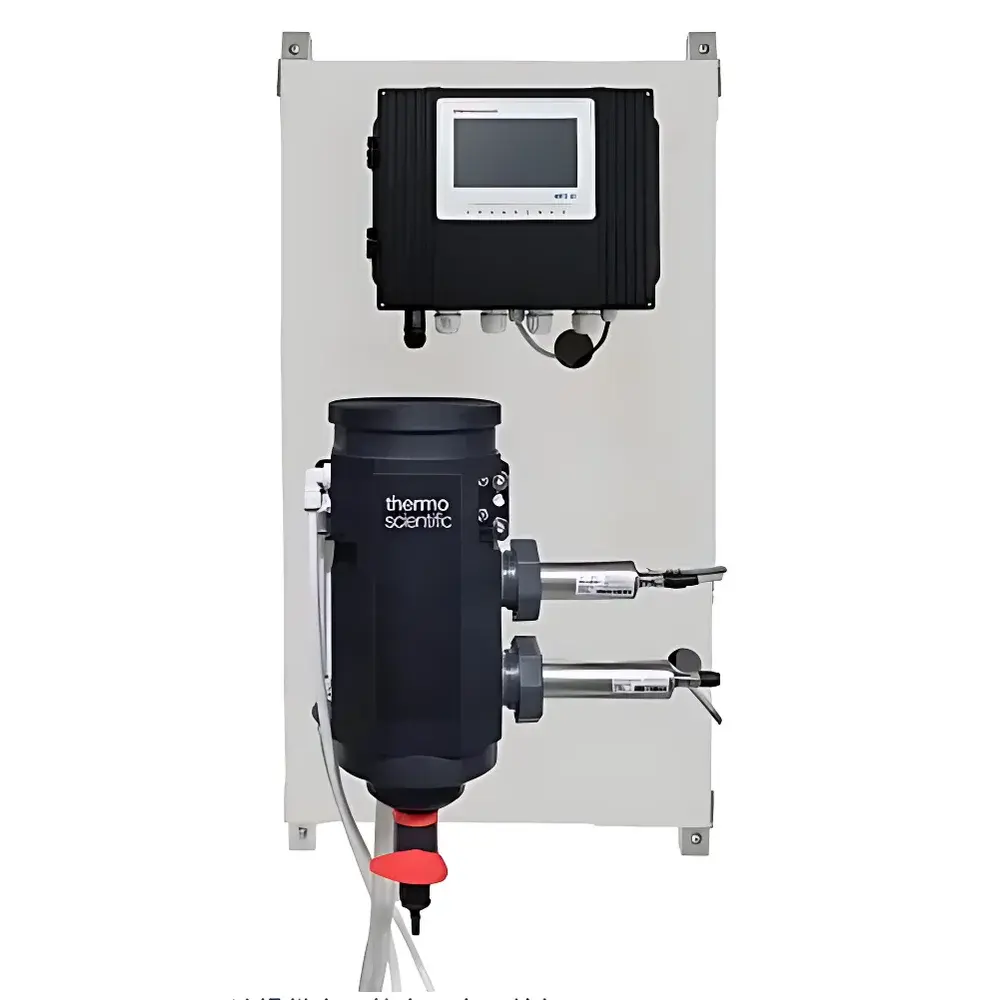
Thermo Scientific™ TSTIO1000 Online Integrated pH, Residual Chlorine, and Turbidity Analyzer
| Brand | Thermo Fisher |
|---|---|
| Origin | Shanghai, China |
| Manufacturer Type | Original Equipment Manufacturer (OEM) |
| Product Category | Domestic |
| Model | Thermo Scientific™ TSTIO1000 |
| Instrument Type | Online Analyzer |
| Measurement Principle | Electrochemical Sensing (pH & residual chlorine) + 90° Nephelometric Light Scattering (turbidity) |
| Measured Parameters | pH, Residual Chlorine, Turbidity, Temperature |
| Measurement Range | Residual Chlorine: 0.01–20 ppm |
| Accuracy | ±0.01 ppm or ±2% of Full Scale |
| Repeatability | ±2% |
| Resolution | 0.01 ppm |
| Detection Limit | 0.01 ppm |
Overview
The Thermo Scientific™ TSTIO1000 Online Integrated pH, Residual Chlorine, and Turbidity Analyzer is an engineered solution for continuous, real-time water quality monitoring in municipal drinking water distribution systems, potable water networks, reservoir outlets, and agricultural irrigation channels. Designed to meet the operational demands of non-industrial, low-maintenance environments, the system integrates three critical water quality parameters—pH, free residual chlorine, and turbidity—into a single compact analyzer platform. Its measurement architecture combines potentiometric electrochemical sensing for pH and residual chlorine with standardized 90° nephelometric detection for turbidity, aligned with USEPA Method 180.1. The analyzer operates under constant-pressure, constant-flow hydraulic conditions within its dual-probe flow cell, ensuring stable hydrodynamic conditions essential for reproducible sensor response. Unlike laboratory-based or portable instruments, the TSTIO1000 is built for unattended, long-term deployment—supporting continuous duty cycles exceeding 12 months between routine calibrations under typical municipal water conditions.
Key Features
- Multi-parameter integration: Simultaneous, synchronized acquisition of pH, residual chlorine, turbidity, and temperature from a single instrument housing—reducing footprint, cabling complexity, and calibration overhead.
- Triple-parameter residual chlorine probe: A proprietary electrochemical sensor simultaneously outputs residual chlorine concentration, pH, and temperature—enabling real-time internal compensation for pH and thermal drift without external reference electrodes or secondary sensors.
- Membrane-free, fill-free residual chlorine sensing: Eliminates consumable membranes and electrolyte solutions—significantly reducing lifecycle maintenance costs and downtime in low-turbidity, low-organic-load potable water applications.
- Self-cleaning planar electrode geometry: Optimized electrode surface topology minimizes biofilm adhesion and particulate fouling; facilitates rapid manual or automated cleaning without disassembly.
- Dual-probe flow cell with integrated de-bubbling and particle retention: Engineered to suppress air entrainment and retain suspended solids upstream of optical and electrochemical sensing zones—ensuring signal stability across variable pressure and flow regimes.
- Backplate-mounted modular design: Enables rapid field installation on existing pipe manifolds or wall brackets with minimal civil works; occupies <0.15 m² footprint.
Sample Compatibility & Compliance
The TSTIO1000 is validated for use with clarified, filtered, and disinfected potable water streams meeting WHO and GB 5749–2022 guidelines. It is not intended for raw surface water, wastewater effluent, or high-salinity brackish sources. Turbidity measurement complies with USEPA Method 180.1 for nephelometric turbidity units (NTU), with resolution down to 0.001 NTU under calibrated flow conditions. Residual chlorine quantification adheres to ASTM D1253–21 (Standard Test Method for Determining Free and Total Residual Chlorine in Water), and pH measurement conforms to ISO 10523:2022 (Water quality — Determination of pH). The system supports GLP-compliant data logging and meets structural requirements for IP65-rated enclosures per IEC 60529.
Software & Data Management
The embedded firmware supports Modbus RTU/ASCII over RS-485 and optional 4G LTE-M communication for secure cloud telemetry via TLS 1.2 encrypted MQTT or HTTP(S) protocols. Local data storage retains ≥30 days of 1-minute interval records with timestamped audit trails—including calibration events, sensor diagnostics, and flow cell pressure logs. Optional Thermo Scientific™ WaterLink Cloud enables role-based access control, configurable alarm thresholds (e.g., chlorine 8.5), and automated PDF report generation compliant with FDA 21 CFR Part 11 Annex 11 requirements for electronic records and signatures.
Applications
- Municipal drinking water treatment plant effluent monitoring
- Real-time compliance verification at distribution network entry points (e.g., zone valves, booster stations)
- Remote irrigation intake surveillance for chlorine carryover and sediment load
- Small-scale community water systems lacking dedicated analytical laboratories
- Pre- and post-disinfection process validation in decentralized water kiosks
FAQ
Does the TSTIO1000 require regular membrane replacement or electrolyte refilling for residual chlorine measurement?
No. The electrochemical residual chlorine sensor uses a solid-state, membrane-free design with no liquid-filled compartments—eliminating scheduled consumable replacements.
Can the system operate reliably in low-flow or intermittent flow conditions?
Yes. The dual-probe flow cell incorporates hydraulic buffering and pressure-dampening features, maintaining stable sensor immersion and laminar flow even during transient flow events typical in rural distribution lines.
Is turbidity measurement affected by colored dissolved organic matter (CDOM)?
Nephelometric turbidity (90° scattering) is largely insensitive to CDOM absorption; however, high concentrations of humic substances may contribute to apparent turbidity. For such cases, correlation with spectrophotometric absorbance at 254 nm is recommended.
What calibration frequency is recommended for regulatory compliance?
Initial factory calibration is traceable to NIST standards. Field recalibration is recommended every 90 days for chlorine and pH, and every 180 days for turbidity—subject to local regulatory interpretation and historical performance data.
Does the system support integration with SCADA or PLC-based control systems?
Yes. Native Modbus RTU support allows direct integration with industry-standard supervisory control platforms without protocol gateways or middleware.







