
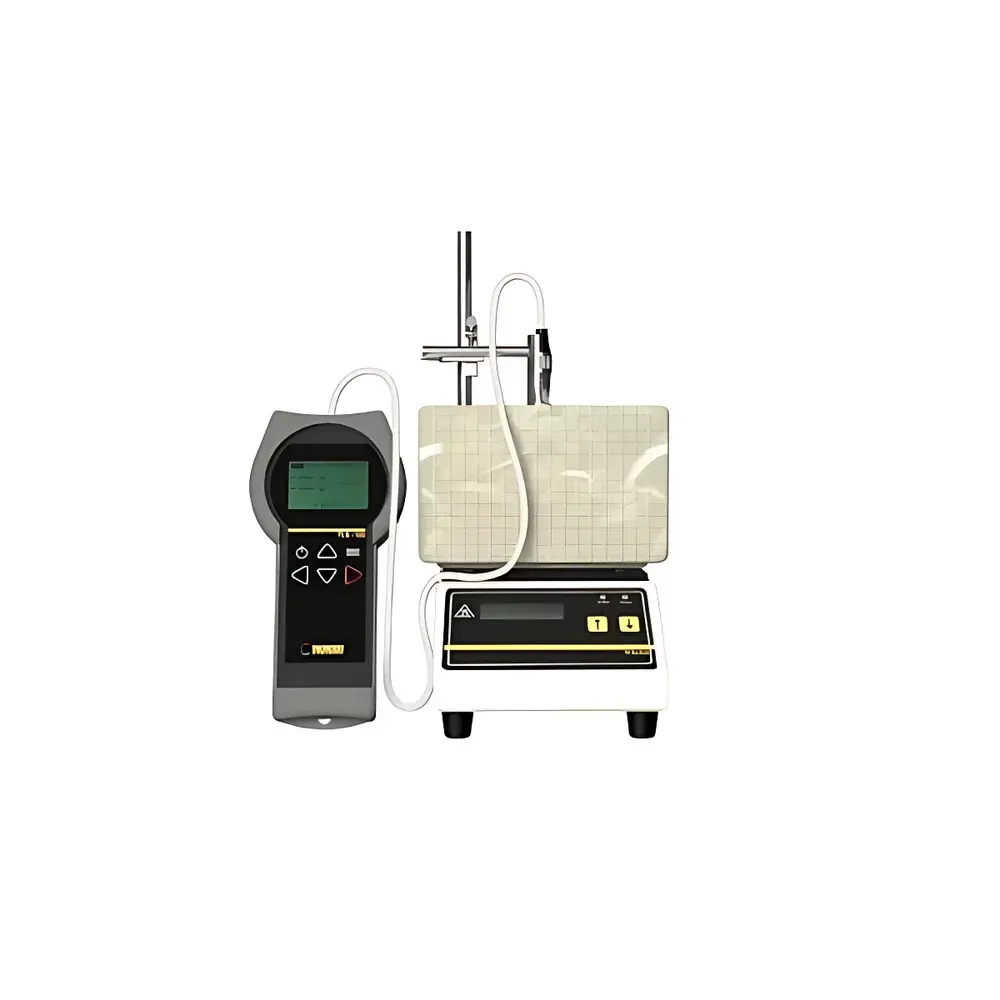
Thermtest TLS-100 Portable Transient Line Source Thermal Conductivity Analyzer
| Brand | Thermtest |
|---|---|
| Origin | Canada |
| Model | TLS-100 |
| Measurement Principle | Transient Line Source Method |
| Thermal Conductivity Range | 0.1–5 W/m·K |
| Thermal Resistance Range | 0.2–10 m·K/W |
| Accuracy | ±5% |
| Repeatability | ±2% |
| Measurement Duration | 120 s |
| Operating Temperature Range | −40 to 100 °C |
| Minimum Sample Dimensions | Ø50 mm × 100 mm (L) |
| Probe Diameter | 1.6 mm |
| Data Storage | Internal memory + SD card (FAT32 formatted, up to 32 GB) |
| Compliance | ASTM D5334-22 |
| Power Supply | Rechargeable Li-ion battery (≥8 h continuous operation) |
| Weight | 1.2 kg |
| Dimensions (L×W×H) | 50 mm × 100 mm × 220 mm |
Overview
The Thermtest TLS-100 is a field-deployable, transient line source (TLS) thermal conductivity analyzer engineered for rapid, in-situ or lab-based measurement of thermal transport properties in heterogeneous, low-to-medium conductivity materials. It operates on the principle of the transient hot-wire method—specifically adapted as a needle probe variant—where a linear heating element embedded in a slender stainless-steel probe delivers a constant power pulse to the surrounding medium. The resulting temperature rise versus time response is recorded at the probe’s thermocouple junction and fitted to the analytical solution of the infinite-line-source conduction model in an isotropic, homogeneous medium. This first-principles approach enables direct calculation of thermal conductivity (λ) without requiring calibration against reference standards, provided sample geometry satisfies minimum dimension constraints (≥50 mm diameter, ≥100 mm length) and thermal contact resistance is minimized via proper insertion technique. Designed for geotechnical, environmental, and agricultural applications, the TLS-100 meets ASTM D5334-22 (“Standard Test Method for Determination of Thermal Conductivity of Soil and Soft Rock by Thermal Needle Probe”) and supports traceable, GLP-aligned data acquisition under ambient or controlled temperature conditions (−40 °C to 100 °C).
Key Features
- True portable architecture: Integrated rechargeable lithium-ion battery, ruggedized housing (IP54 rated), and ergonomic handheld form factor enable uninterrupted field deployment across remote sites, boreholes, or greenhouse environments.
- Real-time thermal stability verification: Pre-test isothermal monitoring over 30 seconds automatically detects baseline drift; integrated drift compensation algorithm adjusts final λ calculation when thermal equilibrium deviation exceeds user-defined thresholds.
- Dual-mode data handling: Measurements stored internally (up to 1,000 records) or exported directly to FAT32-formatted SD cards for offline transfer to Microsoft Excel or third-party analysis platforms (e.g., MATLAB, Python pandas).
- Self-contained firmware: On-device display with intuitive menu navigation, real-time temperature curve visualization, and pass/fail indicators for probe insertion depth and thermal contact quality.
- Probe-specific thermal inertia correction: Automatic application of probe geometry and material-specific heat capacity parameters to minimize boundary effects during short-duration (120 s) measurements.
Sample Compatibility & Compliance
The TLS-100 is validated for use with unconsolidated soils (sandy, silty, clayey), partially saturated sediments, peat, compost, soft rock (e.g., shale, tuff), polymer gels, and viscous slurries—provided samples exhibit sufficient mechanical cohesion to retain probe insertion integrity. It is not suitable for highly conductive metals, aerogels, or vacuum-insulated composites. All measurements comply with ASTM D5334-22, which defines procedural requirements for probe calibration, insertion depth (minimum 5× probe length), ambient temperature stabilization, and uncertainty budgeting. The instrument’s ±5% accuracy and ±2% repeatability are verified per ISO/IEC 17025-accredited interlaboratory studies using NIST-traceable soil simulants (e.g., Ottawa sand, kaolinite clay). No external calibration is required under routine operation, though optional annual verification kits (certified reference soils) are available from Thermtest.
Software & Data Management
Data export utilizes the proprietary TLS-100 Upload Software (Windows/macOS compatible), which ingests .csv files from SD cards or direct USB connection. Each record includes timestamp, ambient temperature, probe voltage/current, raw thermocouple response (T vs. t), fitted λ value, residual error, and drift-corrected thermal resistance (R = ΔT/q). Audit trails are generated per FDA 21 CFR Part 11 guidelines when configured with user authentication and electronic signature modules. Exported datasets retain full metrological traceability metadata—including probe serial number, firmware revision, and compliance flagging for ASTM D5334-22 clause adherence—enabling seamless integration into LIMS or QA/QC reporting workflows.
Applications
- Geotechnical site characterization: Quantifying thermal diffusivity for ground-source heat pump (GSHP) system design and seasonal energy storage modeling.
- Environmental remediation: Monitoring thermal property shifts during in-situ thermal desorption (ISTD) or electrical resistance heating (ERH) treatment of contaminated soils.
- Agricultural research: Correlating soil thermal conductivity with moisture content, organic matter fraction, and compaction state to optimize irrigation scheduling and frost protection strategies.
- Materials science R&D: Screening thermal performance of bio-based insulation fillers, recycled aggregate blends, and stabilized earth construction matrices.
- Educational laboratories: Teaching fundamental heat transfer concepts—including Fourier’s law, transient conduction, and the relationship between λ, ρ, and cp—using empirically grounded, hands-on experiments.
FAQ
Does the TLS-100 require calibration before each use?
No. The instrument performs self-consistent calculations based on first-principles physics and does not rely on empirical calibration curves. However, periodic verification using certified reference soils (recommended annually) ensures long-term metrological confidence.
Can it measure frozen or saturated soils?
Yes—within its operating range (−40 °C to 100 °C). For frozen soils, ensure probe insertion does not fracture ice lenses; for saturated samples, confirm pore water mobility does not induce convective artifacts during the 120 s test window.
Is the probe reusable after multiple insertions?
Yes. The 1.6 mm stainless-steel probe is designed for >5,000 insertions into typical soils. Replacement probes and protective caps are available as consumables.
How is thermal contact resistance addressed?
Users must apply consistent insertion force and verify probe seating via audible “click” feedback. Firmware includes a contact quality index derived from initial thermal response slope; values below threshold trigger warning prompts.
What software formats are supported for post-processing?
Native .csv export is fully compatible with Excel, MATLAB, Python (pandas/numpy), and commercial statistical packages (JMP, Minitab). Thermtest provides open API documentation for custom integration with SCADA or IoT telemetry systems.



