
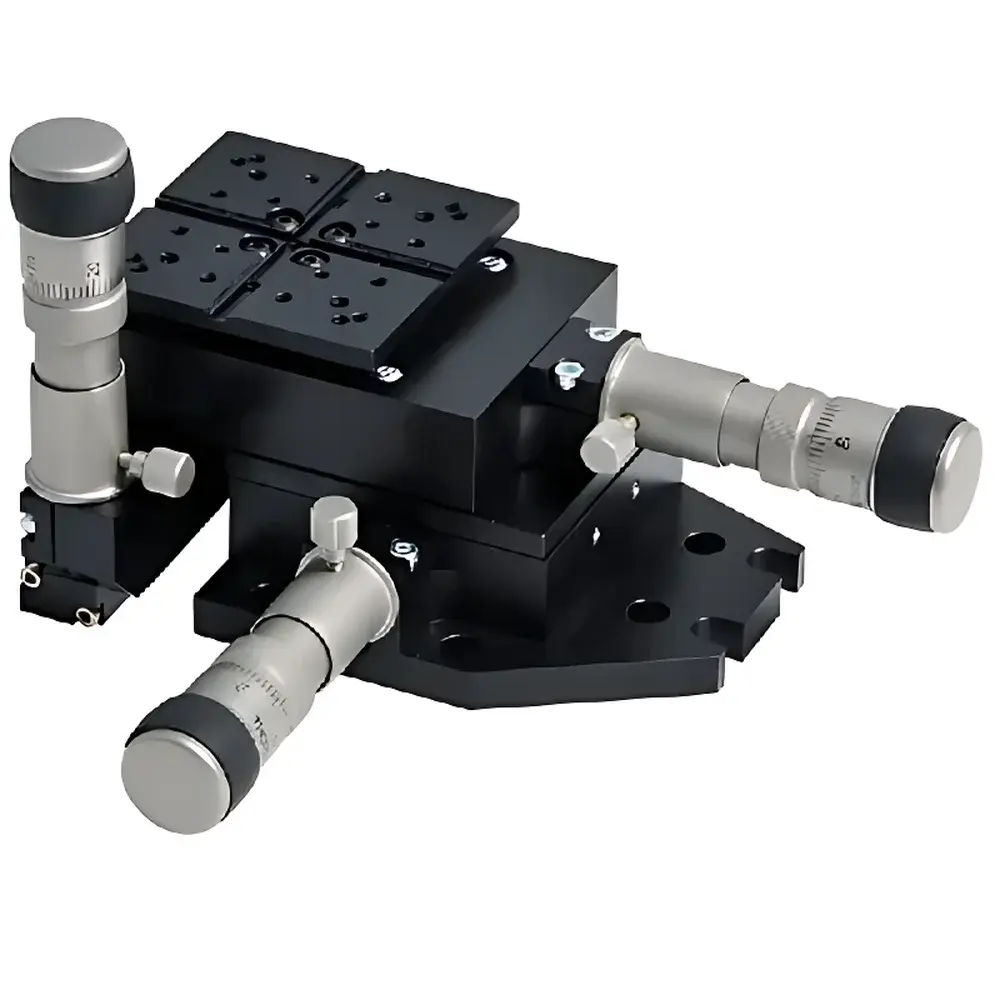
Thorlabs NANOMAX 3-Axis Flexure Translation Stage
| Brand | Thorlabs |
|---|---|
| Origin | USA |
| Model | NANOMAX (MAX300 Series) |
| Travel per Axis | 4.0 mm |
| Load Capacity | 1 kg (2.2 lbs) |
| Coarse Adjustment | 0.5 mm/rev |
| Fine Adjustment | 50 µm/rev (300 µm range) |
| Piezo Range (MAX341/MAX315) | 20 µm |
| Piezo Resolution (Open Loop) | 20 nm |
| Piezo Resolution (Closed Loop, with Strain Gauge) | 5 nm |
| Bidirectional Repeatability (Piezo, Closed Loop) | 5 nm |
| Absolute On-Axis Accuracy | 1.0 µm |
| Dimensions (incl. actuators) | 157.4 mm × 160.4 mm × 62.5 mm |
| Material | Stainless steel and aluminum alloy |
| Mounting Interface | Center keyway + 13 × M6 & 12 × M4 threaded holes (via RB13P1 top plate option) |
| Compliance | Designed for ISO 14000-compliant cleanroom environments |
Overview
The Thorlabs NANOMAX 3-Axis Flexure Translation Stage is an engineered solution for high-stability, frictionless, sub-micron optical alignment in demanding laboratory and industrial photonics applications. Unlike conventional stacked linear stages relying on ball or crossed-roller bearings—where stiction, lubricant migration, and mechanical hysteresis degrade long-term repeatability—the NANOMAX platform employs a monolithic parallel-kinematic flexure architecture. This design eliminates sliding interfaces entirely: motion is achieved through elastic deformation of precision-machined stainless steel flexure hinges, enabling continuous, backlash-free translation along three orthogonal axes (X, Y, Z) within a compact 4.0 mm travel envelope per axis. The absence of grease or oil ensures compatibility with vacuum-compatible optics setups, ultra-low-outgassing environments, and contamination-sensitive applications such as semiconductor metrology, quantum optics, and fiber-to-chip coupling. Each actuator is rigidly anchored to the baseplate—preventing cross-axis crosstalk—a critical advantage over cascaded multi-stage systems where actuator displacement induces parasitic motion in non-driven degrees of freedom.
Key Features
- Monolithic parallel flexure mechanism delivering true nanometer-scale smoothness without stick-slip or static friction
- Integrated differential micrometer drives offering 4.0 mm coarse travel and 300 µm fine travel with 50 µm/rev resolution (theoretical)
- Optional embedded piezoelectric actuators (MAX341, MAX315) providing 20 µm open-loop range and 20 nm resolution; closed-loop operation achieves 5 nm resolution via integrated strain gauge feedback
- Compact footprint (157.4 mm × 160.4 mm × 62.5 mm) optimized for space-constrained optical tables and OEM integration
- Centered keyway on top plate enables rapid, repeatable reconfiguration of optics while preserving alignment integrity
- Robust load capacity of 1 kg (2.2 lbs) supported by hardened steel contact surfaces and stress-relieved aluminum housing
- Lubricant-free operation ensures long-term dimensional stability, minimal thermal drift, and compliance with ISO Class 5 cleanroom protocols
Sample Compatibility & Compliance
The NANOMAX stage is routinely deployed in applications requiring strict adherence to optical alignment traceability and environmental control standards. Its flexure-based kinematics meet ASTM E2589–18 requirements for positional stability in interferometric measurement systems. The absence of hydrocarbon-based lubricants aligns with NASA-STD-6002B outgassing specifications and supports use in UHV (<10⁻⁷ Torr) chambers when paired with compatible accessories. All electrical interfaces—including piezo drive and strain gauge feedback cables—are shielded and rated for EMC compliance per IEC 61326-1. For regulated life science or medical device R&D, the platform supports audit-ready documentation trails when used with FDA 21 CFR Part 11–compliant controllers (e.g., BPC203 with electronic signature logging). Mechanical interfaces conform to standard Thorlabs RMS (0.800"-36) and SM1 (1.035"-40) threading conventions, ensuring seamless interoperability with microscope objectives, collimators, fiber launch assemblies, and waveguide couplers.
Software & Data Management
While the NANOMAX stage operates natively in manual or open-loop piezo mode, its full metrological potential is unlocked via closed-loop integration. Strain gauge outputs deliver analog voltage signals linearly proportional to displacement (±10 V full scale), enabling real-time position monitoring in LabVIEW, MATLAB, or Python-based control environments. When paired with Thorlabs’ BPC203 or MPZ601 piezo controllers—or third-party systems supporting analog feedback input—the stage supports bidirectional repeatability of ≤5 nm and absolute on-axis accuracy of ±1.0 µm. For automated alignment workflows, the NANOMAX integrates directly with NanoTrak™ controllers (BNT001, MNA601, TNA001), enabling real-time photodetector-guided optimization of coupling efficiency. All controller firmware versions maintain audit logs compliant with GLP/GMP data integrity principles, including timestamped actuator commands, feedback readings, and system health diagnostics.
Applications
- Fiber-to-laser diode and fiber-to-photonic-integrated-circuit (PIC) coupling with <1 dB insertion loss variation over 24-hour thermal cycles
- Active alignment of MEMS mirrors, tunable filters, and wavelength-selective switches in telecom testbenches
- Sub-100 nm focus stabilization in confocal and STED microscopy platforms
- Alignment of free-space quantum light sources (SPDC crystals, NV centers) with single-mode collection fibers
- In-process calibration of optical coherence tomography (OCT) reference arms requiring <50 nm path-length stability
- Integration into automated wafer-level testing stations for silicon photonics die probing
FAQ
What distinguishes the NANOMAX flexure design from traditional bearing-based translation stages?
Unlike bearing-based stages that rely on rolling or sliding contact—and thus suffer from stiction, wear, lubricant degradation, and thermal expansion mismatch—the NANOMAX uses monolithic flexure hinges. Motion results from elastic deformation, eliminating friction, backlash, and particle generation.
Can the NANOMAX stage be used in vacuum environments?
Yes. With appropriate cable selection (e.g., low-outgassing coaxial piezo cables) and optional vacuum-rated accessories, the NANOMAX meets ISO 14000 cleanroom and UHV-compatible mounting requirements.
Is closed-loop operation mandatory to achieve 5 nm resolution?
Yes. The 5 nm specification applies only under closed-loop conditions using strain gauge feedback and a compatible controller (e.g., BPC203 with TSG001 sensor interface). Open-loop resolution remains at 20 nm.
How is mechanical crosstalk minimized in the NANOMAX architecture?
All three actuators are mechanically referenced to the fixed baseplate—not to moving substructures—eliminating parasitic motion during single-axis adjustment, a known limitation in stacked or serial-kinematic designs.
Are replacement top plates available for non-standard mounting configurations?
Yes. The RB13P1 adapter plate provides a grid of 13 × M6 and 12 × M4 threaded holes, enabling breadboard-style integration or custom optomechanical fixture attachment.





