
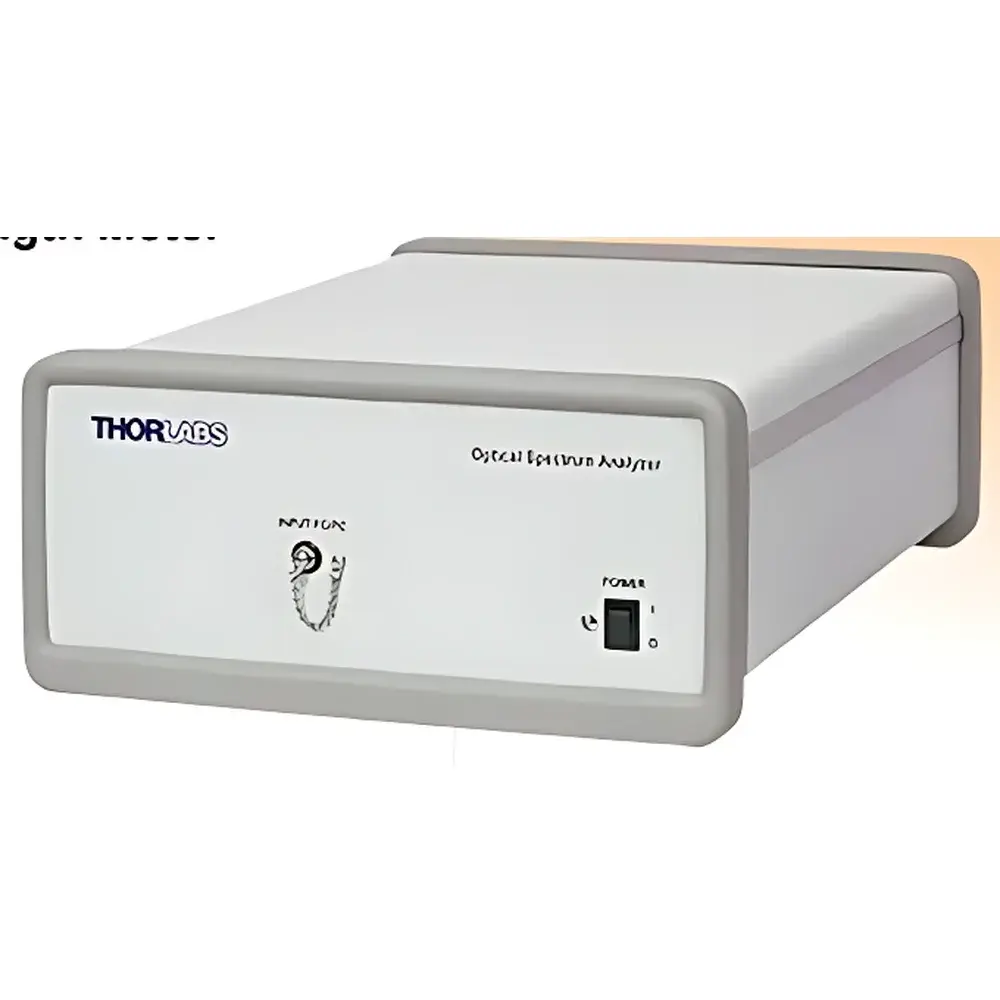
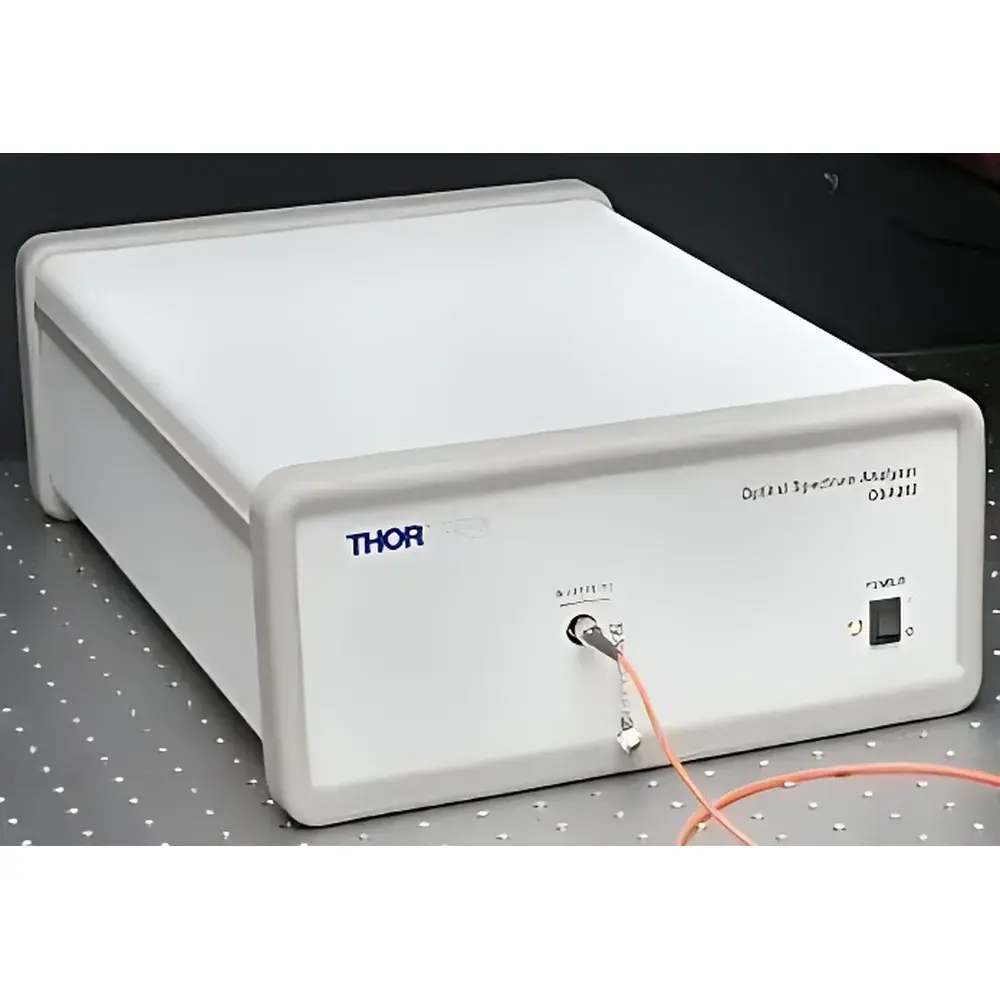
Thorlabs OSA203 Fourier Transform Optical Spectrum Analyzer
| Brand | Thorlabs |
|---|---|
| Origin | USA |
| Model | OSA203 |
| Wavelength Range | 1000–2500 nm |
| Spectral Resolution | 60 pm @ 1550 nm (0.25 cm⁻¹, broadband mode) |
| Wavelength Meter Resolution | 0.2 pm |
| Spectral Accuracy | ±4 pm (broadband), ±2 pm (wavelength meter mode) |
| Spectral Precision | ±1 pm (broadband), 0.2 pm (wavelength meter mode) |
| Input Power Max | 10 mW (CW), 20 mW (peak) |
| Detector | InGaAs |
| Input Fiber | SMF or step-index MMF ≤ Ø50 µm, NA < 0.22 |
| Dimensions | 320 × 149 × 475 mm |
| Input Voltage | 100–240 VAC, 47–63 Hz, 250 W max |
| Operating Temp | 10–40 °C |
| Relative Humidity | <80% non-condensing |
| Interface | High-speed USB 2.0 (6 MB/s transfer via ping-pong buffering) |
| Reference Laser | Stabilized HeNe (λ₀ = 632.9913 nm vacuum), temperature/pressure-compensated using Edlén equation |
Overview
The Thorlabs OSA203 Fourier Transform Optical Spectrum Analyzer (FT-OSA) is a high-precision, benchtop instrument engineered for absolute wavelength calibration and broadband spectral characterization in the near-infrared (NIR) to short-wave infrared (SWIR) range. Unlike conventional grating-based optical spectrum analyzers, the OSA203 employs a scanning Michelson interferometer with dual retroreflectors and a thermally stabilized HeNe reference laser—enabling simultaneous high-resolution spectral acquisition and sub-picometer wavelength metrology. Its core measurement principle is based on time-domain interferometry: input light is split, subjected to a variable optical path difference (OPD) up to ±40 mm, recombined, and detected as an interferogram. A fast Fourier transform (FFT) of this interferogram yields the intensity-vs-wavelength spectrum with inherent wavelength accuracy traceable to the HeNe standard. This architecture delivers intrinsic advantages over dispersive systems—including throughput gain (Jacquinot advantage), wavelength accuracy independent of mechanical calibration drift, and the ability to function concurrently as both a spectrometer and a high-fidelity wavemeter.
Key Features
- Fourier-transform architecture with scanning Michelson interferometer and dual retroreflector design for enhanced alignment stability and common-mode noise rejection
- Stabilized HeNe reference laser (632.9913 nm vacuum wavelength) with real-time air refractive index compensation via integrated temperature, pressure, and humidity sensors (Edlén equation)
- Dual operational modes: broadband spectral analysis (60 pm resolution @ 1550 nm) and precision wavelength metrology (0.2 pm resolution)
- High-dynamic-range InGaAs detector with low-noise transimpedance amplifier, automatic gain control (AGC), and balanced detection topology
- 16-bit ADC sampling synchronized to HeNe interference fringes via programmable phase-locked loop (PLL) with multiplication factors of 16×, 32×, 64×, or 128× for optimized resolution/speed trade-offs
- USB 2.0 interface supporting 6 MB/s interferogram streaming using ping-pong buffering for continuous acquisition without data loss
- Preconfigured desktop workstation included—optimized for multi-threaded FFT processing, zero-padding interpolation, apodization (Hann window), and real-time spectral reconstruction
- FC/PC fiber input compatible with single-mode and step-index multimode fibers (core ≤ 50 µm, NA < 0.22); free-space coupling supported via RC08FC-P01 reflective collimators
Sample Compatibility & Compliance
The OSA203 is designed for characterization of continuous-wave (CW) and quasi-CW optical sources, including distributed feedback (DFB) lasers, external cavity diode lasers (ECDLs), superluminescent diodes (SLDs), semiconductor optical amplifiers (SOAs), and fiber Bragg grating (FBG) reflection spectra. It supports input power levels from –70 dBm (100 pW) to +10 dBm (10 mW) while maintaining linearity and SNR >40 dB across its full 1000–2500 nm range. The system meets key requirements for laboratory-grade optical metrology under ISO/IEC 17025:2017 for calibration laboratories, and its traceable HeNe reference enables compliance with NIST-traceable wavelength standards. While not certified for GMP or FDA 21 CFR Part 11 out-of-the-box, audit-ready data logging—including full interferogram storage, timestamped metadata, user-defined measurement parameters, and software versioning—is fully supported in the native OSA software suite for GLP-aligned workflows.
Software & Data Management
The bundled OSA software provides a deterministic, multi-stage signal processing pipeline: raw interferogram acquisition → HeNe-fringe-synchronized resampling → zero-filling and apodization → parallelized multi-threaded FFT → spectral calibration and display. The software automatically selects optimal FFT length and windowing functions based on selected resolution and sensitivity settings. All spectral results are exportable in CSV, HDF5, and industry-standard SPC formats. Full interferogram datasets (up to 16 million points) are retained alongside processed spectra, enabling post-acquisition reprocessing with alternate parameters. The application enforces strict separation between broadband spectral analysis and wavelength meter mode—automatically disabling the latter when multi-peak or broadband inputs exceed coherence-length assumptions. Software updates are delivered via Thorlabs’ secure firmware portal, and all versions include SHA-256 checksums for integrity verification. No cloud connectivity or telemetry is enabled by default; all data remains local unless explicitly exported by the user.
Applications
- Precision characterization of narrow-linewidth lasers (e.g., ECDLs, DFBs) for telecom and quantum optics research
- Measurement of Fabry–Pérot cavity mode spacing and gain profiles in semiconductor laser chips
- Analysis of broadband sources such as ASE from erbium-doped fiber amplifiers (EDFAs) and supercontinuum generators
- Verification of wavelength-stabilized tunable lasers against primary standards
- Calibration of wavelength references in photonic integrated circuit (PIC) testbenches
- Monitoring spectral shifts in FBG-based strain and temperature sensors
- Validation of optical filter passbands, isolation, and out-of-band rejection in NIR/SWIR systems
FAQ
What is the fundamental difference between FT-OSA and grating-based OSAs?
FT-OSAs measure interferograms in the time domain and reconstruct spectra via Fourier transformation, offering superior wavelength accuracy (traceable to HeNe), higher optical throughput (Jacquinot advantage), and immunity to grating calibration drift. Grating-based instruments rely on mechanical wavelength scanning and require periodic recalibration.
Can the OSA203 measure pulsed lasers?
Yes—provided pulse repetition rates exceed the interferometer scan speed and average power remains within the 10 mW CW limit. For low-duty-cycle pulses, users should verify that peak power does not exceed 20 mW to avoid detector saturation or damage.
How is wavelength accuracy maintained over time and environmental changes?
The integrated HeNe laser provides continuous self-referencing. Air refractive index is dynamically corrected using real-time measurements of temperature, pressure, and relative humidity (for visible/NIR); in the SWIR (>1800 nm), humidity effects are negligible and omitted from compensation.
Does the system support external triggering or synchronization?
No—the OSA203 uses internal HeNe fringe timing for all sampling. External trigger input is not provided, as synchronous acquisition is inherently achieved through the interferometric reference.
Is the included computer upgradeable or replaceable?
Yes—the system ships with a validated Windows-based desktop PC meeting minimum CPU (quad-core), RAM (16 GB), and SSD (512 GB) specifications. Users may substitute their own machine if it satisfies the documented hardware requirements and installs the official Thorlabs OSA software package.




