
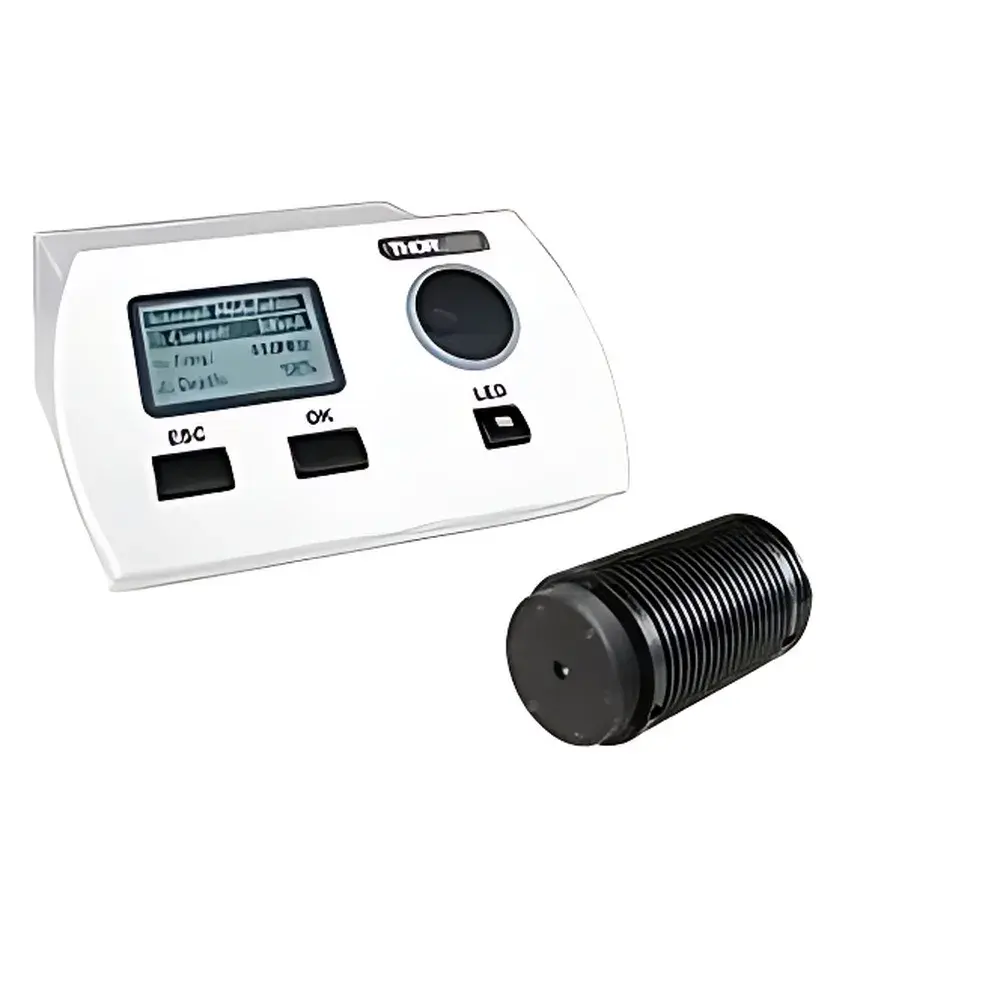
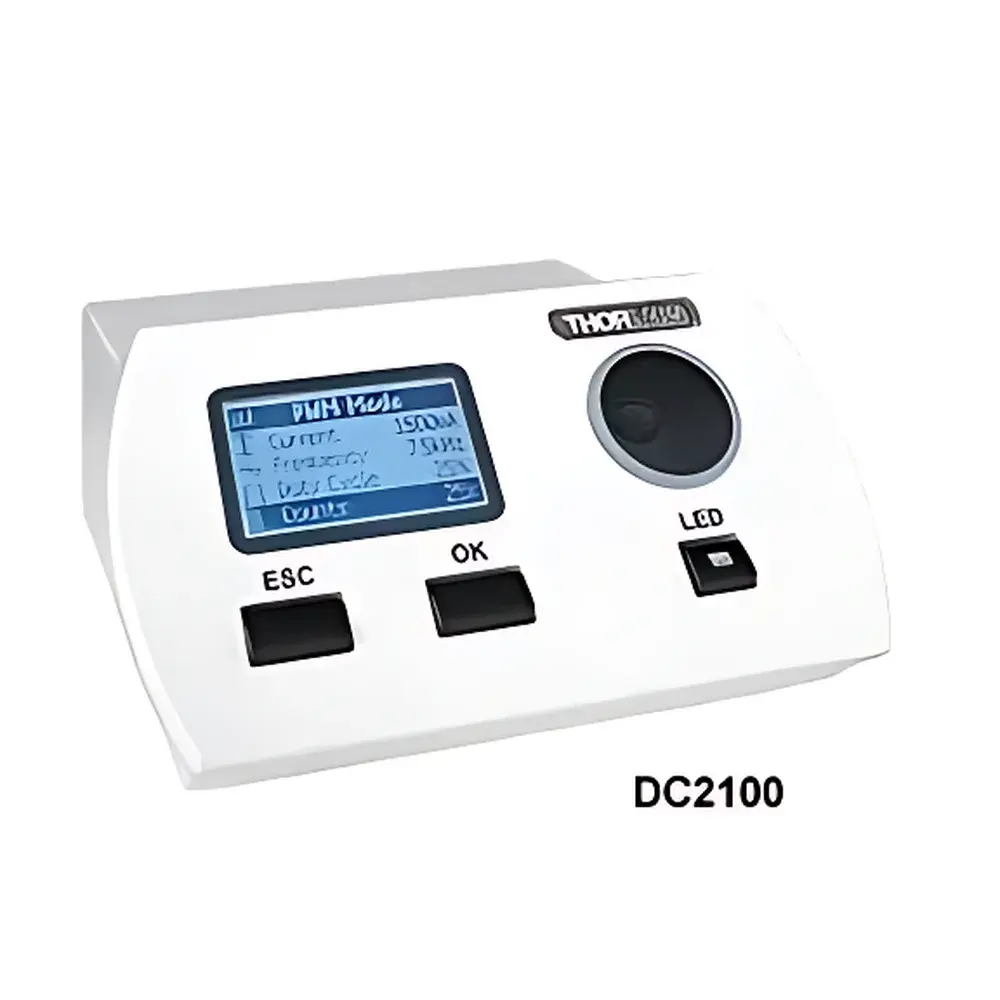
Thorlabs SPL-LEDD LED Current Controller
| Brand | Thorlabs |
|---|---|
| Origin | USA |
| Model | SPL-LEDD |
| Output Current Range | 0–1000 mA (DC4100 variant), 0–2000 mA (DC2100 variant), 0–1200 mA (LEDD1B variant) |
| Forward Voltage Compliance | 5 V (DC4100), 12 V (LEDD1B), 24 V (DC2100) |
| Modulation Bandwidth | DC–100 kHz (sine/arbitrary), up to 100 MHz internal (DC3100 series) |
| Trigger Input | 0–5 V TTL-compatible |
| USB Interface | USB 2.0 with CDC-class enumeration |
| Control Modes | Constant Current, Analog Modulation, External Trigger, PWM Pulse Sequencing |
| Software Support | µManager plugin, Thorlabs Kinesis, LabVIEW VIs |
| Compliance | CE, RoHS, FCC Class B |
Overview
The Thorlabs SPL-LEDD series comprises a family of precision, laboratory-grade LED current controllers engineered for stable, low-noise, and highly reproducible optical excitation in demanding scientific applications. These instruments operate on the principle of closed-loop, analog current regulation—maintaining precise LED drive current independent of forward voltage drift, thermal load variation, or supply fluctuations. Unlike simple voltage sources or resistive drivers, SPL-LEDD controllers employ high-bandwidth current-sense feedback and low-thermal-drift operational amplifiers to deliver sub-millisecond response times and exceptional long-term stability. Designed explicitly for integration into fluorescence microscopy, time-resolved spectroscopy, optogenetics, and quantum optics setups, the SPL-LEDD platform supports both continuous-wave (CW) and high-fidelity modulated operation—including sinusoidal, arbitrary waveform, and precisely timed pulse sequences.
Key Features
- Multi-mode operation: Selectable constant-current, analog modulation (voltage-controlled amplitude tracking), external trigger gating, and programmable PWM sequencing—all accessible via front-panel controls or remote interface.
- High-resolution current control: 1 mA resolution across full output range; accuracy specified at ±10 mA (DC4100) or ±20 mA (DC2100), traceable to NIST-calibrated reference standards.
- Broad modulation capability: DC–100 kHz analog bandwidth for real-time intensity shaping; DC3100 variants support internal 10–100 MHz RF modulation for frequency-domain FLIM and phase-sensitive detection.
- Robust thermal architecture: Active heat sinking and thermally isolated current paths ensure stable performance under sustained high-current loads (e.g., 2 A @ 24 V for DC2100).
- USB 2.0 + software ecosystem: Native CDC-class USB enumeration enables plug-and-play integration with Windows, Linux, and macOS; supported by Thorlabs Kinesis, µManager (with dedicated plugin), and LabVIEW driver libraries.
- Front-panel usability: Backlit LCD display (DC4100), rotary encoder navigation, tactile mode switching, and real-time parameter readout reduce setup overhead in multi-instrument environments.
Sample Compatibility & Compliance
The SPL-LEDD controllers are compatible with single-emitter LEDs, multi-die packages, and linear/2D LED arrays—provided the combined forward voltage remains within the unit’s compliance range (5 V to 24 V). Each model includes reverse-polarity protection, over-temperature shutdown, and current-limit soft-start to prevent LED damage during power-up or transient events. All units comply with CE marking requirements (2014/30/EU EMC Directive and 2011/65/EU RoHS Directive), FCC Part 15 Class B radiated emission limits, and IEC 61000-4-2/3/4/6 immunity standards. For regulated environments, the USB-based control architecture supports audit-trail-capable logging when integrated with GLP/GMP-compliant data acquisition systems; while not FDA 21 CFR Part 11 certified out-of-the-box, the deterministic command protocol and timestamped binary logging enable validation-ready system integration.
Software & Data Management
Thorlabs provides native Kinesis software with full GUI support for all SPL-LEDD models, enabling real-time current sweep, modulation waveform definition (sine, triangle, square, custom CSV import), and trigger delay calibration. The open-source µManager platform—widely adopted in automated microscopy—includes a production-tested SPL-LEDD plugin that exposes all hardware parameters via its device adapter API, supporting synchronized LED control alongside camera exposure, stage motion, and filter wheel actuation. Low-level communication uses ASCII-based SCPI-like commands over virtual COM port, facilitating custom Python/Matlab/C++ implementations. All firmware updates are delivered via signed .hex files with bootloader verification; configuration states (current setpoint, modulation depth, trigger threshold) persist across power cycles in non-volatile memory.
Applications
- Fluorescence Lifetime Imaging Microscopy (FLIM): DC3100-series units provide phase-locked, MHz-range modulation essential for time-domain and frequency-domain lifetime decay analysis.
- Optogenetic stimulation: Precise, jitter-free current pulses (down to microsecond width) enable reliable neuronal activation with minimal phototoxicity.
- Spectroscopic light sources: Stable CW output eliminates intensity drift during absorbance or reflectance measurements; analog modulation supports lock-in detection schemes.
- Calibration & metrology: Used as traceable intensity references in photodiode linearity testing, camera quantum efficiency mapping, and radiometric standardization.
- Industrial inspection: Integrated into machine vision systems requiring strobed illumination synchronized to conveyor speed or robotic motion profiles.
FAQ
What is the difference between modulation mode and trigger mode?
In modulation mode, the output current linearly tracks an external 0–5 V analog input signal in real time—including waveform shape and amplitude. In trigger mode, a rising-edge voltage crossing a fixed 2.5 V threshold initiates a step transition to the pre-set current level, enabling clean digital gating or basic PWM generation.
Can I synchronize multiple SPL-LEDD units?
Yes—via shared TTL trigger lines or master-slave USB enumeration. Kinesis and µManager both support coordinated multi-channel timing with sub-millisecond inter-unit skew.
Is optical isolation available for the analog input?
No. The analog modulation and trigger inputs are referenced to the controller’s internal ground. For galvanically isolated control, users must implement external optocouplers or isolated DAQ outputs.
Does the DC2100 support true arbitrary waveform generation?
It accepts arbitrary waveforms via USB-hosted streaming at up to 100 kS/s, but internal storage is limited to 16k points; complex waveforms require host buffering and real-time streaming.
How often does the current calibration drift?
Under typical lab conditions (23 °C ±2 °C, no mechanical shock), long-term drift is less than ±0.02% per 1000 hours—verified by annual recalibration against a Keysight B2902A SMU.



