
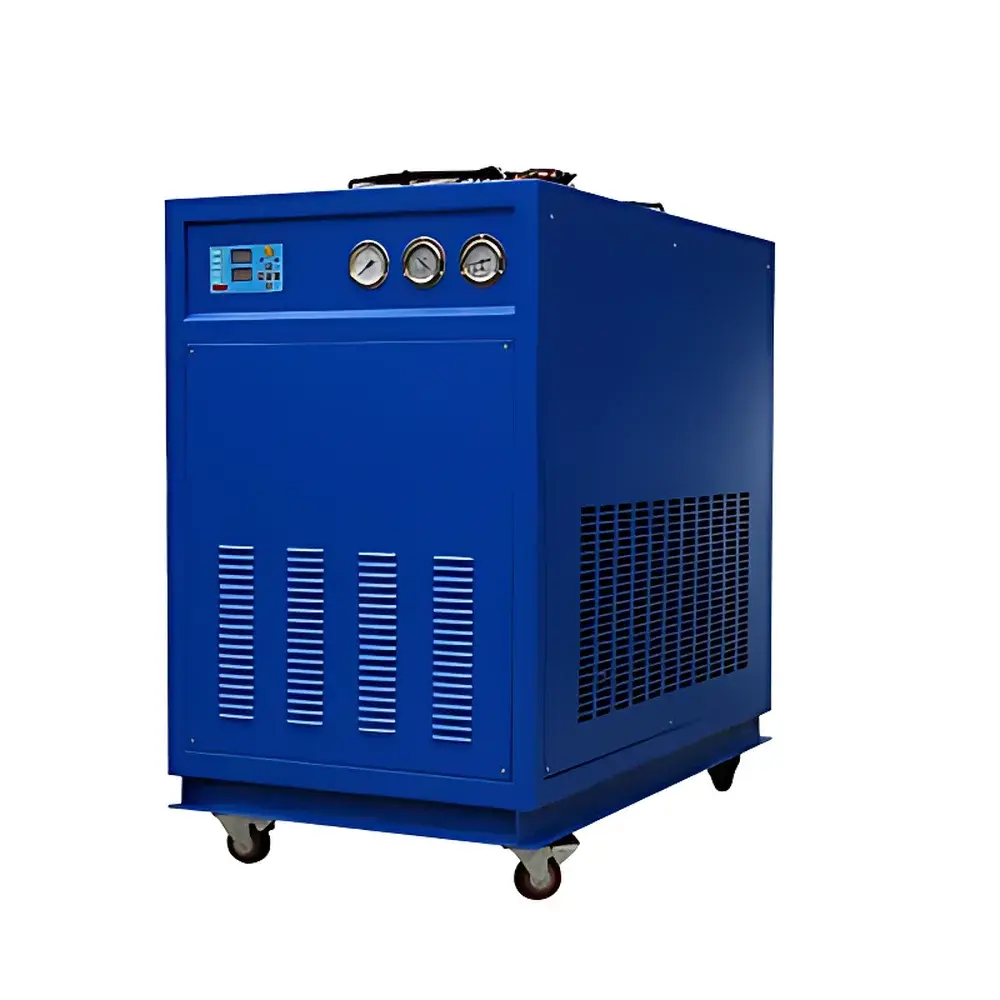
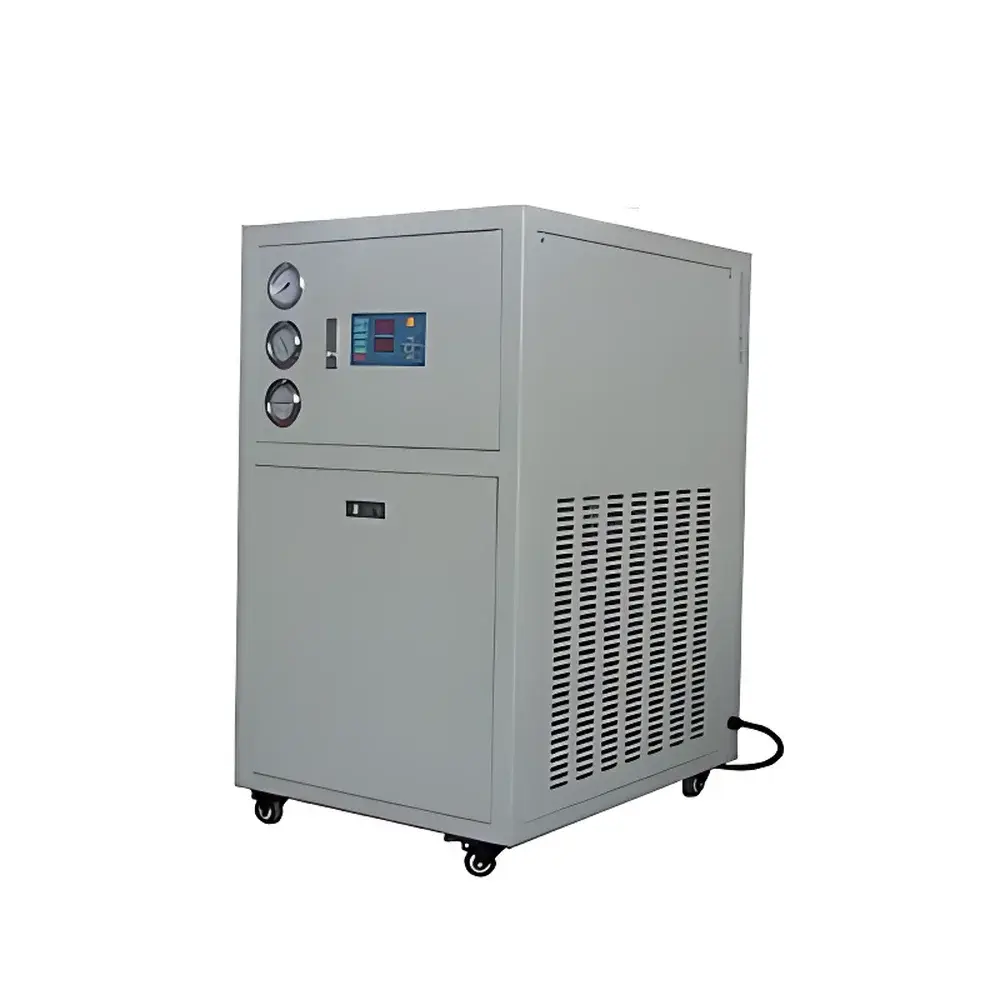
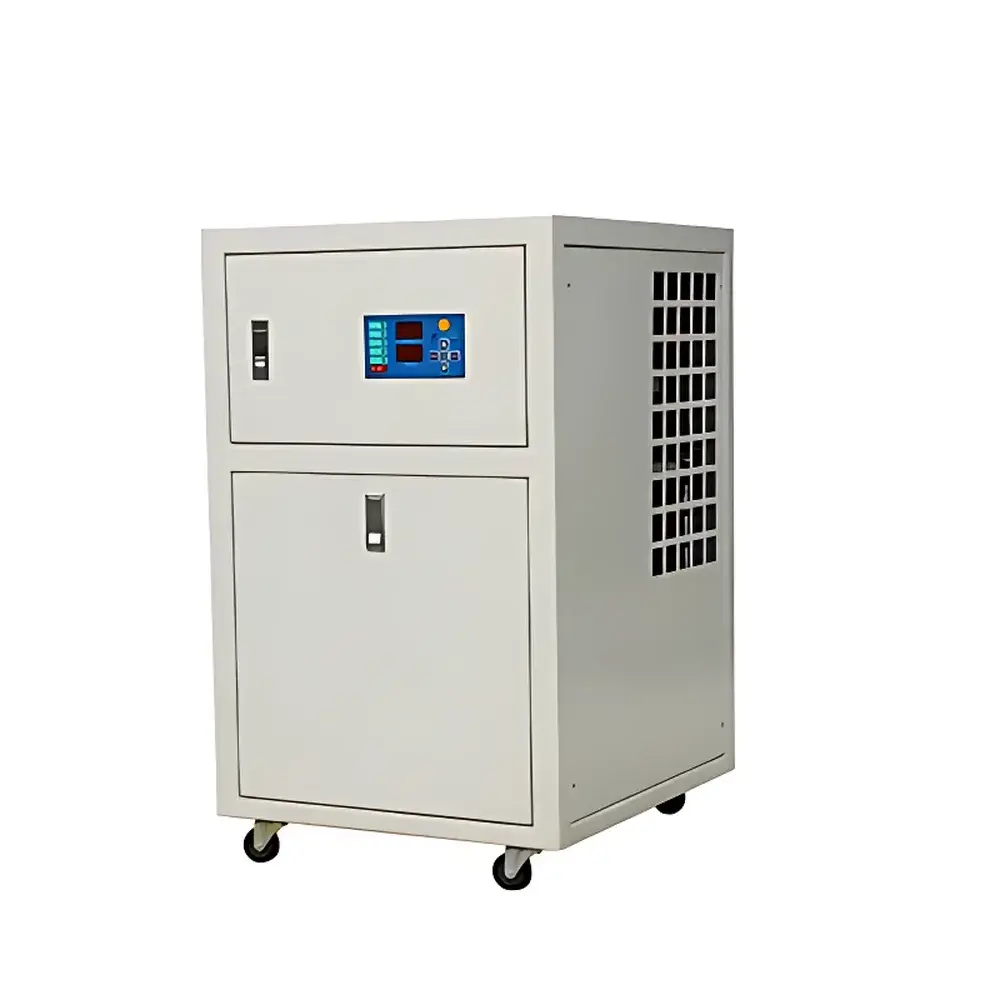
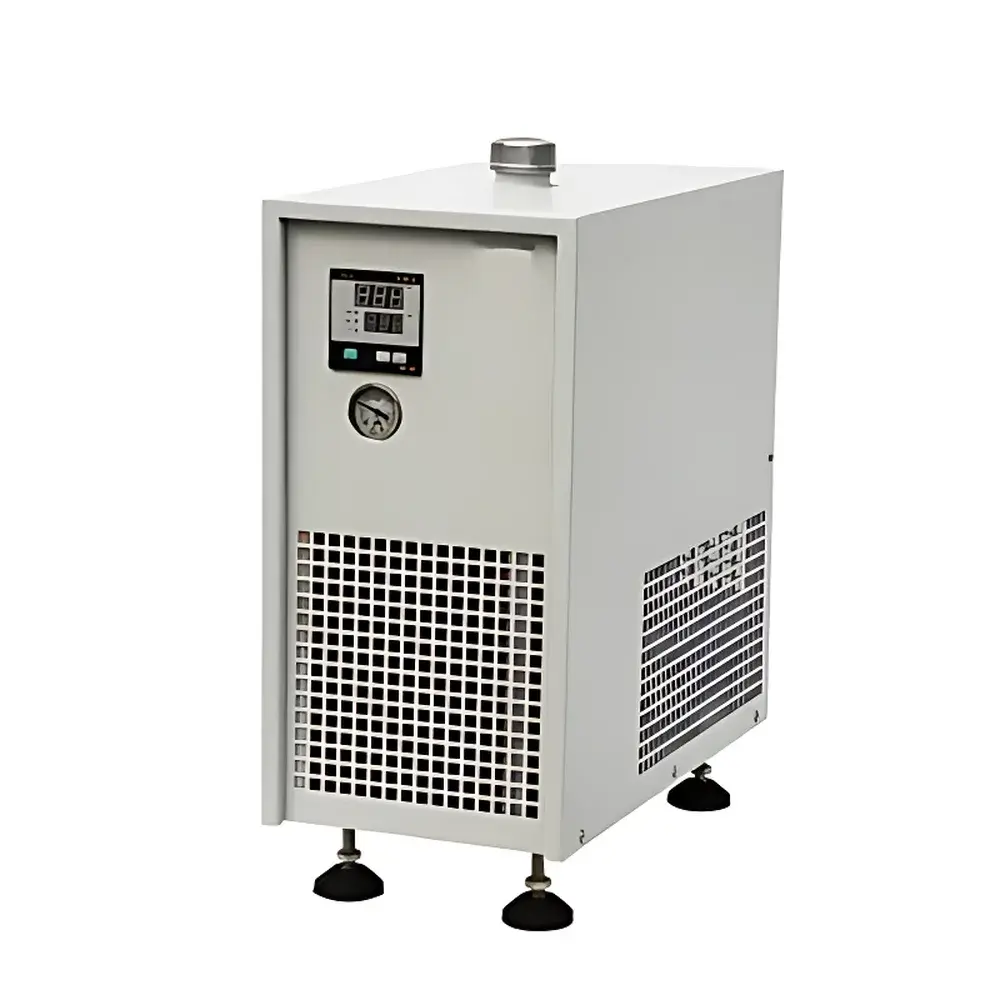
Tianfeng LS-25000W Air-Cooled Circulating Chiller
| Brand | Tianfeng |
|---|---|
| Origin | Shanghai, China |
| Manufacturer Type | Direct Manufacturer |
| Product Category | Domestic |
| Model | Tianfeng-LS-25000W |
| Instrument Type | Integrated Unit |
| Cooling Method | Air-Cooled |
| Temperature Stability Range | 0–10 °C |
| Cooling Capacity | 25 kW |
| Temperature Fluctuation | ±0.1 °C |
| Circulating Pump Pressure | 2.0 bar |
| Circulating Pump Flow Rate | 2 L/min |
| Reservoir Volume | 200 L |
| Operating Mode | Continuous Duty |
| Power Supply | 220 V, 50 Hz |
| Compressor Type | Scroll Compressor |
| Safety Protections | Compressor Overheat Protection, Overcurrent Protection, High/Low Pressure Switches, Overtemperature Cut-off |
| Reservoir & Pump Material | Full Stainless Steel |
| Control System | Digital PID Temperature Controller (Optional RKC Controller Available) |
| Electrical Components | Siemens / Schneider / Omron |
| Refrigeration Components | Italian/German Expansion Valves & Solenoid Valves |
| Noise Level | Low-Noise Design |
| Dimensions (L×W×H) | 1350 × 900 × 1845 mm |
| Weight | Approx. 420 kg |
Overview
The Tianfeng LS-25000W Air-Cooled Circulating Chiller is an integrated, high-stability thermal management system engineered for continuous-duty laboratory and industrial applications requiring precise, reliable coolant temperature control. Unlike water-cooled chillers that depend on external cooling towers or facility water loops, this unit employs a closed-loop air-cooled condensing system—making it ideal for laboratories with limited infrastructure, mobile setups, or environments where water supply or drainage is constrained. Its core thermodynamic architecture utilizes a scroll compressor paired with high-efficiency copper-aluminum finned condensers and optimized refrigerant circuitry (R410A or R407C, compliant with current EU F-Gas regulations), delivering stable 25 kW nominal cooling capacity at standard conditions (chilled water inlet 12 °C, outlet 7 °C; ambient intake 30 °C, exhaust ≤40 °C). The chiller maintains setpoint accuracy within ±0.1 °C across its operational range of 0–10 °C—critical for instrumentation demanding minimal thermal drift, such as graphite furnace atomic absorption spectrometers (GFAAS), inductively coupled plasma optical emission spectrometers (ICP-OES), and transmission electron microscopes (TEM).
Key Features
- Integrated air-cooled design eliminates dependency on facility water lines or cooling towers—reducing installation complexity and total cost of ownership.
- Precision digital PID temperature controller with real-time LED display of actual and setpoint temperatures; optional RKC controller available for enhanced repeatability and programmable ramp/soak profiles.
- Full stainless-steel reservoir (200 L) and circulation pump—resistant to corrosion from deionized water, glycol-water mixtures, or mild chemical coolants commonly used in analytical instrumentation.
- High-reliability scroll compressor with integrated overheat, overcurrent, and high/low pressure safety interlocks—ensuring robust operation under variable load conditions typical of laser systems or vacuum pumps.
- Adjustable flow rate (0–60 L/min) and pressure (0–2.0 bar) via calibrated bypass valve and variable-speed pump driver—enabling compatibility with instruments having diverse hydraulic resistance requirements.
- Low-noise acoustic enclosure (<65 dB(A) at 1 m) suitable for placement within shared laboratory spaces without violating occupational noise exposure limits (OSHA/NIOSH guidelines).
- Comprehensive electrical architecture using certified components from Siemens, Schneider Electric, and Omron—supporting long-term reliability and compliance with IEC 61000-6-2/6-4 EMC standards.
Sample Compatibility & Compliance
This chiller is validated for thermal stabilization of heat-generating subsystems in analytical, materials science, and life science instrumentation—including but not limited to: GFAAS graphite furnaces, ICP-MS torch interfaces, X-ray diffractometer (XRD) goniometers, scanning electron microscope (SEM) column cooling jackets, and laser-based material processing tools (e.g., fiber lasers, CO₂ lasers). It meets ISO 9001:2015 quality management system requirements and conforms to CE marking directives (2014/30/EU EMC, 2014/35/EU LVD). While not intrinsically rated for hazardous locations, its construction complies with IP20 ingress protection and UL 61010-1 safety standards for laboratory electrical equipment. For regulated environments (e.g., pharmaceutical QC labs operating under FDA 21 CFR Part 11 or EU Annex 11), the optional RKC controller supports audit-trail-enabled parameter logging and user-access-level configuration—facilitating GLP/GMP traceability when integrated with validated LIMS or SCADA platforms.
Software & Data Management
The base unit operates via embedded firmware with local control only; however, the optional RKC controller provides RS-485 Modbus RTU or Ethernet TCP/IP communication interfaces. This enables remote monitoring and setpoint adjustment through third-party SCADA systems (e.g., Ignition, WinCC, LabVIEW) or custom Python/Node-RED scripts. Logged data—including real-time temperature, flow rate, compressor run time, and fault codes—is timestamped and exportable in CSV format. When deployed in multi-instrument cooling networks, units can be daisy-chained for centralized supervision. All firmware updates are performed via secure USB flash drive—no internet connectivity required—preserving network isolation integrity in secure research facilities.
Applications
- Materials Characterization: Stabilizing detector cooling stages in XRF and XRD systems to minimize thermal noise and improve peak resolution.
- Atomic Spectroscopy: Maintaining constant graphite tube temperature during GFAAS atomization cycles to ensure reproducible calibration curves (per ASTM D5174, ISO 11885).
- Electron Microscopy: Regulating specimen stage and lens coil temperatures in TEM/SEM to suppress thermal drift during high-magnification imaging (>100k×).
- Laser Systems: Managing diode-pumped solid-state (DPSS) and fiber laser head temperatures to sustain wavelength stability and beam pointing accuracy.
- Vacuum & Thin-Film Deposition: Cooling diffusion pumps and ion sources in sputtering and evaporation systems to prevent oil backstreaming and maintain base pressure integrity.
- Pharmaceutical Process Support: Providing controlled coolant to jacketed reactors during lyophilization cycle development or fermentation temperature profiling (aligned with USP analytical instrument qualification).
FAQ
What is the maximum recommended return water temperature for continuous operation?
The unit is designed for chilled water return temperatures ≤40 °C. Sustained return temperatures above this threshold increase compressor discharge pressure and reduce volumetric efficiency—potentially triggering high-pressure cutout. For optimal service life, maintain return water ≤35 °C.
Can this chiller operate with 30% ethylene glycol/water mixture?
Yes—the stainless-steel reservoir, pump, and internal heat exchanger are compatible with glycol concentrations up to 40%. Note that glycol reduces effective cooling capacity by ~8–12% and increases fluid viscosity; adjust flow rate accordingly to maintain Reynolds number >2300 for turbulent flow in connected instrumentation.
Is remote alarm output available for integration into building management systems?
Standard units include dry-contact fault relay outputs (compressor fault, high temp, low flow). Optional analog 4–20 mA or Modbus signals are available with the RKC controller upgrade.
Does the chiller meet environmental refrigerant regulations for export to the EU or UK?
Yes—it uses R410A or R407C refrigerants, both listed under the EU F-Gas Regulation (No. 517/2014) with GWP values below the phase-down thresholds applicable to commercial chillers in its capacity class.
What maintenance intervals are recommended for laboratory-grade operation?
Inspect air filters monthly; clean condenser coils quarterly using compressed air or low-pressure water. Verify refrigerant charge and compressor oil level annually via certified technician. Log all interventions in accordance with ISO/IEC 17025 clause 8.9 for accredited testing laboratories.



