
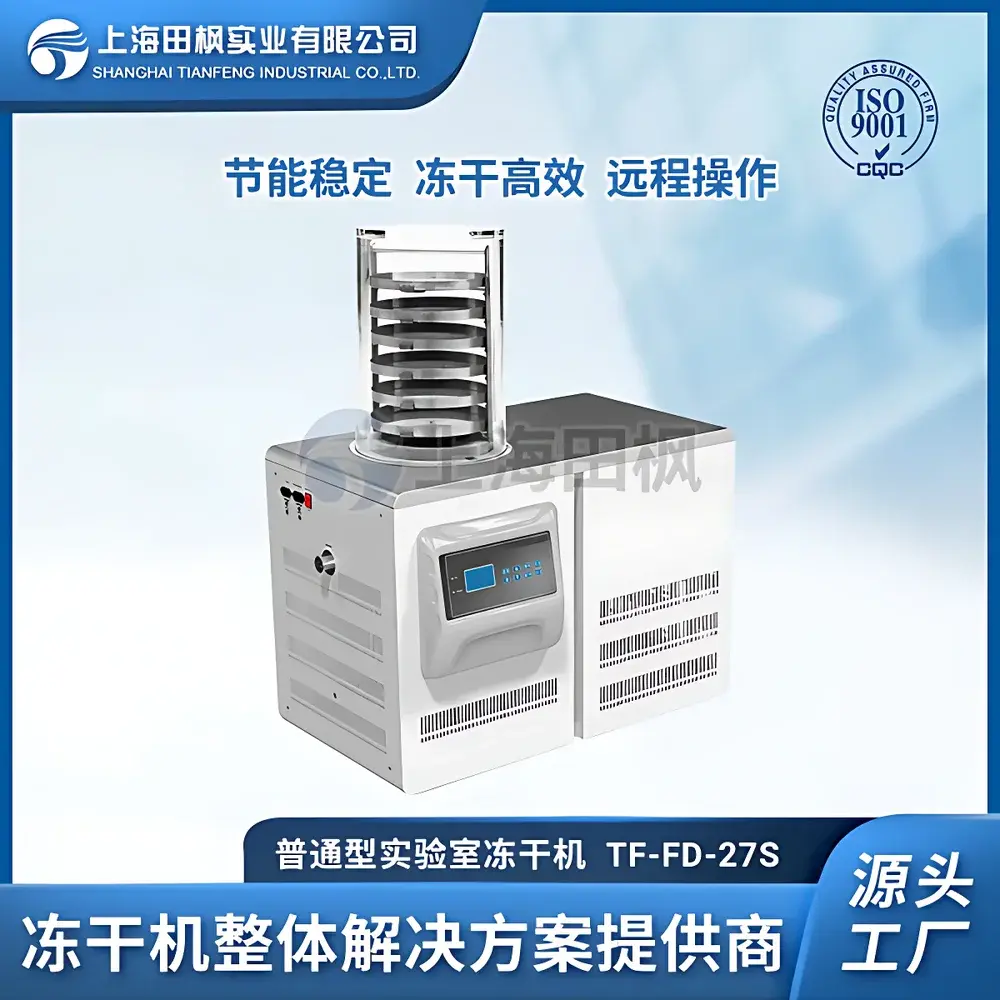
Tianfeng TF-FD-27S Laboratory Benchtop Freeze Dryer (Standard Shelf Type)
| Brand | Tianfeng |
|---|---|
| Origin | Shanghai, China |
| Manufacturer | Tianfeng Industrial Co., Ltd. |
| Type | Standard shelf-type laboratory freeze dryer |
| Application | R&D and small-batch lyophilization of biologicals, pharmaceuticals, and food samples |
| Lyophilization Area | 0.27 m² |
| Ultimate Vacuum (No-load) | <15 Pa |
| Condenser Temperature | <−80 °C |
| Ice Capacity | 6 kg/24 h |
| Dimensions (Main Unit, excl. Drying Chamber) | 1200 mm × 550 mm × 870 mm |
| Power Supply | 220 V, 50 Hz |
| Rated Power | 2200 W |
| Shelf Configuration | 6-layer Φ240 mm stainless steel shelves |
| Control System | Touchscreen LCD with real-time shelf temperature & chamber pressure monitoring, PID-controlled shelf heating, programmable freeze-drying cycle |
| Construction | 304 stainless steel condenser chamber and internal surfaces |
| Refrigeration | Dual-stage cascade refrigeration system |
| Optional Features | In-chamber inert gas backfill valve, co-lyophilization point detection kit, automatic stoppering module, temperature data logger (GLP-compliant) |
Overview
The Tianfeng TF-FD-27S is a benchtop laboratory freeze dryer engineered for precision lyophilization of heat-sensitive biomaterials—including marine-derived bioactives (e.g., sea cucumber extracts), microbial cultures, vaccines, enzymes, antibodies, and botanical therapeutics. It operates on the fundamental principle of sublimation: frozen aqueous samples are subjected to high vacuum (<15 Pa, no-load), enabling ice to transition directly from solid to vapor phase without passing through liquid—thereby preserving structural integrity, conformational stability, and biological activity. Unlike conventional thermal drying methods, which induce denaturation, oxidation, or collapse, lyophilization maintains native protein folding, enzymatic kinetics, and microbiological viability. The TF-FD-27S employs a dual-stage cascade refrigeration system achieving ≤−80 °C condenser temperature, ensuring efficient capture of both water and low-volatility organic solvents (e.g., ethanol, acetone) commonly used in extraction protocols for marine or herbal matrices. Its 0.27 m² shelf area supports scalable batch processing while retaining full process control—making it suitable for method development, stability studies, and GLP-compliant pre-formulation work.
Key Features
- Dual-stage cascade refrigeration system with high-efficiency compressors, delivering stable condenser temperatures ≤−80 °C for superior solvent trapping and reduced primary drying time.
- Six-tier 304 stainless steel shelves (Φ240 mm each), flat and dimensionally stable, facilitating uniform heat transfer and easy cleaning—critical for cross-sample contamination control in microbiological or pharmaceutical workflows.
- Integrated touchscreen HMI with real-time graphical display of shelf temperature, chamber pressure, and lyophilization progress curves; supports user-defined multi-step programs with PID-regulated shelf heating (±1 °C accuracy).
- Original-position pre-freezing capability: samples freeze directly on shelves under controlled conditions, eliminating manual transfer and minimizing thermal shock or ice crystal reorganization.
- High-transparency acrylic drying chamber door with integrated observation window, enabling continuous visual monitoring of cake formation, collapse, or sublimation front progression.
- Backfill valve for controlled inert gas (N₂ or Ar) introduction post-drying—essential for oxygen-sensitive biologics and long-term storage stability of lyophilized marine peptides or probiotic strains.
- Full 304 stainless steel interior construction, corrosion-resistant and compliant with ISO 14644-1 Class 7 cleanroom-compatible cleaning protocols.
Sample Compatibility & Compliance
The TF-FD-27S accommodates diverse sample formats: bulk solutions in trays, vials (2–20 mL), serum bottles, and custom containers up to 240 mm diameter. It is routinely deployed for lyophilizing thermolabile marine compounds (e.g., saponins, glycosaminoglycans from sea cucumbers), bacterial and fungal spores, plasmid DNA preparations, monoclonal antibody formulations, and traditional Chinese medicine extracts. Its ≤−80 °C condenser enables reliable drying of formulations containing ≤15% (v/v) miscible organic solvents—extending applicability beyond aqueous systems. From a regulatory standpoint, the system supports audit-ready documentation when paired with optional GLP-compliant temperature data loggers (IEC 60751 Class A Pt100 sensors, ±0.15 °C accuracy) and meets mechanical design requirements referenced in USP , ISO 22042:2017 (freeze-drying equipment), and ASTM F2375-04 (standard guide for lyophilization process validation). All electrical components comply with IEC 61000-6-3 EMC standards.
Software & Data Management
The embedded control firmware records timestamped shelf temperature, chamber pressure, and condenser temperature at user-configurable intervals (1–60 s). Exportable CSV files support post-process analysis in MATLAB, Python, or commercial CQV platforms. Optional data loggers provide 21 CFR Part 11–compliant electronic signatures, audit trails, and role-based access control—enabling full traceability for FDA, EMA, or NMPA submissions. Cycle parameters (freezing ramp rate, hold times, primary/secondary drying setpoints) are stored with version control and user ID tagging. Remote monitoring via Ethernet is supported through Modbus TCP integration for lab-wide LIMS or MES connectivity.
Applications
- Stabilization of marine bioactive compounds: Sea cucumber triterpene glycosides, fucoidan, and collagen peptides retain >92% bioactivity post-lyophilization due to low-temperature sublimation and absence of liquid-phase stress.
- Microbial preservation: Lyophilization of lactic acid bacteria, bifidobacteria, and actinomycetes achieves >10⁹ CFU/g viability retention over 24 months at 4 °C—validated per ISO 11133:2014.
- Pharmaceutical R&D: Formulation screening of sterile injectables (e.g., peptide APIs), vaccine candidates (inactivated viral vectors), and diagnostic reagents requiring cold-chain independence.
- Botanical and nutraceutical processing: Stabilization of enzyme-rich seaweed extracts, polyphenol concentrates, and probiotic-fortified functional foods without Maillard degradation.
- Academic research: Cryo-electron microscopy sample preparation support, tissue banking (corneal epithelium, cartilage explants), and synthetic biology chassis strain archiving.
FAQ
What is the maximum sample volume per batch?
With six Φ240 mm shelves, the TF-FD-27S supports up to 4.5 L total solution volume (assuming 2 cm depth), or ~1,200 standard 10-mL vials.
Can it handle samples containing ethanol or acetone?
Yes—the ≤−80 °C condenser efficiently traps volatile organics; validated for formulations with up to 15% (v/v) ethanol or 10% (v/v) acetone.
Is shelf heating required for all cycles?
Shelf heating is optional but recommended for secondary drying of amorphous formulations (e.g., proteins, polysaccharides) to reduce residual moisture to <1.0% w/w per USP .
Does the system meet GMP/GLP documentation requirements?
When equipped with the optional data logger and electronic signature module, it fulfills ALCOA+ principles and 21 CFR Part 11 Annex 11 expectations for regulated environments.
What maintenance is required for long-term reliability?
Quarterly oil changes for compressors, annual calibration of pressure and temperature sensors, and biannual inspection of O-rings and vacuum pump oil—detailed in the ISO 9001:2015–certified service manual.



