
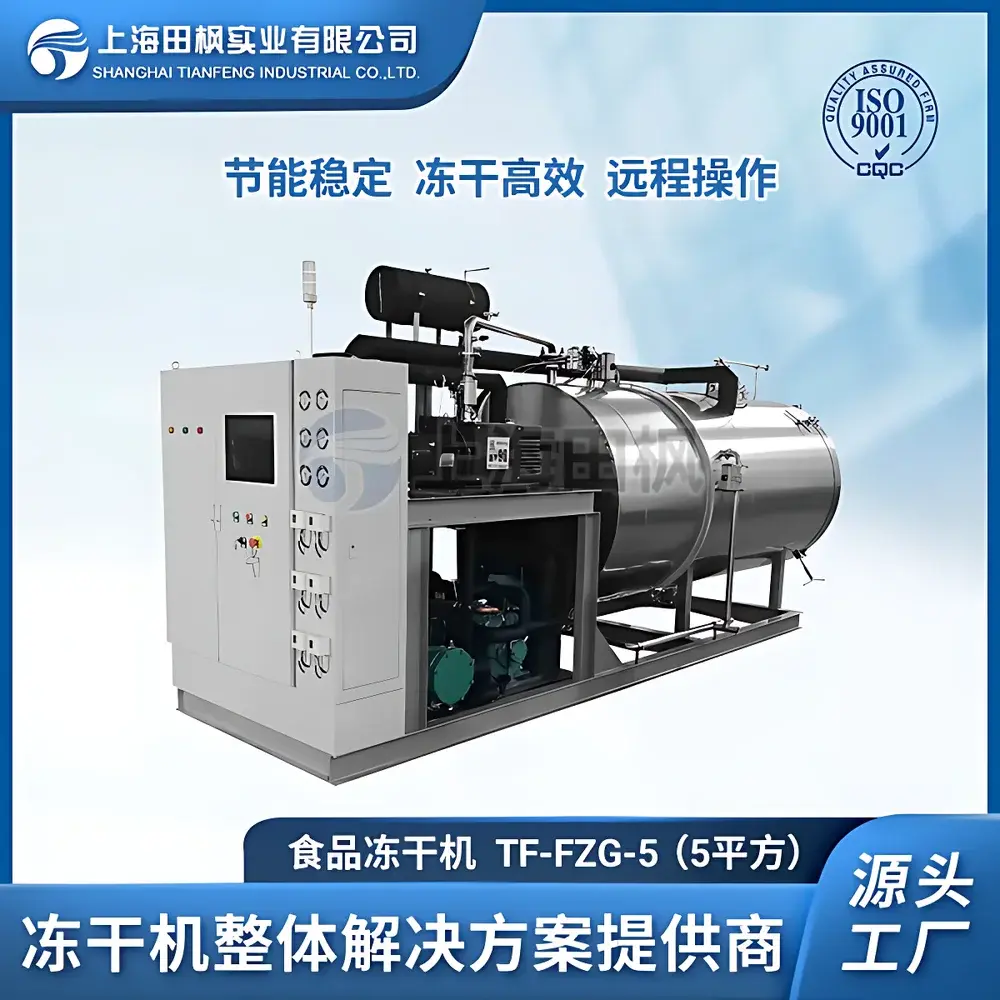
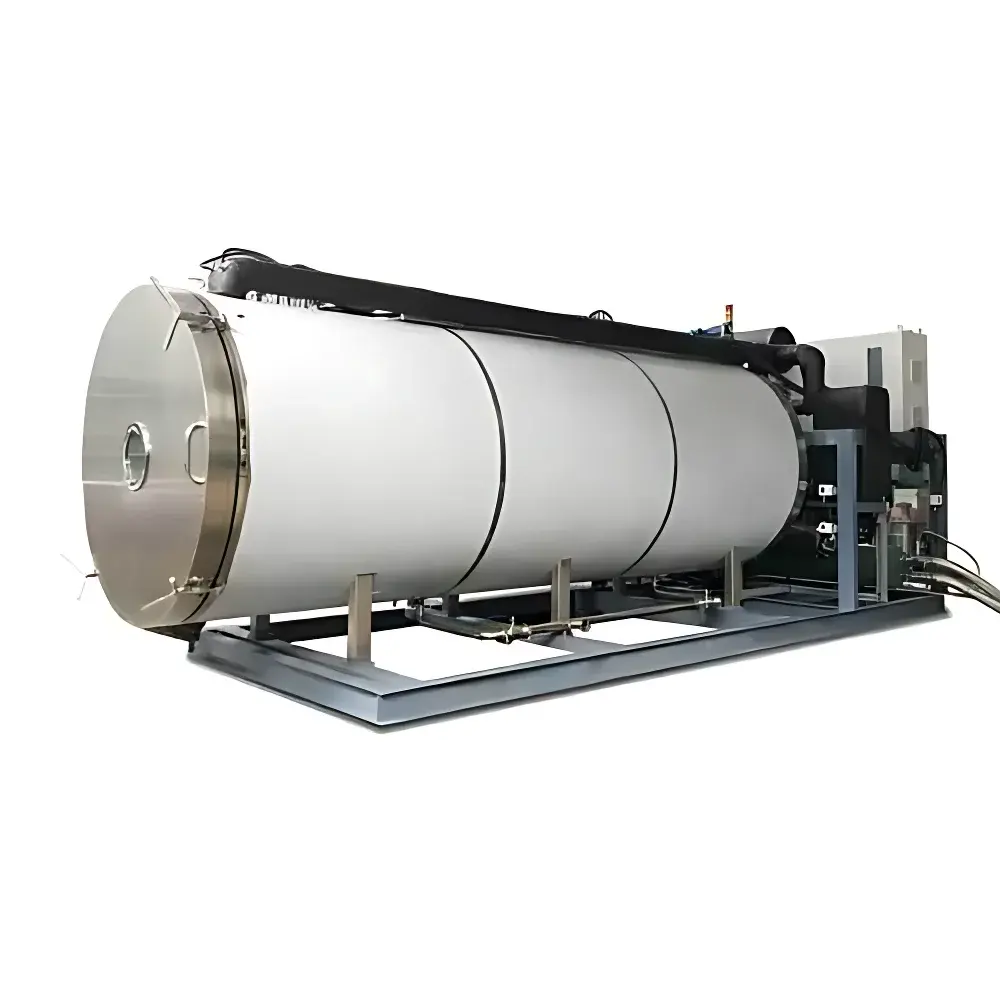
Tianfeng TF-FZG-5 Industrial Freeze Dryer for Floral Preservation and Anthocyanin Stabilization
| Brand | Tianfeng |
|---|---|
| Origin | Shanghai, China |
| Manufacturer Type | Direct Manufacturer |
| Product Category | Domestic |
| Model | TF-FZG-5 |
| Instrument Type | Standard Shelf-Type Freeze Dryer |
| Application Scope | Production-Scale |
| Lyophilization Area | 5.13 m² |
| Ultimate Vacuum | 2.7 Pa |
| Condenser Temperature | ≤ −65 °C |
| Ice Capacity (24 h) | 100 kg/24 h |
| Chamber Dimensions (W×D) | 900 mm × 950 mm |
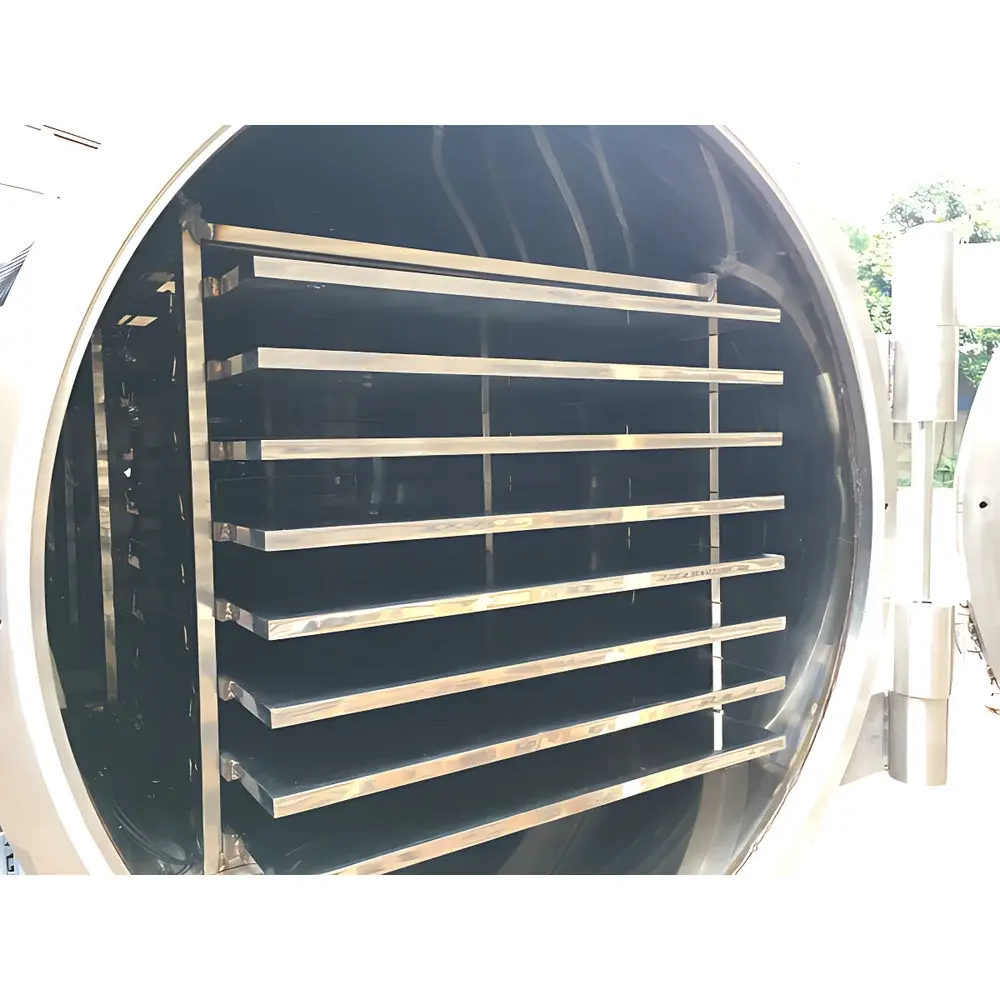
| Shelf Count | 7 (6+1) |
| Shelf Spacing | 65 mm |
| Shelf Temp Range | −45 to +70 °C |
| Total Power | 31.0 kW |
| Cooling Water Flow | 11 m³/h |
| Unit Weight | 5 T |
| Material | 304 Stainless Steel (Chamber & Shelves) |
| Control System | Omron PLC with Auto/Manual Mode, Multi-Recipe Storage, In-Process Step Jump & Parameter Adjustment |
| Defrost Method | Immersion or Steam Defrost |
| Compliance | Designed per GMP principles for pharmaceutical-grade processing environments |
Overview
The Tianfeng TF-FZG-5 Industrial Freeze Dryer is a production-scale, shelf-type lyophilization system engineered for the low-temperature, vacuum-based dehydration of heat-sensitive biological materials—particularly fresh cut flowers, petals, and anthocyanin-rich botanicals. Unlike conventional thermal drying methods operating above 0 °C, this unit performs primary drying below the eutectic point of floral tissue water (typically −20 °C to −35 °C), followed by secondary drying under deep vacuum (≤2.7 Pa) and controlled shelf heating (up to +70 °C). This two-stage process enables sublimation of ice directly from solid to vapor phase without passing through liquid state—preserving cellular architecture, pigment integrity (e.g., anthocyanins), volatile terpenoids, and structural morphology. The resulting lyophilized flowers retain original color fidelity, dimensional stability, and textural resilience, qualifying them for long-term ambient storage (>24 months) without desiccant or inert gas packaging. Its design integrates pharmaceutical-grade engineering principles—including GMP-aligned chamber construction, traceable process control, and audit-ready operational logs—making it suitable not only for floriculture but also for R&D in natural product stabilization, cosmetic active ingredient recovery, and botanical extract preservation.
Key Features
- 5.13 m² stainless steel shelf area with 7 independently configurable shelves (6 working + 1 auxiliary), spaced at 65 mm intervals for uniform heat transfer and scalable batch loading
- Double-walled, mirror-polished 304 stainless steel drying chamber conforming to ASME BPVC Section VIII and EU GMP Annex 1 surface finish standards (Ra ≤ 0.4 µm)
- Integrated condenser with ≤−65 °C minimum temperature capability and 100 kg/24 h ice-trapping capacity, fabricated from electropolished sanitary-grade stainless steel tubing
- High-efficiency refrigeration system using premium imported compressors (e.g., Bitzer or Danfoss), achieving ≤−65 °C condenser temperature in <90 minutes from ambient start
- Omron PLC-based control platform supporting ≥100 user-defined lyophilization protocols, real-time parameter logging (shelf temp, chamber pressure, condenser temp), and 21 CFR Part 11-compliant electronic signatures and audit trails
- Front-loading chamber with double-glazed observation window, integrated LED illumination, and rapid-access door seal mechanism minimizing downtime between cycles
- Dual-mode defrost system (steam or immersion) enabling full condenser cleaning within 20 minutes, validated for residue-free operation per ISO 14644-1 Class 7 cleanroom maintenance protocols
Sample Compatibility & Compliance
The TF-FZG-5 accommodates whole stems, loose petals, layered floral arrangements, and pre-packed botanical matrices up to 50 L total volume per cycle. Its shelf temperature range (−45 °C to +70 °C) supports both cryo-stabilization of anthocyanin glycosides and gentle desorption drying of delicate epidermal tissues. All wetted surfaces comply with FDA 21 CFR 178.3570 (food-contact stainless steel) and ISO 8573-1:2010 Class 2 compressed air purity requirements where applicable. The system meets CE Machinery Directive 2006/42/EC, RoHS 2011/65/EU, and is designed to support validation against ASTM F2337-04 (Standard Practice for Validation of Freeze Drying Processes) and ISO 22000:2018 food safety management criteria. Documentation packages include IQ/OQ protocols, material certificates (EN 10204 3.1), and calibration records traceable to NIST standards.
Software & Data Management
The embedded HMI interface provides intuitive recipe creation with stepwise control over shelf ramp rates, hold durations, vacuum ramp profiles, and pressure modulation via pneumatic throttling valve. All process data—including time-stamped shelf temperature gradients, chamber pressure curves, condenser load accumulation, and alarm history—are stored locally on encrypted SD card and exportable via USB or Ethernet to LIMS-compatible CSV or XML formats. Optional integration with SCADA systems (Modbus TCP/RTU) enables centralized monitoring across multi-unit facilities. Audit trail functionality records operator ID, timestamp, parameter changes, and manual overrides—fully compliant with FDA 21 CFR Part 11 Subpart C requirements for electronic records and signatures.
Applications
- Commercial-scale production of premium preserved flowers (“eternal roses”, orchids, hydrangeas) for luxury gifting and interior decor markets
- Stabilization of anthocyanin-rich extracts from berries, red cabbage, and purple sweet potato for nutraceutical and functional food applications
- Recovery of volatile floral waters (hydrosols) during primary drying—collected condensate retains native terpenes, phenolics, and osmolytes for use in cosmeceutical formulations
- Lyophilization of enzymatically active plant tissues for botanical reference standards and phytochemical library curation
- Process development for GMP-compliant botanical API drying in accordance with ICH Q5C and WHO TRS 986 Annex 5 guidelines
FAQ
What is the maximum batch size for whole rose stems?
The unit supports up to 80–100 kg of fresh floral biomass per cycle depending on stem density and packing configuration—validated with standard Rosa damascena specimens at 85% initial moisture content.
Can the system be validated for pharmaceutical use?
Yes. Full IQ/OQ documentation templates, sensor calibration certificates, and FAT/SAT reports are provided. The control architecture supports 21 CFR Part 11 compliance when paired with approved network authentication infrastructure.
Is steam sterilization of the chamber possible?
No. The chamber is not designed for SIP (Steam-in-Place); however, it supports VHP (vaporized hydrogen peroxide) decontamination cycles per ISO 14644-3 Class 5 protocols using third-party generators.
What vacuum pump options are available?
Standard configuration includes ULVAC or Ebara oil-lubricated rotary vane pumps; optional dry scroll or screw pump configurations are available for solvent-laden or halogenated vapor applications.
How is condenser defrost water quality verified?
Condensate collection vessels may be fitted with inline conductivity sensors (0–2000 µS/cm) and pH probes; typical floral hydrosol conductivity ranges from 15–45 µS/cm, indicating minimal mineral leaching and high organic purity.



