
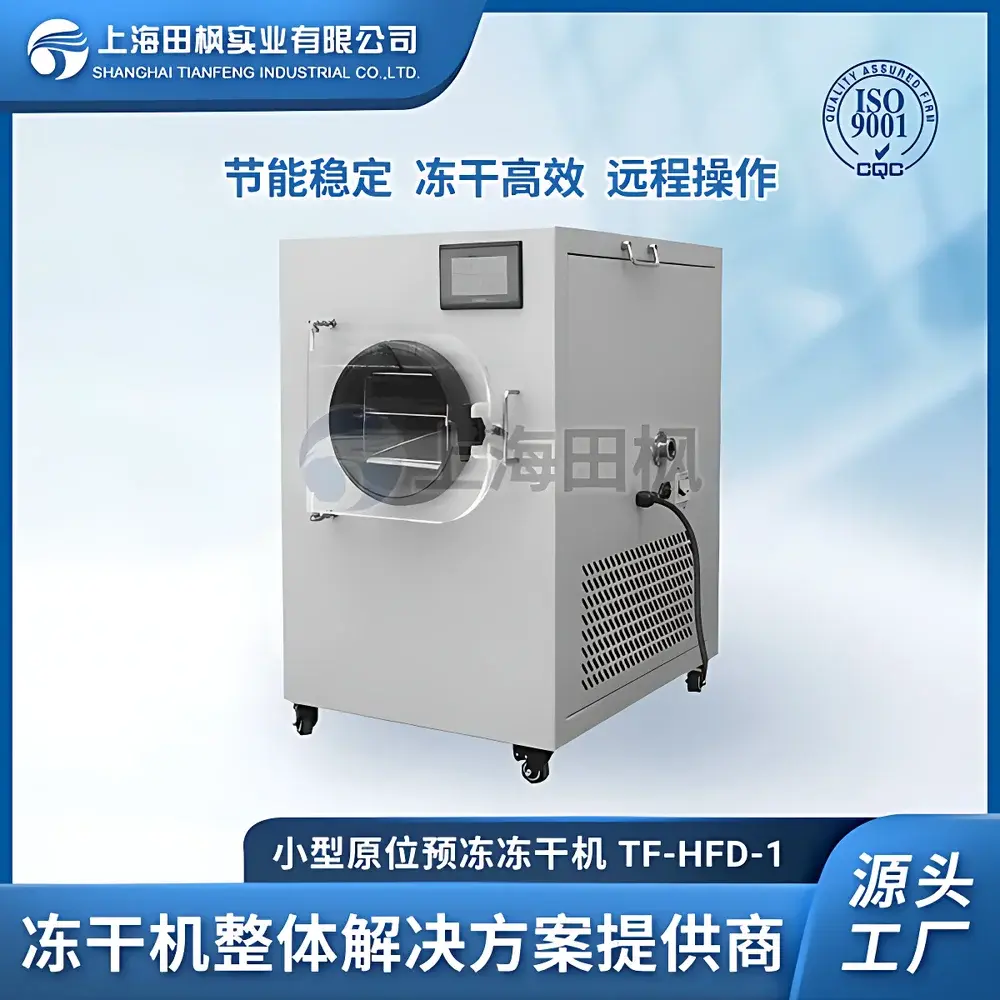
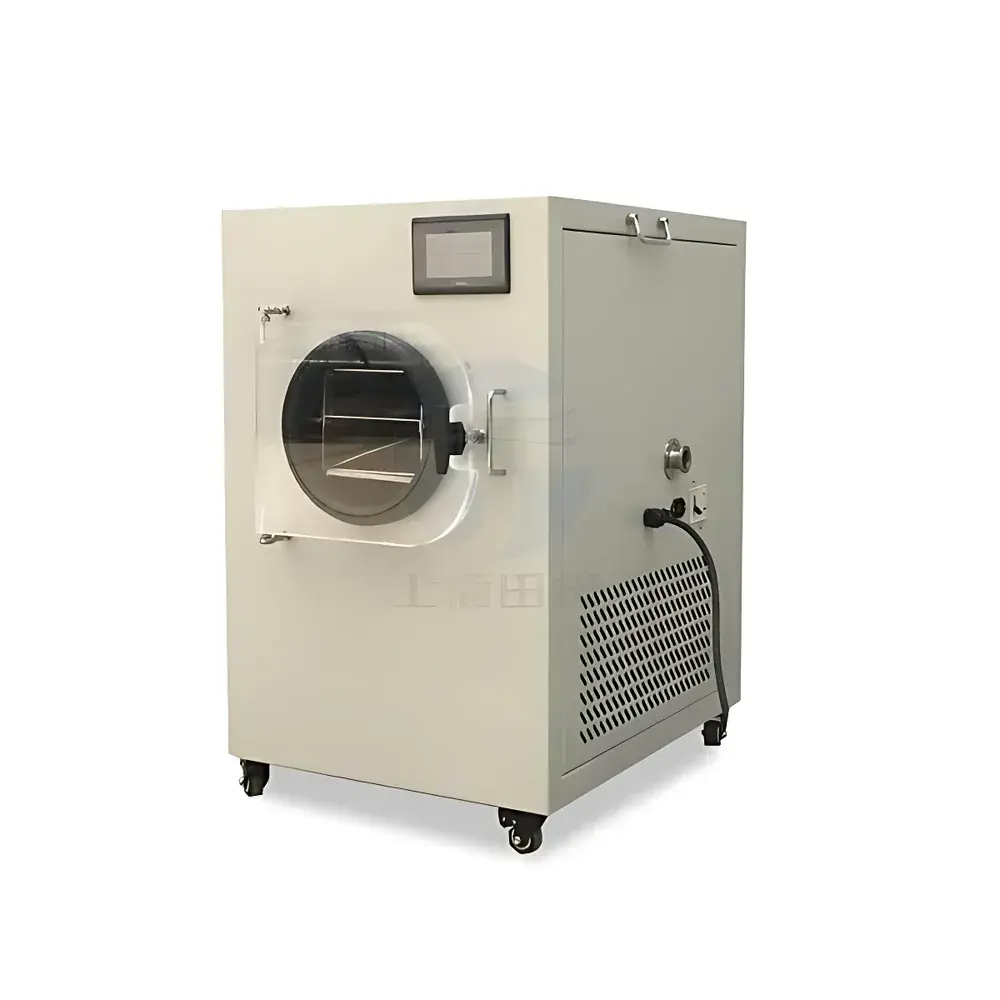
Tianfeng TF-HFD-11 Benchtop In-Situ Freeze Dryer
| Brand | Tianfeng |
|---|---|
| Origin | Shanghai, China |
| Manufacturer Type | Direct Manufacturer |
| Product Category | Domestic |
| Model | TF-HFD-11 |
| Instrument Type | Standard Shelf-Type Freeze Dryer |
| Application Scope | Pilot & Small-Scale Production |
| Lyophilization Area | 0.1 m² |
| Ultimate Vacuum | ≤10 Pa (at no-load) |
| Condenser Temperature | ≤−40 °C |
| Water Capture Capacity | 3 kg/24 h |
| Overall Dimensions (W×D×H) | 400 mm × 550 mm × 700 mm (excluding door and handles) |
| Shelf Temperature Range | −35 °C to +60 °C |
| Power Supply | 220 V, 50 Hz |
| Rated Power | 750 W |
| Shelf Tray Size | 140 mm × 278 mm |
| Construction Material | SUS304 Stainless Steel Interior & Trays |
| Viewing Window | Transparent Acrylic Door |
| Control System | Touchscreen Interface with Real-Time Curve Monitoring & Programmable Cycle Editing |
| Defrosting | One-Touch Electric Defrost |
| Compliance | Designed for GLP-compliant laboratory environments |
Overview
The Tianfeng TF-HFD-11 is a compact, in-situ benchtop freeze dryer engineered for precision lyophilization of heat-sensitive biologicals, herbal extracts, food matrices, and pharmaceutical intermediates. It operates on the fundamental principle of sublimation—removing water from frozen samples under deep vacuum while maintaining product integrity through controlled thermal management. Unlike ambient drying methods such as sun-drying or hot-air dehydration, which induce thermal degradation, enzymatic activity, and morphological collapse, this system preserves native conformation, bioactivity, color fidelity, and structural porosity. Its integrated refrigeration condenser achieves ≤−40 °C, enabling efficient vapor capture during primary drying, while the programmable shelf temperature control (−35 °C to +60 °C) supports both freezing and secondary drying phases within a single chamber. With a nominal lyophilization area of 0.1 m² and a 3 kg/24 h condensing capacity, the TF-HFD-11 bridges the gap between analytical-scale research and pilot-line process development.
Key Features
- In-situ freezing and drying in one chamber—eliminates sample transfer, minimizing contamination risk and preserving sterility-critical integrity
- High-resolution touchscreen HMI with real-time graphical display of shelf temperature, chamber pressure, and condenser temperature curves
- Programmable multi-step drying protocols with adjustable ramp rates, hold times, and vacuum modulation
- SUS304 stainless steel interior and trays—corrosion-resistant, non-reactive, and compliant with ISO 14644-1 Class 5 cleanroom handling standards
- Optically transparent acrylic front door—enables direct visual monitoring of cake formation, sublimation front progression, and potential collapse events
- Low-noise, high-efficiency dual-stage compressor system—optimized for stable condenser performance and energy conservation (rated power: 750 W)
- One-touch electric defrost function—reduces downtime between cycles and prevents ice accumulation-induced vacuum leaks
- Over-temperature and over-pressure safety interlocks—automatically halt operation if parameters exceed preconfigured thresholds
Sample Compatibility & Compliance
The TF-HFD-11 accommodates a broad spectrum of sample formats including vials (up to 20 mL), petri dishes, and custom trays (140 mm × 278 mm). It is routinely deployed for lyophilizing aqueous-based formulations of probiotics, enzyme solutions, botanical extracts (e.g., Ophiocordyceps sinensis), fruit purees, and diagnostic reagents. The system meets mechanical and operational prerequisites outlined in ISO 22057 (freeze-drying equipment specifications) and supports method validation per ICH Q5C and USP <1211>. When operated with optional data-logging firmware, it delivers time-stamped, user-authenticated records suitable for GLP audits and 21 CFR Part 11 compliance—enabling electronic signatures, audit trails, and secure data export in CSV or PDF format.
Software & Data Management
The embedded control firmware provides full-cycle parameter logging at 1-second intervals, storing up to 100 complete drying profiles locally. Users may export datasets via USB interface for post-processing in MATLAB, Python (Pandas), or commercial CQV platforms. Optional PC-based software extends functionality with comparative curve overlay, deviation analysis against master curves, and automated report generation—including batch ID tagging, operator ID, environmental timestamping, and pass/fail flagging based on user-defined acceptance criteria. All system events—including door opening, power interruption, alarm triggers, and manual intervention—are permanently recorded in an immutable audit trail.
Applications
- Stabilization of thermolabile biologics (e.g., monoclonal antibodies, viral vectors, mRNA-LNPs) for long-term storage and transport
- Preparation of standardized herbal reference materials—retaining volatile oils, polysaccharides, and nucleoside analogs in Cordyceps, ginseng, and goji berries
- R&D-scale dehydration of functional foods (e.g., berry powders, mushroom mycelia, fermented dairy cultures)
- Production of calibration standards for HPLC, LC-MS, and ELISA assays requiring matrix-matched stability
- Process optimization studies—mapping critical quality attributes (CQAs) such as residual moisture (<5%), reconstitution time, and cake morphology against cycle parameters
FAQ
What is the maximum sample volume per batch?
The unit supports up to 1.5 L of total liquid load across standard trays—equivalent to approximately 3 kg of ice, consistent with its 24-hour condensation capacity.
Can the shelf temperature be independently controlled during primary and secondary drying?
Yes. The system allows separate setpoint definition and ramp scheduling for each phase, supporting dynamic control strategies such as annealing or ramped shelf warming.
Is remote monitoring supported?
Local Ethernet connectivity is available as an upgrade option, enabling integration into lab-wide SCADA systems and secure remote access via TLS-encrypted web interface.
Does the unit comply with electrical safety standards for international use?
It conforms to IEC 61010-1:2010 for laboratory equipment safety and includes CE marking documentation. Voltage adaptation kits (110 V / 60 Hz) are available upon request.
How often does the vacuum pump require maintenance?
With continuous operation, oil changes are recommended every 500 hours; dry scroll pump variants are offered for oil-free applications requiring ultra-low hydrocarbon background.



