
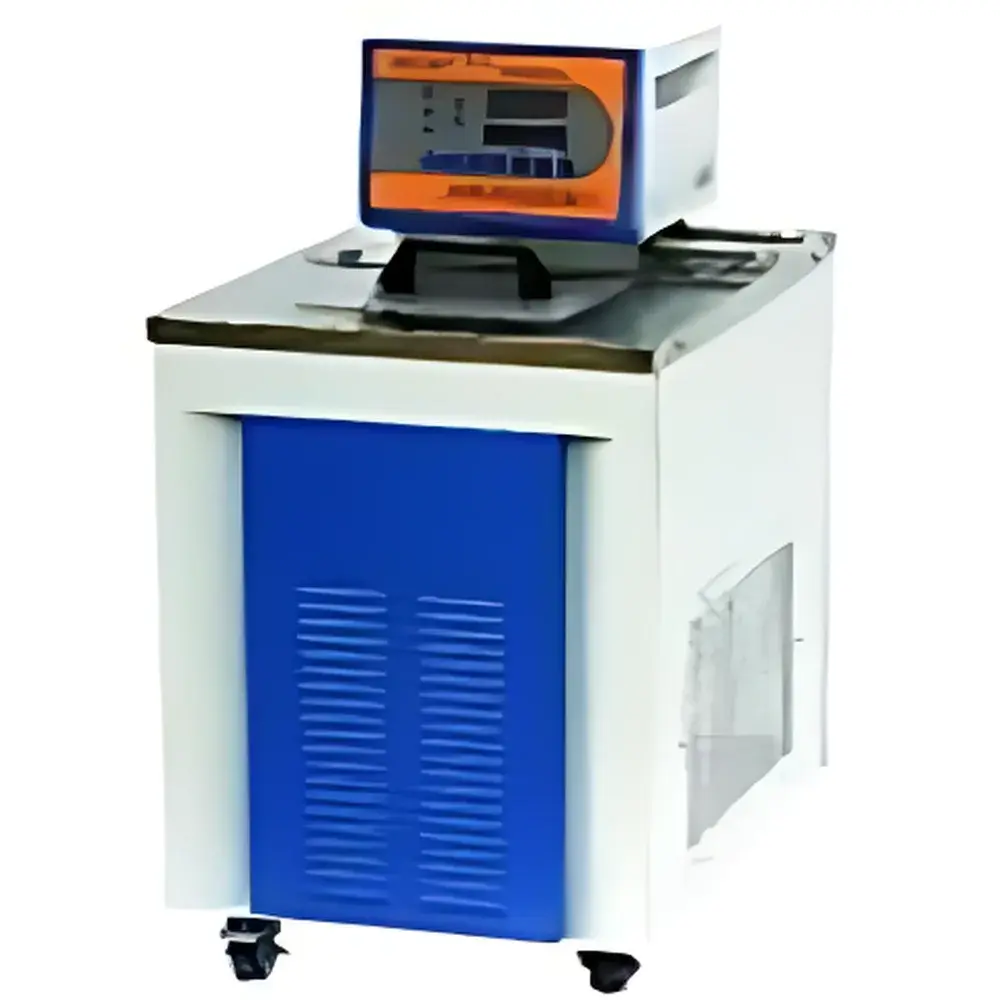
Tianfeng TF-HX-8B Precision Refrigerated/Heating Circulating Bath
| Brand | Tianfeng |
|---|---|
| Origin | Shanghai, China |
| Manufacturer Type | Direct Manufacturer |
| Instrument Type | Refrigerated/Heating Circulating Bath |
| Capacity | 8 L |
| Temperature Range | −20 °C to +99 °C |
| Temperature Stability | ±0.1 °C |
| Power Supply | 220 V / 50 Hz |
| Rated Power | 520 W |
| External Dimensions (L×W×H) | 430 × 313 × 797 mm |
| Operating Panel Dimensions (L×W×H) | 185 × 140 × 120 mm |
| Circulation Mode | Internal & External |
| Control Interface | Touch-sensitive Soft Keys |
| Temperature Display | Digital LED |
| Control Algorithm | PID-based Output |
| Construction | Full Stainless Steel Interior & Work Surface |
| Safety Features | Over-Temperature Alarm, Differential-Temperature Alarm, Scheduled Start/Stop |
Overview
The Tianfeng TF-HX-8B is a high-stability, dual-mode refrigerated/heating circulating bath engineered for precision temperature control in laboratory and analytical environments. It operates on the principle of forced liquid circulation—using a stainless steel reservoir, integrated pump, and thermally optimized heat exchanger—to maintain setpoint accuracy across both cooling and heating modes. The unit employs a hermetically sealed, air-cooled compressor with imported refrigeration components, enabling reliable operation from −20 °C to +99 °C with a certified stability of ±0.1 °C under steady-state conditions. Its design adheres to fundamental thermal engineering principles: large-surface-area evaporator geometry improves heat transfer efficiency; low-turbulence internal flow paths minimize thermal gradients; and PID-controlled power modulation ensures minimal overshoot during ramping. Unlike passive water baths, the TF-HX-8B actively circulates fluid both internally (for uniform bath temperature) and externally (to regulate temperature of external reactors, spectrophotometer cells, or jacketed vessels), making it suitable for applications requiring dynamic thermal management.
Key Features
- Hermetically sealed, air-cooled refrigeration system with imported compressor for consistent low-temperature performance and extended service life
- Dual-mode temperature control: seamless transition between refrigeration (−20 °C) and heating (+99 °C) without manual configuration changes
- Full stainless steel tank and work surface—resistant to corrosion, compatible with aqueous, ethylene glycol, and silicone oil media
- PID-based digital temperature controller with touch-sensitive soft keys and real-time LED display of setpoint and actual bath temperature
- Programmable timing functions: scheduled start-up and delayed shutdown for unattended overnight operation
- Integrated safety monitoring: independent over-temperature cutoff and differential-temperature alarm (e.g., detecting abnormal sensor drift or coolant loss)
- High-efficiency evaporator design based on large-volume heat exchange theory—enabling rapid cooldown and improved spatial uniformity (±0.05 °C typical gradient across 8 L volume)
- External circulation port with pressure-regulated flow output (adjustable up to 15 L/min at 0.3 bar) for coupling with jacketed reactors, viscometers, or calorimeters
Sample Compatibility & Compliance
The TF-HX-8B supports a broad range of heat-transfer fluids—including deionized water, 30–50% aqueous glycol solutions, and low-viscosity silicone oils—enabling compatibility with diverse sample containers (glass, stainless steel, PTFE-lined) and experimental configurations. Its stainless steel construction meets basic hygienic requirements for QC labs handling pharmaceutical intermediates or food-grade samples. While not certified to ISO/IEC 17025 calibration standards out-of-box, the unit’s ±0.1 °C stability and digital traceability (via time-stamped setpoint logs in optional software mode) support GLP-compliant workflows when paired with external NIST-traceable thermometry. It conforms to IEC 61010-1:2010 safety requirements for laboratory electrical equipment and incorporates reinforced insulation and earth leakage protection.
Software & Data Management
The TF-HX-8B features an embedded microcontroller with RS232 communication interface (optional USB-to-serial adapter available), allowing integration into lab-wide monitoring systems via Modbus RTU or ASCII protocol. When connected to host software (e.g., LabVIEW, MATLAB, or custom Python scripts), users can log temperature profiles, export CSV-formatted time-series data, and trigger alarms via serial commands. Audit trails—including operator ID (if network-authenticated), parameter changes, and alarm events—are recordable in external databases. Though the device does not natively comply with FDA 21 CFR Part 11, its deterministic control logic and timestamped operational logs provide foundational traceability required for GMP-aligned validation protocols.
Applications
- Calibration of temperature-sensitive instruments (e.g., thermocouples, RTDs, infrared sensors) against reference standards
- Thermal conditioning of samples prior to rheological, viscometric, or density measurements
- Temperature stabilization of optical components in spectroscopy setups (UV-Vis, FTIR) to reduce thermal drift
- Cooling of exothermic reactions in small-scale batch reactors or flow chemistry modules
- Controlled thawing/freezing studies in biopharmaceutical development (e.g., protein stability assays)
- Environmental simulation for material testing—e.g., coefficient of thermal expansion (CTE) determination per ASTM E831
FAQ
What temperature accuracy can be expected during external circulation?
Under nominal load (≤10 L/min flow rate, ambient ≤25 °C), the system maintains ±0.15 °C stability at the external outlet when using a 40% glycol/water mix.
Is the bath compatible with silicone oil as a working fluid?
Yes—provided viscosity remains below 50 cSt at operating temperature; maximum recommended fill level is 7.5 L to prevent pump cavitation.
Does the unit support remote start/stop via digital I/O?
No native dry-contact I/O; control is limited to RS232 serial command set or front-panel interaction.
Can the internal temperature sensor be calibrated by the user?
Yes—via a two-point offset adjustment function accessible through service mode, using a NIST-traceable reference thermometer.
What maintenance intervals are recommended for long-term reliability?
Compressor oil and refrigerant levels require verification every 24 months; condenser coil cleaning is advised quarterly in dusty environments.



