
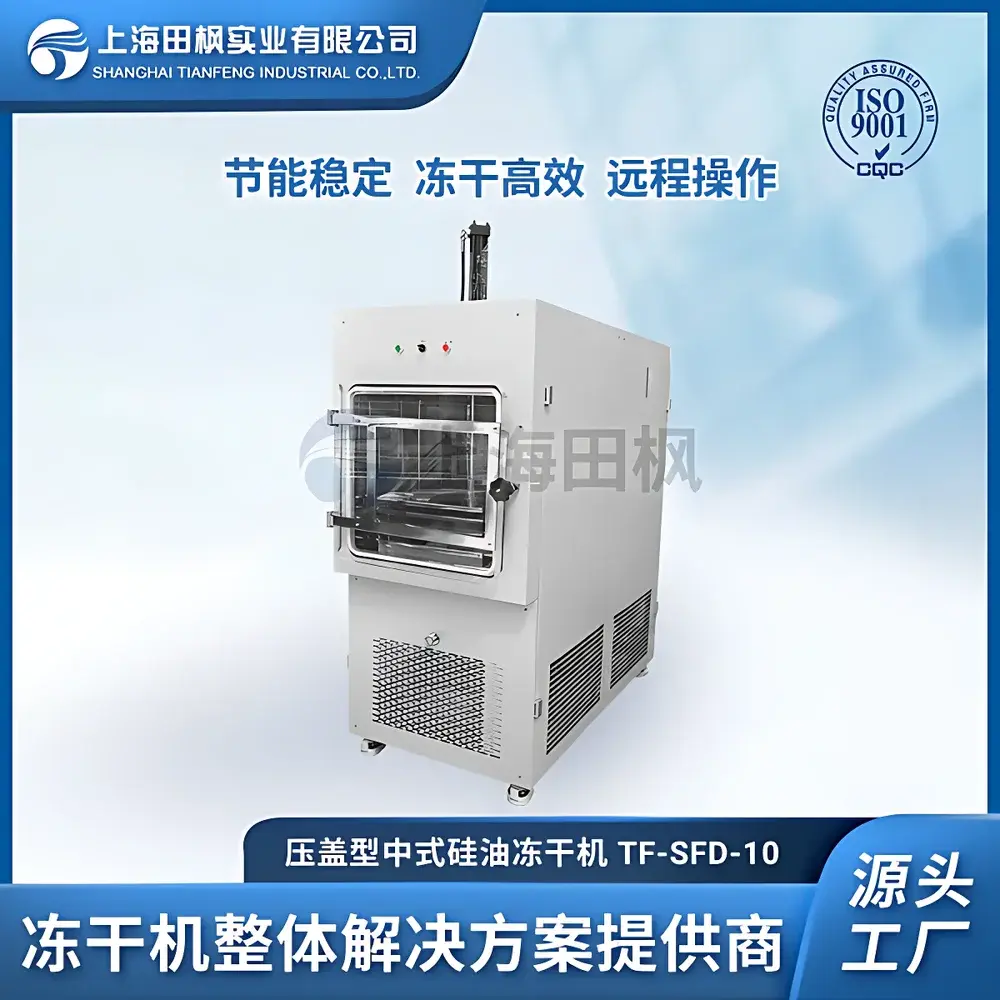
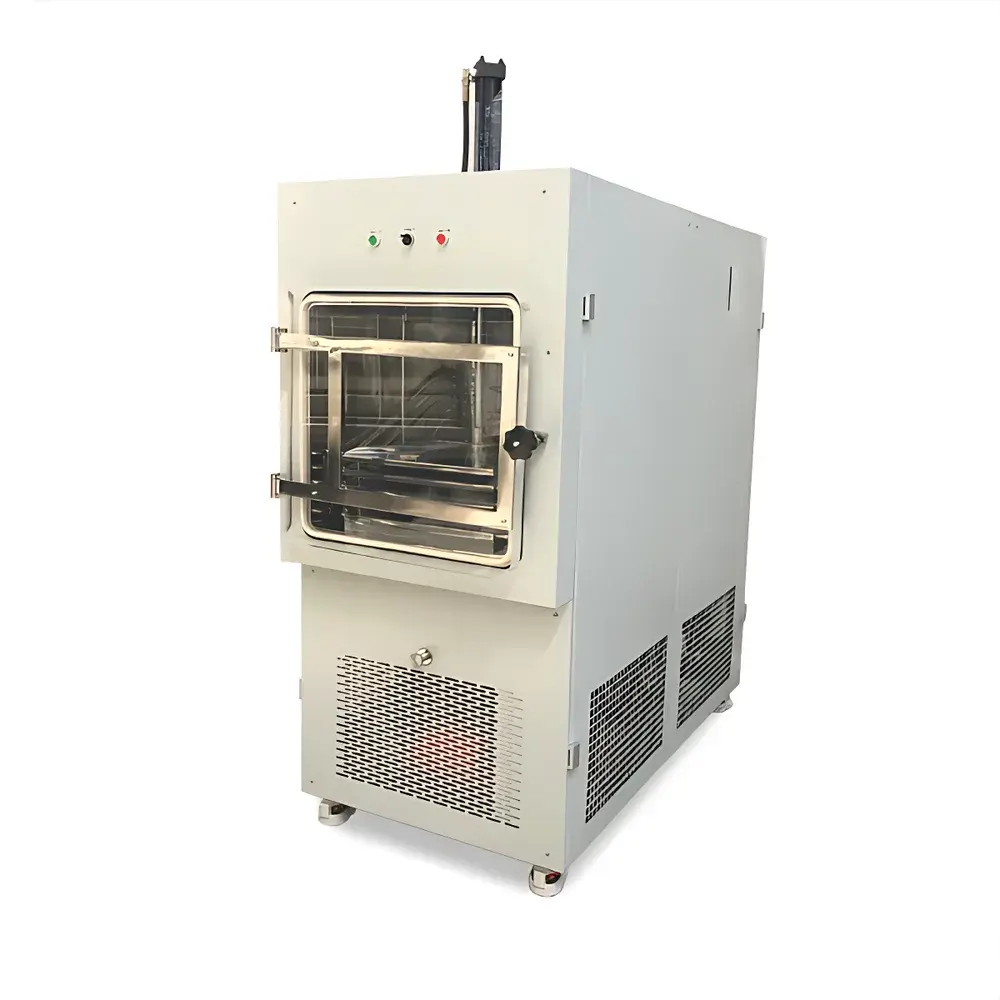
Tianfeng TF-SFD-10 In-Situ Shelf-Type Pharmaceutical Freeze Dryer
| Brand | Tianfeng |
|---|---|
| Origin | Shanghai, China |
| Manufacturer Type | Direct Manufacturer |
| Equipment Category | Domestic |
| Model | TF-SFD-10 |
| Instrument Type | Shelf-Type with Hydraulic Stoppering |
| Scale | Pilot-Scale |
| Lyophilization Area | 1.05 m² |
| Ultimate Vacuum | ≤5 Pa |
| Condenser Temperature | ≤−70 °C |
| Ice Capacity (24 h) | 16 kg/24 h |
| Shelf Dimensions | 450 mm × 600 mm |
| Shelf Quantity | 5 (4 working + 1 bottom) |
| Shelf Spacing | 70 mm |
| Shelf Temp Range | −50 °C to +80 °C |
| Chamber Viewing Window | High-transparency acrylic door |
| Refrigeration System | Cascade refrigeration with silicone oil as heat transfer medium |
| Control System | Touchscreen HMI with PID-controlled shelf temperature, real-time drying curve plotting, and data logging |
| Optional Accessories | Co-lyophilization point tester, automated stopper press, temperature mapping probes, 21 CFR Part 11-compliant data recorder |
Overview
The Tianfeng TF-SFD-10 is an in-situ shelf-type pharmaceutical freeze dryer engineered for pilot-scale lyophilization of thermolabile biologics, cosmetic actives, and sterile parenteral formulations. It operates on the fundamental principle of sublimation—where frozen water is removed directly from the solid phase to vapor under deep vacuum—preserving structural integrity, biological activity, and chemical stability without thermal degradation. Designed for GMP-aligned environments, the system integrates primary drying (sublimation) and secondary drying (desorption) stages within a single, fully enclosed chamber. Its in-situ freezing capability eliminates manual transfer between pre-freezing and drying units, minimizing contamination risk and ensuring batch consistency—critical for regulatory compliance in cosmetic injectables (e.g., EGF, bFGF, aFGF), vaccines, monoclonal antibodies, and diagnostic reagents.
Key Features
- In-situ hydraulic stoppering: Integrated pneumatic stopper mechanism enables sterile closure of vials under vacuum or inert gas (N₂/Ar), meeting USP and ISO 13408-1 requirements for aseptic processing.
- Cascade refrigeration system: Dual-stage compressor architecture achieves ≤−70 °C condenser temperature with high ice-trapping efficiency (16 kg/24 h), reducing primary drying time and improving process robustness.
- Silicone oil-heated/cooled shelves: ±1 °C uniformity across 5 stainless steel 316L shelves (450 × 600 mm, 70 mm spacing); precise PID control ensures reproducible freezing ramp rates and annealing profiles.
- Full-featured HMI interface: 10.4″ color touchscreen displays real-time shelf temperature, chamber pressure, condenser temp, and drying curves; supports user-defined protocols, alarm history, and exportable CSV logs.
- GMP-enabling design: 304 stainless steel interior, electropolished surfaces, leak-tight chamber (helium-tested), and optional IQ/OQ documentation packages compliant with ASTM F2699 and ISO 20578.
- Process monitoring & safety: Built-in vacuum gauge (capacitance manometer), overpressure relief valve, automatic defrost cycle, and emergency stop with hardware interlock.
Sample Compatibility & Compliance
The TF-SFD-10 accommodates standard pharmaceutical vials (Φ16 mm: up to 3,900 units/batch; Φ20 mm: up to 2,016 units/batch) and custom trays for bulk lyophilization of serums, enzyme powders, or cosmetic ampoules. Its validated operating envelope supports formulations with eutectic temperatures ranging from −45 °C to −5 °C. The system meets core regulatory expectations for lyophilizer qualification per FDA Guidance for Industry: *Lyophilization of Parenterals* (2022), EU Annex 1 (2022), and ICH Q5C. Optional co-lyophilization point detection and temperature mapping (per ISO 14644-3 Class 5 cleanroom integration) support full validation under GLP/GMP frameworks. All electrical components comply with CE EN 61000-6-4 and EN 61000-6-2 standards.
Software & Data Management
Data acquisition and traceability are managed via embedded firmware supporting audit trails, electronic signatures (per 21 CFR Part 11 when paired with optional validated recorder), and configurable alarm thresholds. Users may define multi-step drying cycles—including controlled nucleation, variable shelf ramping, and pressure rise tests (PRT)—with automatic hold points triggered by product temperature feedback. Raw data (time-stamped shelf temp, chamber pressure, condenser load) is stored internally for ≥3 months and exportable via USB or Ethernet to LIMS or ELN platforms. Optional software modules enable remote monitoring, deviation reporting, and trend analysis aligned with PQS (Process Quality System) requirements.
Applications
- Stabilization of cosmetic growth factors (EGF, bFGF, aFGF) into sterile, reconstitutable lyophilized powders for dermal delivery systems.
- Pilot-scale development of lyophilized monoclonal antibody formulations, viral vectors, and mRNA-LNPs requiring strict cold chain preservation.
- Production of diagnostic reagents (e.g., ELISA kits, PCR master mixes) where enzymatic activity and antigenicity must be retained post-drying.
- R&D of herbal injectables (e.g., ginseng saponins, cordycepin) and traditional Chinese medicine extracts requiring low-temperature dehydration.
- Bio-banking applications: long-term cryopreservation of cell lysates, serum panels, and reference standards at −50 °C shelf conditions.
FAQ
What is the maximum batch capacity for 20 mL vials?
The TF-SFD-10 holds up to 2,016 standard 20 mm diameter vials per batch when arranged on five 450 × 600 mm shelves.
Does the system support automated process validation (APV)?
Yes—when equipped with calibrated PT100 sensors, pressure transducers, and optional data logger, it supports IQ/OQ/PQ execution per ASTM E2500 and ISPE Good Practice Guide.
Can the condenser handle solvents other than water?
The condenser is optimized for aqueous systems; organic solvent compatibility (e.g., tert-butanol, acetonitrile) requires prior consultation and potential cold trap modification.
Is remote monitoring available out-of-the-box?
Basic Ethernet connectivity is standard; full SCADA integration (OPC UA, Modbus TCP) is supported via optional communication module.
What maintenance intervals are recommended for the cascade refrigeration system?
Compressor oil and filter replacement every 2,000 operating hours; annual helium leak testing and vacuum gauge calibration per ISO 20578 Clause 7.3.
Related Products



