
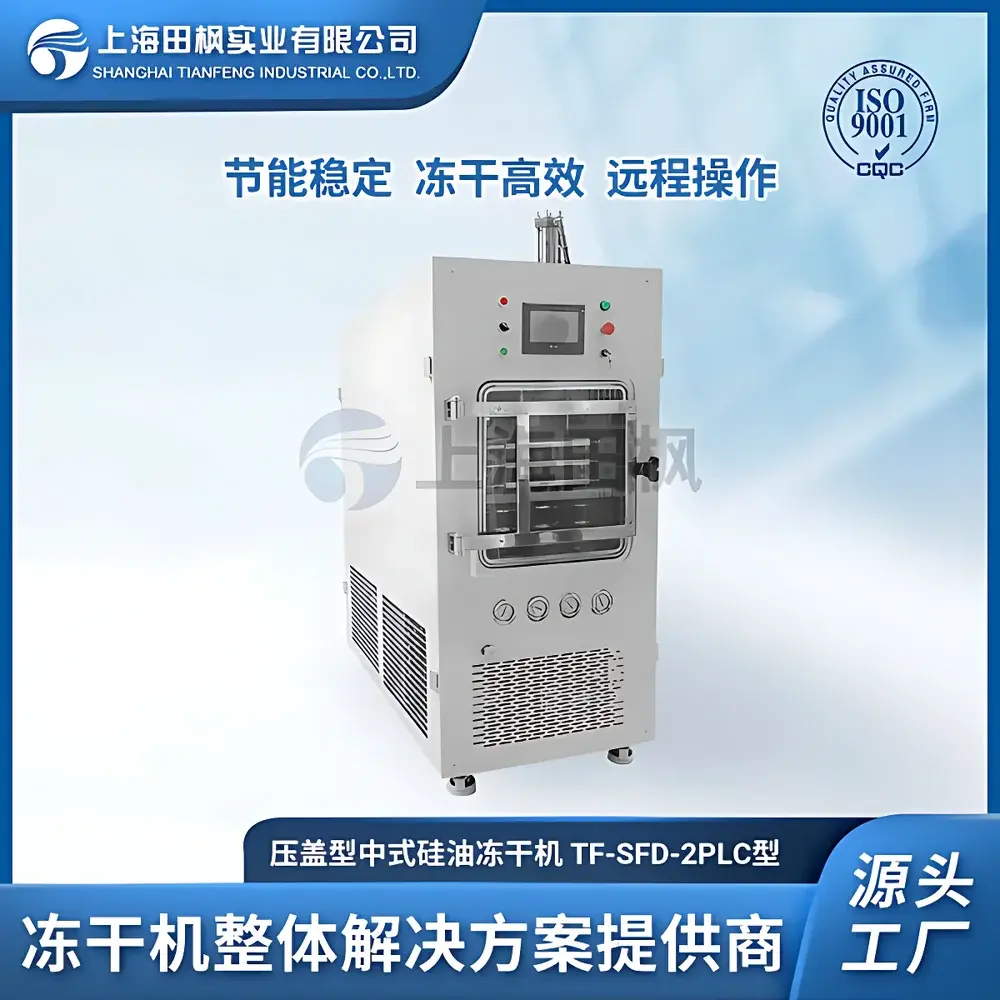
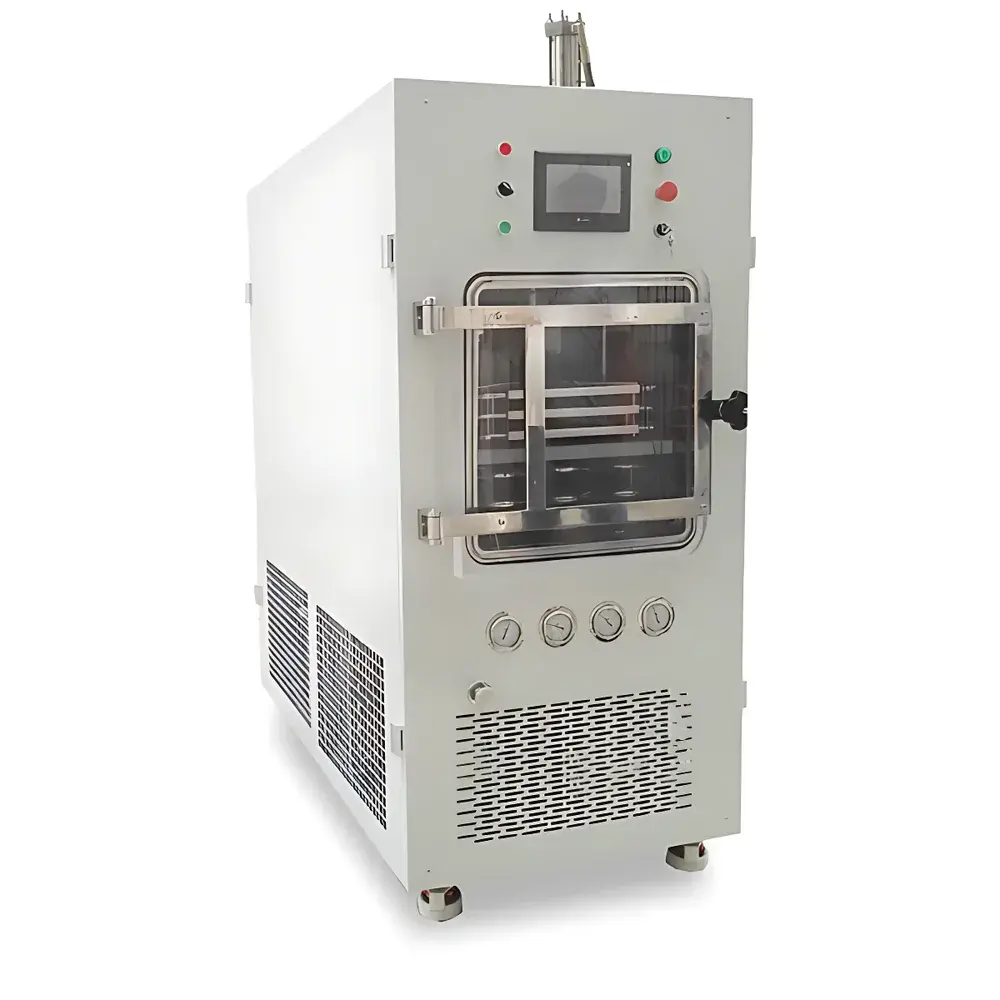
Tianfeng TF-SFD-2 Benchtop Pharmaceutical Freeze Dryer with Stoppering Function
| Brand | Tianfeng |
|---|---|
| Origin | Shanghai, China |
| Manufacturer Type | Direct Manufacturer |
| Instrument Type | In-situ Freeze Dryer with Hydraulic Stoppering |
| Application Scope | Pilot-scale Pharmaceutical Processing |
| Shelf Area | 0.21 m² |
| Ultimate Vacuum | ≤5 Pa |
| Condenser Temperature | ≤−70 °C |
| Ice Capacity (24 h) | 3 kg/batch |
| Shelf Temperature Range | −50 °C to +80 °C |
| Shelf Dimensions (W × L) | 278 mm × 380 mm |
| Shelf Spacing | 70 mm |
| Number of Shelves | 2 + 1 (condenser shelf) |
| Chamber Viewing Window | High-transparency Acrylic Door |
| Refrigeration System | Dual-stage Cascade Refrigeration |
| Control Interface | 7-inch Touchscreen LCD with Real-time Drying Curve & PID Temperature Control |
| Construction Material | Full 304 Stainless Steel Interior |
| Optional Accessories | Temperature Data Logger, Eutectic Point Tester, Automatic Stopper Actuator, Inert Gas Purge Valve (N₂/Ar) |
Overview
The Tianfeng TF-SFD-2 is a pilot-scale, in-situ pharmaceutical freeze dryer engineered for reproducible, GMP-aligned lyophilization of heat-sensitive biologics, sterile injectables, and clinical trial batches. It operates on the fundamental principle of sublimation—removing water from frozen samples under deep vacuum while maintaining product integrity below the eutectic temperature. Unlike conventional drying methods conducted above 0 °C, this system performs primary drying at cryogenic temperatures (typically −30 °C to −50 °C), followed by secondary drying at controlled elevated shelf temperatures (up to +80 °C), ensuring minimal thermal stress and preservation of protein conformation, enzymatic activity, and immunogenicity. Its integrated stoppering mechanism enables aseptic vial sealing under vacuum or inert gas backfill—critical for sterile dosage form development and stability testing per ICH Q5C and USP .
Key Features
- In-situ pre-freezing and drying within a single chamber eliminates manual transfer, reducing contamination risk and enabling full process automation from freezing to stoppering.
- Dual-stage cascade refrigeration system delivers stable condenser temperatures ≤−70 °C, supporting high ice capture efficiency and consistent primary drying rates across batch sizes up to 858 × Φ16 mm vials.
- Full 304 stainless steel interior with electropolished surfaces complies with ISO 14644-1 Class 5 cleanroom compatibility and facilitates CIP validation per FDA guidance on cleaning process validation.
- 7-inch industrial touchscreen interface displays real-time shelf temperature, chamber pressure, condenser temperature, and drying progress curves; supports user-defined multi-step protocols with PID-controlled ramp/soak profiles.
- Hydraulic stoppering actuator ensures uniform compression force across all vials, minimizing stopper misalignment and residual moisture variation—key for meeting USP container closure integrity requirements.
- Optional inert gas purge valve allows nitrogen or argon backfilling post-drying to mitigate oxidation of sensitive APIs; configurable for partial or full headspace replacement.
- Silicone oil-based shelf heating/cooling provides ±1 °C temperature uniformity across the 0.21 m² active surface, critical for achieving consistent cake morphology and reconstitution time per EP 2.9.20.
Sample Compatibility & Compliance
The TF-SFD-2 accommodates standard pharmaceutical vials (Φ16 mm, Φ20 mm), serum bottles, and custom trays. Its design supports lyophilization of monoclonal antibodies, recombinant proteins, live-attenuated vaccines, plasma-derived therapeutics, and small-molecule APIs requiring low residual moisture (<1.0%). The system meets mechanical and electrical safety standards per IEC 61010-1 and is manufactured under an ISO 9001:2015–certified quality management system. While not inherently 21 CFR Part 11 compliant, its optional data logger provides ALCOA+–aligned audit trails—including user login, parameter changes, alarm events, and timestamped curve exports—for GLP/GMP documentation during process characterization and regulatory submissions.
Software & Data Management
The embedded control software logs all critical process parameters at user-configurable intervals (1–60 seconds). Export formats include CSV and PDF reports compatible with LIMS integration. Optional temperature mapping kits support IQ/OQ execution per ASTM F2697–21. All firmware updates are delivered via secure USB import; no cloud connectivity is implemented—ensuring data sovereignty and alignment with EU Annex 11 and FDA cybersecurity guidance for legacy manufacturing systems.
Applications
This unit serves as a bridge between laboratory-scale feasibility studies and commercial manufacturing. It is routinely deployed for: formulation screening of lyoprotectants and bulking agents; cycle development and optimization per QbD principles; stability batch production for ICH Q1–Q5 studies; aseptic process simulation (media fills); and small-batch GMP release of orphan drugs and ATMPs. Its performance characteristics align with common requirements for Phase I–III clinical supply chains, particularly where cold-chain continuity and terminal sterilization alternatives are mandated.
FAQ
What is the maximum batch capacity for 2R vials?
Up to 858 vials (Φ16 mm) or 432 vials (Φ20 mm) per cycle, assuming standard fill volumes of 2–3 mL.
Does the system support automated eutectic point detection?
Yes—when equipped with the optional eutectic point tester, the system performs real-time resistance monitoring to determine collapse temperature and optimize primary drying endpoints.
Can the freeze dryer be validated for GMP use?
Yes—the mechanical design, material certifications (304 SS, FDA-compliant gaskets), and traceable calibration paths enable full IQ/OQ/PQ execution with third-party service providers.
Is remote monitoring supported?
No native Ethernet or Wi-Fi capability is included; however, analog 4–20 mA outputs and dry contact alarms allow integration into existing SCADA or BMS infrastructures.
What maintenance intervals are recommended?
Vacuum pump oil change every 500 operating hours; condenser coil inspection quarterly; door seal integrity verification before each batch per SOP.



