
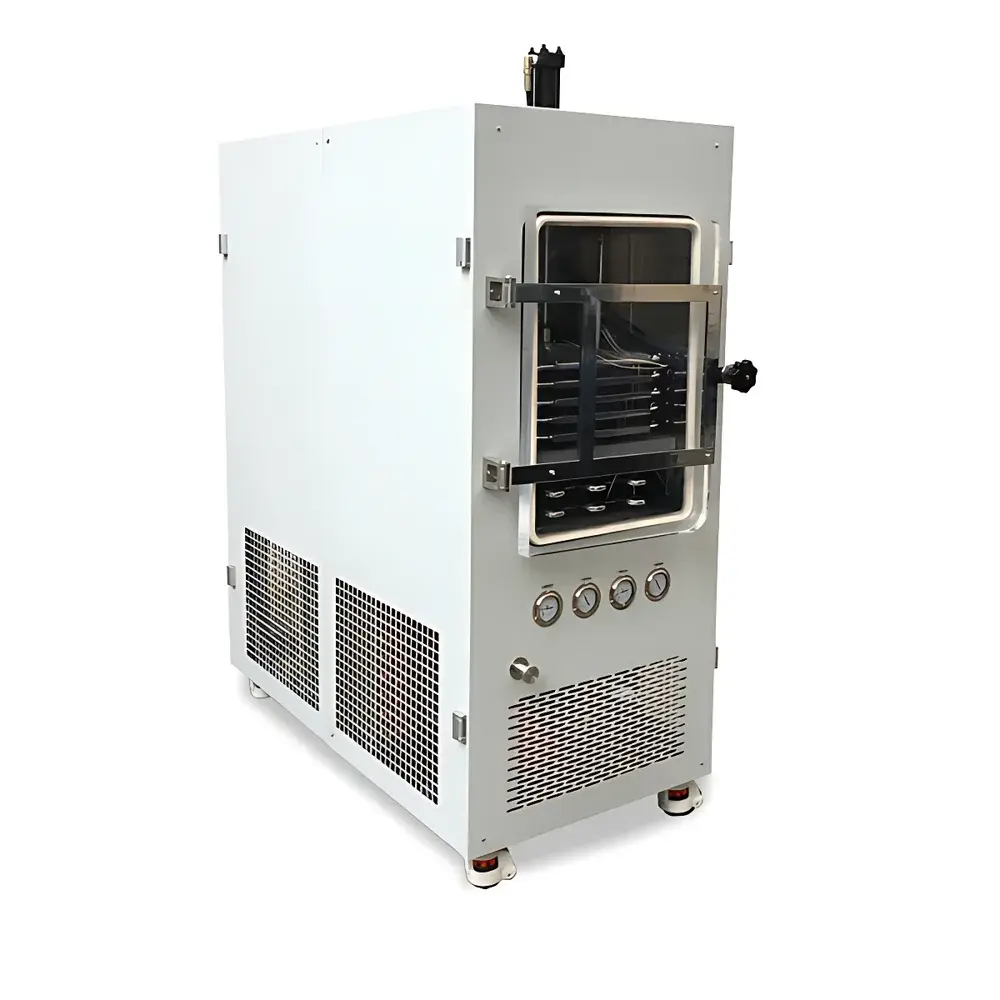
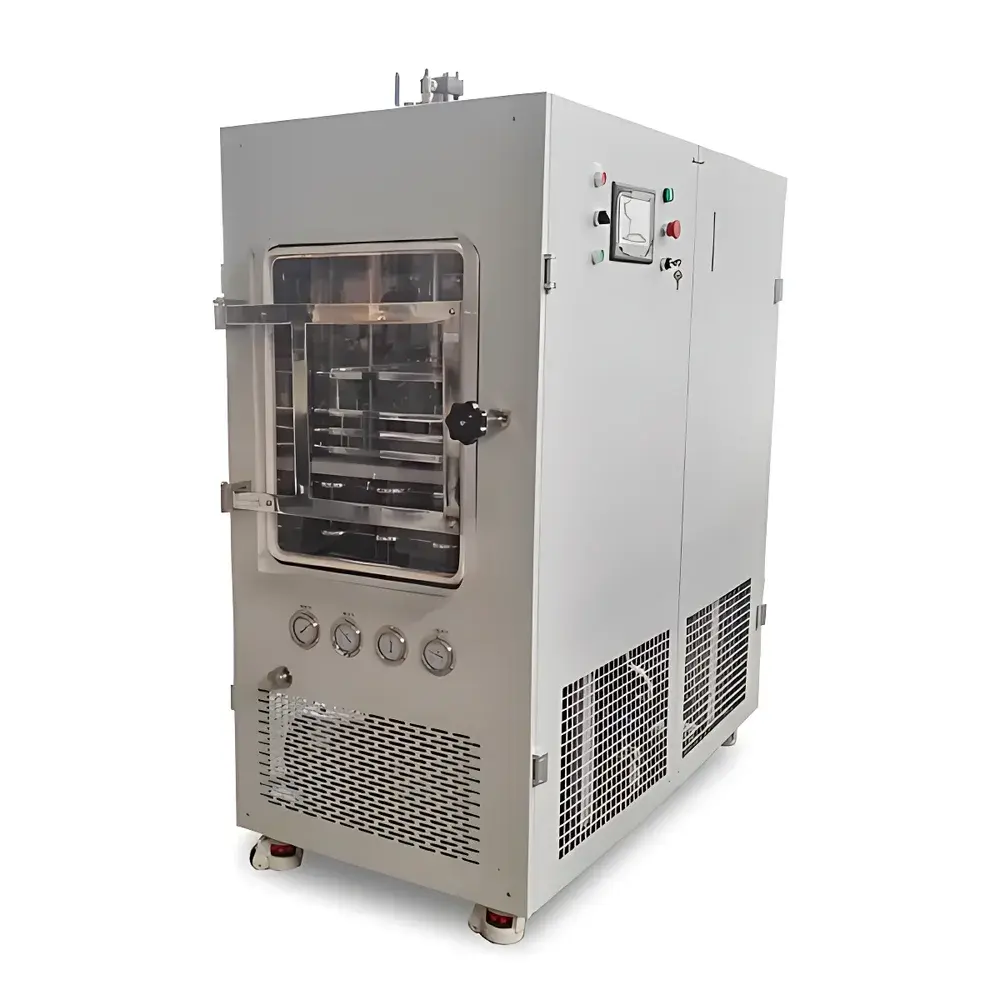
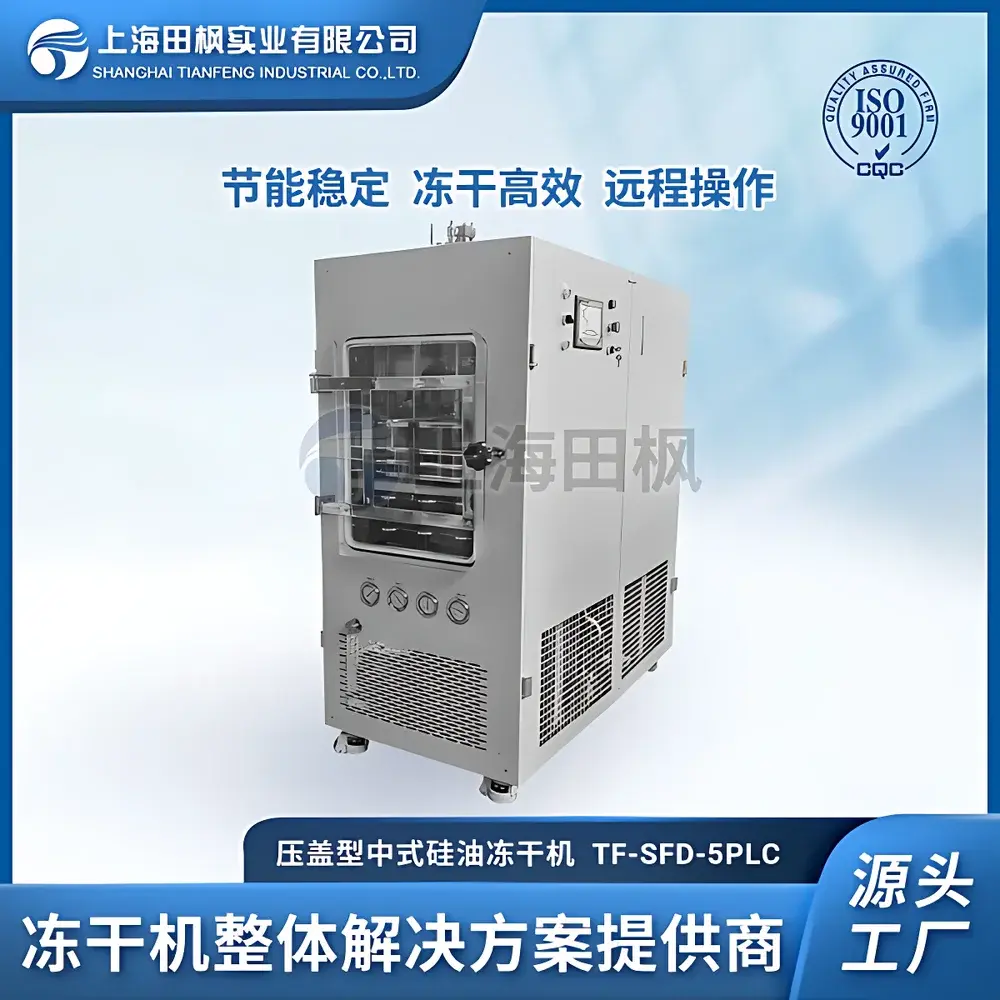
Tianfeng TF-SFD-5 Stoppering Freeze Dryer
| Brand | Tianfeng |
|---|---|
| Origin | Shanghai, China |
| Manufacturer Type | Direct Manufacturer |
| Instrument Type | Stoppering (In-situ) Freeze Dryer |
| Application Scope | Pilot-scale |
| Shelf Area | 0.5 m² |
| Ultimate Vacuum | ≤5 Pa |
| Condenser Temperature | ≤−70 °C |
| Ice Capacity (24 h) | 8 kg/24 h |
| Shelf Dimensions (W × L) | 278 mm × 460 mm |
| Shelf Quantity | 5 (4 working + 1 bottom) |
| Shelf Spacing | 70 mm |
| Shelf Temp Range | −50 °C to +80 °C |
| Power Rating | 4.5 kW |
| Net Weight | 500 kg |
| Construction | 304 Stainless Steel Interior |
| Refrigeration System | Cascade Refrigeration |
| Control Interface | Touchscreen LCD with PID Regulation & Real-time Drying Curve Display |
| Optional | Temperature Data Logger, Eutectic Point Tester, Automatic Stoppering Actuator, Inert Gas Purge Valve |
Overview
The Tianfeng TF-SFD-5 is a pilot-scale, in-situ stoppering freeze dryer engineered for reproducible lyophilization of heat-sensitive biopharmaceuticals, herbal extracts (e.g., Houttuynia cordata), and functional food matrices (e.g., corn, mushrooms). It operates on the fundamental principle of sublimation: aqueous samples are first frozen solid at low temperature, then subjected to high vacuum (≤5 Pa), enabling ice to transition directly from solid to vapor without passing through the liquid phase. This process preserves structural integrity, enzymatic activity, and immunogenic conformation—critical for biologicals such as antibiotics, vaccines, enzymes, and botanical active compounds. Unlike benchtop manifold or tray-type units, the TF-SFD-5 integrates an in-chamber hydraulic stoppering mechanism, allowing sterile sealing of vials (e.g., 2112 × Ø16 mm or 1056 × Ø20 mm) immediately after primary drying, eliminating post-drying exposure to ambient humidity and preventing rehydration or microbial ingress during storage.
Key Features
- In-situ freezing and drying within a single chamber—eliminates manual transfer, reducing contamination risk and process variability.
- Five stainless steel shelves (304 grade), each 278 mm wide × 460 mm long, with precise ±1 °C uniformity via silicone oil heating/cooling system; shelf temperature programmable from −50 °C to +80 °C.
- Cascade refrigeration architecture delivers condenser temperatures ≤−70 °C and sustained ice capture capacity of 8 kg per 24-hour cycle—optimized for high-moisture botanical loads and viscous pharmaceutical formulations.
- Full-color touchscreen interface with real-time graphical display of shelf temperature, chamber pressure, condenser temperature, and drying progress curves; PID-based control ensures stable thermal ramping and hold accuracy.
- High-transparency acrylic door enables continuous visual monitoring of cake formation, collapse behavior, and sublimation front progression without vacuum interruption.
- Integrated inert gas purge valve (N₂ or argon compatible) supports oxygen-sensitive formulations and facilitates controlled reconstitution protocols.
- Optional eutectic point detection module and automated stoppering actuator enhance GMP alignment for clinical-stage batch production.
Sample Compatibility & Compliance
The TF-SFD-5 accommodates diverse sample formats including standard serum vials (Ø16 mm and Ø20 mm), glass ampoules, and shallow trays—ideal for botanical extracts (e.g., Houttuynia cordata volatile oils), cereal-based matrices (corn starch suspensions), and fungal biomass (mushroom mycelium pellets). Its design conforms to core engineering benchmarks for laboratory-scale lyophilizers under ISO 22042 (freeze-drying equipment performance testing) and supports compliance pathways toward FDA 21 CFR Part 11 when paired with validated data logging systems. The all-stainless-steel interior and electropolished surfaces meet basic GLP cleaning requirements; optional temperature mapping and pressure rise tests enable IQ/OQ documentation for regulated environments.
Software & Data Management
The embedded controller logs timestamped process parameters at user-defined intervals (1–60 sec resolution), exporting CSV files via USB port for offline analysis. Optional certified temperature recorders provide audit-ready traceability compliant with ALCOA+ principles (Attributable, Legible, Contemporaneous, Original, Accurate). While the base system does not include electronic signatures or role-based access control, its data structure aligns with third-party LIMS integration for centralized batch record management—particularly relevant for QC labs validating herbal drug stability per USP or ICH Q5C guidelines.
Applications
This system serves cross-sectoral R&D and pilot manufacturing needs: in biopharma, it supports formulation development of monoclonal antibody intermediates and live-attenuated vaccine candidates; in traditional medicine research, it enables stabilization of thermolabile alkaloids and flavonoids from Houttuynia cordata while retaining anti-inflammatory activity; in food science, it produces instant rehydratable mushroom powders with preserved umami nucleotides and corn-based functional ingredients with minimized Maillard degradation. Its 0.5 m² shelf area bridges the gap between lab-scale feasibility studies and small-batch cGMP production—making it suitable for university technology transfer centers, CDMOs, and botanical API manufacturers scaling up from flask-based to vial-based lyophilization.
FAQ
What is the difference between in-situ stoppering and manual stoppering?
In-situ stoppering occurs inside the vacuum chamber immediately after drying completion, using integrated hydraulics to seal vials under inert gas—preventing moisture uptake and maintaining sterility. Manual stoppering requires breaking vacuum and transferring vials to a separate isolator, increasing contamination and variability risk.
Can the TF-SFD-5 handle high-sugar or high-viscosity botanical extracts?
Yes—the cascade refrigeration system and −70 °C condenser support efficient water vapor removal from viscous matrices, though formulation optimization (e.g., bulking agents, annealing cycles) is recommended for optimal cake structure in polysaccharide-rich samples like corn syrup derivatives.
Is this unit suitable for regulatory filing batches?
While the base configuration meets essential engineering criteria, formal regulatory submissions require additional validation (IQ/OQ/PQ), documented calibration, and optionally, 21 CFR Part 11-compliant software upgrades—available through Tianfeng’s qualified service partners.
What maintenance intervals are recommended for the cascade compressor system?
Compressor oil and filter replacement every 3,000 operating hours; annual condenser coil inspection and vacuum pump oil change; quarterly verification of shelf temperature uniformity and leak rate (<0.1 Pa·min⁻¹) using calibrated gauges.
Does the unit support controlled ice nucleation?
Not natively—but the programmable shelf cooling profile allows stepwise freezing protocols that approximate nucleation control; for precise ice nucleation, external nucleation devices (e.g., SNiF™) can be integrated via auxiliary ports.



