
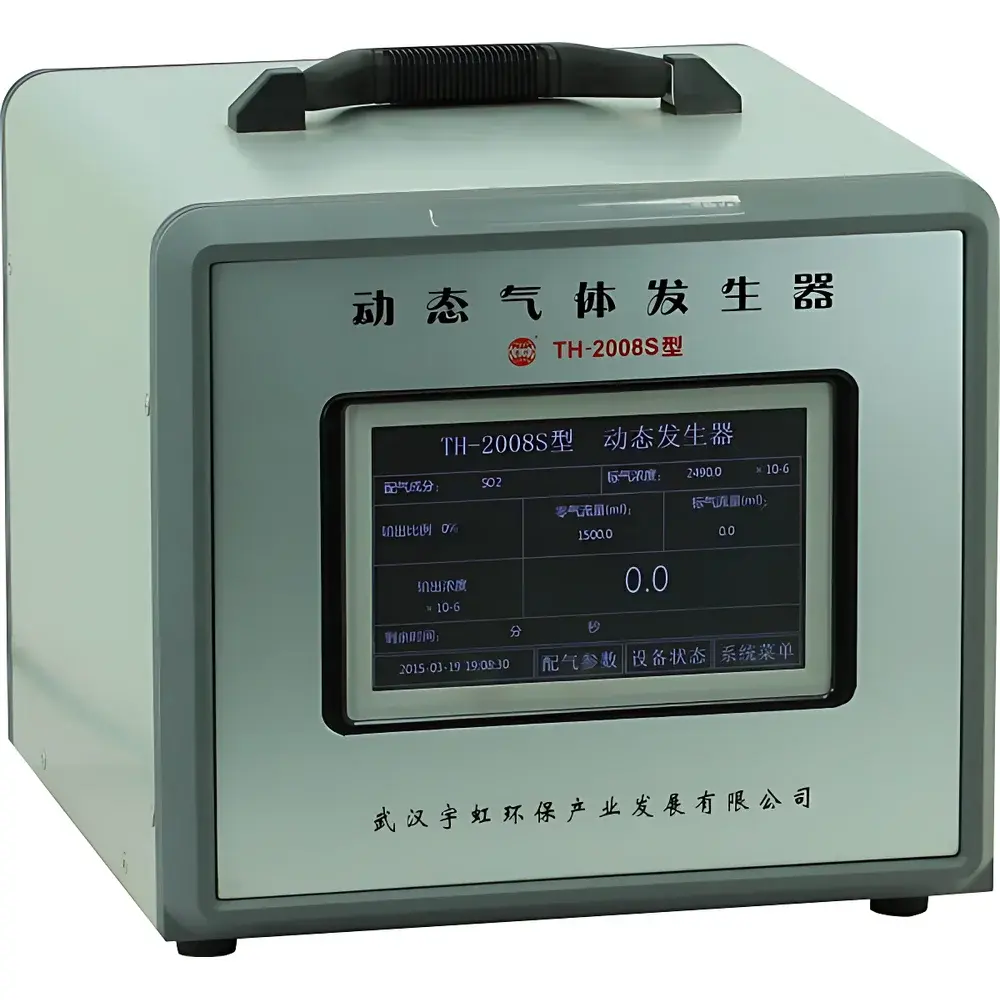
Tianhong TH-2008S Dynamic Gas Generator
| Brand | Tianhong |
|---|---|
| Model | TH-2008S |
| Origin | Hubei, China |
| Type | Zero Air & Multi-Gas Dynamic Dilution Generator |
| Gas Compatibility | SO₂, NOₓ, CO, CO₂, NH₃, HCl, N₂ |
| Flow Control | High-Accuracy Mass Flow Controllers (MFCs) with PID Regulation |
| Display | 7-inch Touchscreen Interface |
| Operating Principle | Dynamic Gravimetric Dilution via Precision MFCs |
| Compliance Context | Designed for CEMS calibration per EPA Method 205, ISO 12039, and CNAS/China Metrology Verification Regulations (JJG 1113–2015) |
| Pressure & Temperature Compensation | Real-time P/T sensing for STP-corrected flow calculation |
| Calibration Mode | Pre-programmed multi-point sequence or manual on-site adjustment |
Overview
The Tianhong TH-2008S Dynamic Gas Generator is an engineered solution for traceable, on-site calibration of Continuous Emission Monitoring Systems (CEMS) analyzers in industrial stack and environmental monitoring applications. Unlike static gas cylinders or fixed-ratio dilutors, the TH-2008S implements dynamic gas dilution based on gravimetric mass flow control principles—where certified standard gases are precisely metered and mixed with zero air or nitrogen in real time using calibrated thermal mass flow controllers (MFCs). This architecture enables continuous, programmable generation of low-concentration gas standards (e.g., 1–200 ppm SO₂ in air) without requiring multiple high-pressure reference cylinders. The system operates under ISO/IEC 17025-aligned metrological conditions: all MFCs are factory-traceable to national standards, and real-time pressure and temperature measurements feed into standardized volume correction algorithms (per ISO 6145-4 and ASTM D6166), ensuring molar concentration accuracy compliant with regulatory audit requirements.
Key Features
- Dynamic multi-gas dilution capability supporting SO₂, NOₓ (NO/NO₂), CO, CO₂, NH₃, HCl, and other reactive or non-reactive analytes—without MFC re-calibration between gas changes;
- Imported high-stability thermal mass flow controllers with <1% full-scale repeatability, zero warm-up delay, and integrated PID feedback loops for sub-second flow stabilization;
- Onboard environmental compensation: simultaneous measurement of inlet pressure (±0.1 kPa) and gas temperature (±0.2 °C) enables automatic conversion to standard temperature and pressure (STP: 25 °C, 101.325 kPa);
- Intuitive 7-inch capacitive touchscreen interface with graphical workflow navigation, password-protected parameter editing, and dual-language (English/Chinese) UI support;
- Predefined calibration sequences compliant with Chinese JJG 1113–2015 and U.S. EPA Performance Specification 2 (PS-2) multi-point linearity verification protocols;
- Compact benchtop form factor (W320 × D450 × H280 mm, <18 kg) with integrated zero-air generation module (optional) and modular gas inlet manifolds for rapid field deployment.
Sample Compatibility & Compliance
The TH-2008S accommodates standard compressed gas cylinders (CGA-600/CGA-320 fittings) containing certified reference materials (CRMs) traceable to NIST, NIM, or BAM. It supports both single-component and pre-mixed multi-gas standards, including reactive species such as NH₃ and HCl—provided cylinder regulators meet ISO 8573-1 Class 2 purity requirements. The instrument’s dilution architecture complies with ISO 12039:2000 (stationary source emissions — determination of sulfur dioxide and nitrogen oxides — performance characteristics of automated measuring systems), and its operational documentation meets GLP data integrity expectations for audit-ready calibration logs. All firmware and configuration files are timestamped and stored with immutable metadata, satisfying basic 21 CFR Part 11 recordkeeping prerequisites when used in regulated QA/QC environments.
Software & Data Management
The embedded control firmware provides local data logging of every calibration event—including gas ID, target concentration, actual delivered concentration, flow rates, P/T values, operator ID, and pass/fail status against user-defined tolerance bands (e.g., ±2% of nominal). Logs export via USB 2.0 to CSV or PDF formats compatible with LIMS integration. Optional Ethernet/Wi-Fi connectivity enables remote monitoring and scheduled calibration task execution through a secure web-based dashboard. Audit trails retain full revision history of method parameters and system configurations, supporting ISO/IEC 17025 clause 7.7.1 (control of records) and CNAS-CL01:2018 documentation requirements.
Applications
- Multi-point span and zero calibration of CEMS analyzers installed at coal-fired power plants, cement kilns, waste incinerators, and chemical manufacturing facilities;
- Field verification of analyzer linearity and drift according to EPA Method 205 (Dynamic Spiking Procedure) and China’s HJ 75–2017 technical specification for CEMS operation and quality control;
- Reference gas generation for laboratory validation of optical absorption (DOAS, TDLAS), electrochemical, and paramagnetic O₂ analyzers;
- Supporting stack testing campaigns where transport of multiple high-concentration standard cylinders poses logistical or safety constraints;
- Integration into mobile calibration labs or ambient air monitoring networks requiring portable, self-contained gas standard delivery.
FAQ
Does the TH-2008S require recalibration of mass flow controllers when switching between different standard gases?
No. The MFCs are calibrated using nitrogen-equivalent scaling factors and maintain accuracy across common industrial gases within their specified viscosity and thermal conductivity ranges per ISO 6145-3.
Can the instrument generate true zero air for analyzer zero checks?
Yes—when equipped with the optional catalytic zero-air generator module (TH-ZA1), it delivers hydrocarbon-free air meeting EPA Method 205 specifications (<0.1 ppm THC, <0.02 ppm CO).
Is remote software update supported?
Firmware updates are performed via USB stick with digital signature verification; over-the-air updates are not enabled by default for security and regulatory compliance reasons.
What is the minimum detectable concentration achievable with SO₂ dilution?
Using a 100 ppm SO₂ primary standard and maximum 1000:1 dilution ratio, the system achieves stable output down to 100 ppb with ±3% relative uncertainty (k=2) under controlled lab conditions.
Does the device meet electromagnetic compatibility (EMC) requirements for industrial sites?
Yes—it conforms to IEC 61326-1:2013 Class A emission limits and immunity testing per IEC 61000-4 series (ESD, surge, fast transient burst).







