
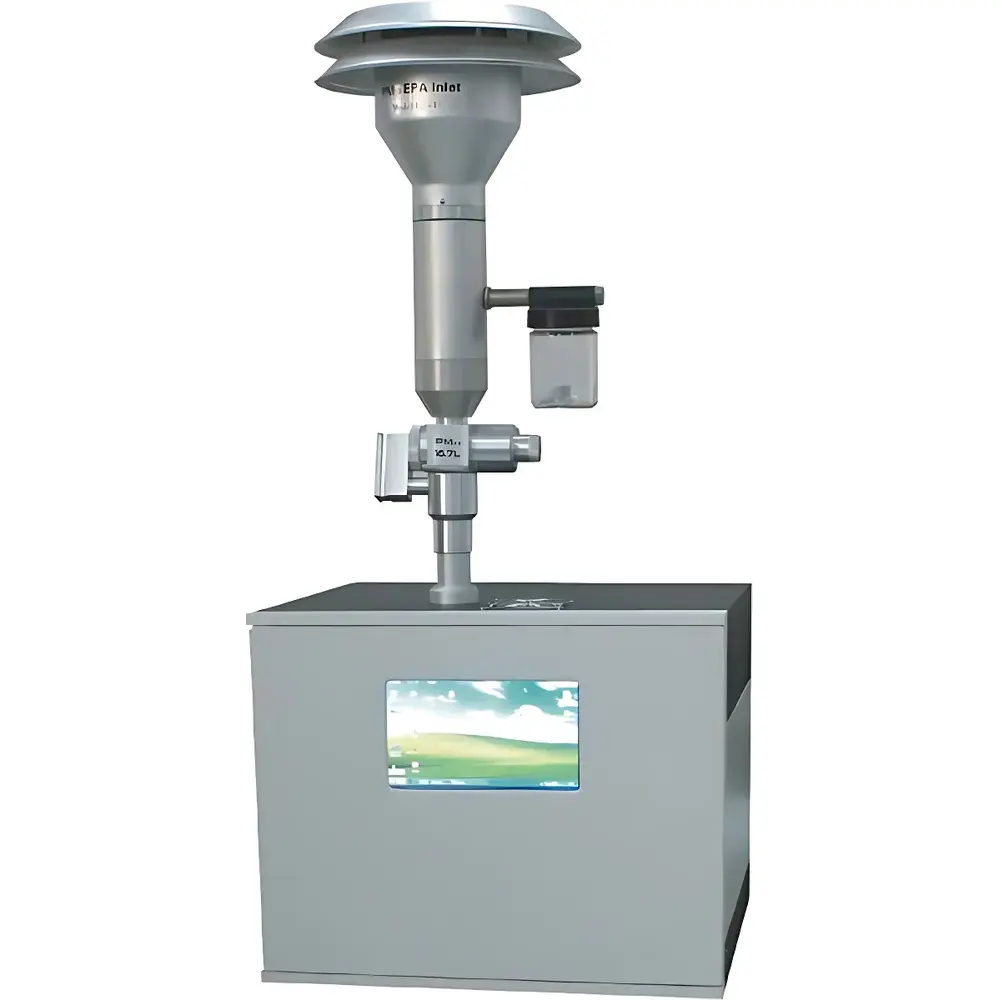
Tianhong TH-2016 Atmospheric Heavy Metal Online Analyzer
| Brand | Tianhong |
|---|---|
| Origin | Hubei, China |
| Model | TH-2016 |
| Measurement Principle | Energy-Dispersive X-Ray Fluorescence (ED-XRF) |
| Measurement Range | 0–200 µg/m³ |
| Detection Limit | 1 ng/m³ |
| Filter Tape Replacement Interval | 4 days |
| Operating Temperature | −40 to +50 °C |
| Operating Relative Humidity | 0–90 % RH |
| Operating Pressure Range | 1 kPa |
| Compliance | U.S. EPA Method IO-3.3 |
| Particle Size Selection | Optional TSP, PM₁₀, or PM₂.₅ inlets |
| Elemental Capability | Up to 32 heavy metals including Pb, As, Hg |
| Data Interfaces | RS-232/485, USB, GPRS, Ethernet |
| Enclosure | 19″ rack-mountable chassis |
Overview
The Tianhong TH-2016 Atmospheric Heavy Metal Online Analyzer is an automated, field-deployable instrument engineered for continuous, real-time quantification of trace-level heavy metals in ambient airborne particulate matter. It operates on the principle of energy-dispersive X-ray fluorescence (ED-XRF), a non-destructive, multi-element analytical technique widely accepted for environmental monitoring applications. Unlike offline laboratory methods requiring filter collection and subsequent digestion or analysis, the TH-2016 integrates atmospheric particle enrichment, automated tape handling, and in situ XRF spectroscopy into a single robust platform—enabling unattended operation over extended periods with minimal maintenance. The system conforms to U.S. Environmental Protection Agency (EPA) Method IO-3.3 for ambient metal aerosol monitoring, ensuring regulatory alignment for compliance reporting and trend analysis in air quality networks.
Key Features
- Integrated atmospheric particulate enrichment system featuring aerodynamic particle size-selective inlets—compatible with TSP, PM10, or PM2.5 cut-points per ISO 10791-3 and EPA reference methods.
- Dedicated polytetrafluoroethylene (PTFE) filter tape with ultra-low intrinsic metal background, eliminating spectral interference from substrate contamination and enhancing measurement fidelity at sub-ng/m³ levels.
- Low-power, high-stability imported X-ray tube optimized for long-term field deployment; coupled with a semiconductor-cooled silicon drift detector (SDD) delivering high count-rate performance, exceptional energy resolution (<145 eV at Mn Kα), and zero peak drift under thermal fluctuation.
- Automated multi-filter wheel (3-position) for dynamic background suppression across elemental emission lines—enabling optimal excitation-to-detection ratios for light (e.g., Al, Si) and heavy (e.g., Pb, Hg) elements alike.
- Self-calibrating architecture: built-in reference module enables simultaneous energy and intensity axis calibration without external standards; factory pre-calibrated using EPA-certified thin-film standards—no field recalibration required during routine operation.
- 10-inch integrated industrial touchscreen interface with embedded Linux-based control firmware; supports full local operation without external PC dependency.
- Rack-mountable 19″ chassis design compliant with IEC 60297-3-100, suitable for permanent installation in national air quality monitoring stations or mobile laboratories aboard environmental survey vehicles.
Sample Compatibility & Compliance
The TH-2016 is designed for direct analysis of airborne particulate matter collected onto PTFE tape under controlled flow conditions. Its particle inlet configuration adheres to internationally recognized size-separation criteria (ISO 7708, EN 12341, EPA Method 201A), enabling speciated assessment of metal distribution across inhalable (PM10) and respirable (PM2.5) fractions. The instrument meets the technical requirements of U.S. EPA IO-3.3 for continuous XRF-based metal monitoring, and its data acquisition architecture supports audit-ready logging aligned with GLP principles. While not certified under FDA 21 CFR Part 11, its timestamped, tamper-evident data records—including raw spectra, calibration logs, and environmental metadata—are structured to facilitate integration into validated environmental data management systems meeting ISO/IEC 17025 and EU Directive 2008/50/EC reporting frameworks.
Software & Data Management
The TH-2016 runs a modular, layered software architecture built on POSIX-compliant embedded OS. Core modules include real-time spectrum acquisition, peak deconvolution using fundamental parameter (FP) algorithms, matrix correction routines for particle density and composition effects, and time-series concentration calculation per element. All spectral data are stored in standardized HDF5 format with embedded metadata (flow rate, temperature, pressure, tape position, calibration status). Communication protocols include ASCII-over-RS485 for legacy SCADA integration, TCP/IP for MODBUS/TCP and HTTP-based RESTful API access, and optional GPRS telemetry for remote sites with limited infrastructure. Data export supports CSV, XML, and EPA AQS-compatible formats. Software updates and configuration changes are performed via secure SSH or authenticated web interface.
Applications
- Long-term ambient air quality monitoring networks tracking Pb, As, Cd, Cr, Ni, Zn, Cu, Mn, and other regulated metals under national and regional air pollution control programs.
- Source apportionment studies near industrial clusters (e.g., smelters, coal-fired power plants, waste incinerators) where temporal resolution supports correlation with stack emissions or meteorological parameters.
- Urban background and traffic-influenced site characterization, particularly for neurotoxic elements such as mercury and lead in proximity to legacy contamination zones.
- Mobile monitoring campaigns deploying on vehicle-mounted platforms to map spatial gradients of airborne metal burden across metropolitan areas or industrial corridors.
- Supplemental verification for regulatory compliance against WHO Air Quality Guidelines and EU Ambient Air Quality Directives (2004/107/EC).
FAQ
What particle size fractions can the TH-2016 measure?
The instrument accepts interchangeable impactor inlets—TSP, PM10, or PM2.5—each meeting ISO 7708 aerodynamic diameter cutoff specifications.
Is the system capable of unattended operation for extended periods?
Yes. With a 4-day filter tape replacement interval, wide environmental operating range (−40 to +50 °C, 0–90% RH), and redundant power input options, it supports continuous 24/7 monitoring with scheduled maintenance intervals exceeding 30 days.
Does the analyzer require periodic recalibration in the field?
No. Factory calibration using NIST-traceable thin-film standards per EPA IO-3.3 is stable over time; the internal auto-zero and energy calibration modules maintain spectral integrity without user intervention.
Which heavy metals are routinely quantified, and how many elements can be reported simultaneously?
Standard reporting includes Pb, As, Hg, Cd, Cr, Ni, Zn, Cu, Mn, and Fe; the ED-XRF engine supports quantitative analysis of up to 32 elements depending on spectral overlap and minimum detection requirements.
Can raw XRF spectra be exported for independent processing?
Yes. Full-resolution MCA (Multi-Channel Analyzer) spectra, including live-time-corrected counts per channel, are accessible via USB or network interface in HDF5 format with documented metadata schema.
Related Products







