
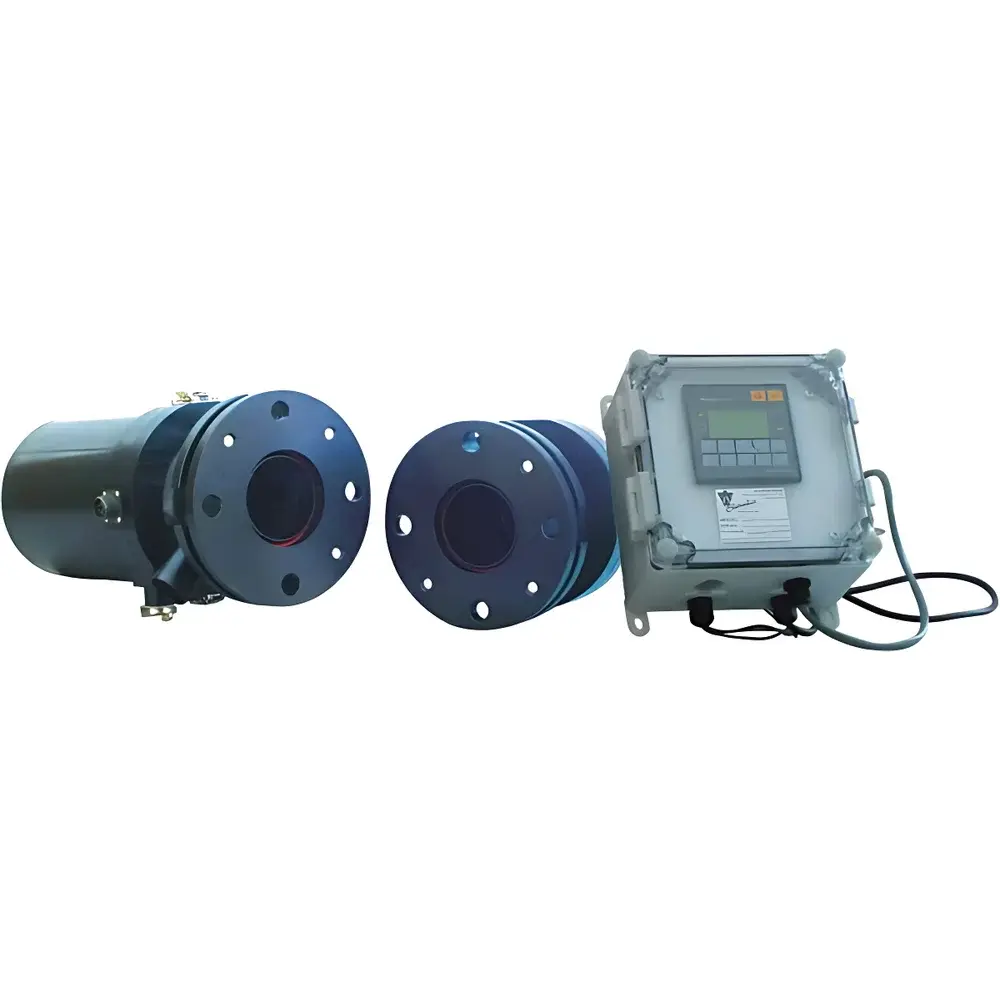
Tianhong TH-OPAC100II In-Situ Opacity and Particulate Concentration Monitor
| Brand | Tianhong |
|---|---|
| Origin | Hubei, China |
| Manufacturer Type | Authorized Distributor |
| Country of Manufacture | China |
| Model | TH-OPAC100II |
| Pricing | Upon Request |
Overview
The Tianhong TH-OPAC100II is an in-situ, dual-path optical opacity and particulate concentration monitor engineered for continuous emission monitoring (CEM) in industrial flue gas ducts and stacks. It operates on the principle of transmissometry—measuring the attenuation of a collimated light beam traversing the flue gas stream—to quantify optical density (opacity) in accordance with EPA Method 9 and ISO 10849. Unlike single-beam systems, the TH-OPAC100II employs a true dual-optical-path architecture: a measurement beam travels across the duct to a retroreflective mirror and back to a co-located detector, while a reference beam bypasses the duct entirely via internal beam splitting. This configuration eliminates drift caused by source intensity fluctuation, lamp aging, or ambient thermal loading—critical for long-term stability in unattended stack applications. The instrument is designed for installation at standard duct diameters (≥0.5 m), with optical alignment maintained via integrated focus correction points and real-time beam diagnostics.
Key Features
- Co-located optical head design: Light source (modulated infrared LED or narrowband visible source), beam splitter, reference detector, and main photodetector are housed in a single, hermetically sealed protective enclosure—minimizing misalignment risk and simplifying field commissioning.
- Active optical surface maintenance: Integrated compressed-air purge system delivers continuous laminar airflow across both the emission window and retroreflector surface, preventing dust deposition, condensation, and soot accumulation without mechanical wipers or consumables.
- Automatic optical alignment verification: Built-in focus correction point enables periodic validation of beam convergence; deviation triggers diagnostic alert and optional auto-realignment sequence via motorized mirror adjustment (configurable).
- Modulated light source: Carrier-frequency modulation (typically 1–10 kHz) suppresses interference from ambient radiation (e.g., furnace glow, sunlight ingress) and electrical noise, ensuring signal integrity in electrically noisy plant environments.
- Robust mechanical architecture: IP65-rated housing, stainless-steel mounting flange, and high-temperature optical components rated for continuous operation up to 200 °C (flue gas side) and 60 °C (electronics side).
Sample Compatibility & Compliance
The TH-OPAC100II is validated for use with dry or moderately humid flue gases containing fly ash, soot, metal oxides, and other submicron-to-micron particulates typical of coal-fired boilers, waste incinerators, cement kilns, and metallurgical furnaces. It is not intended for corrosive or highly abrasive streams without supplemental conditioning (e.g., dilution probe or heated sample line). The instrument complies with key regulatory frameworks including EPA Performance Specification 1 (PS-1) for opacity monitors, EN 15267-3 (QAL1 certification readiness), and ISO 10849:1996 for determination of smoke number and opacity. Data output supports integration into EPA-compliant CEMS architectures with audit-trail-capable data loggers meeting 40 CFR Part 60 Appendix B requirements.
Software & Data Management
The TH-OPAC100II outputs analog 4–20 mA signals (opacity %, zero/span status, fault codes) and digital RS-485 Modbus RTU interface for direct connection to DCS, PLC, or centralized CEMS servers. Optional embedded firmware includes configurable averaging intervals (1–60 sec), automatic zero calibration cycles (user-defined schedule), and event-triggered data logging (e.g., alarm onset, purge activation). All operational parameters—including beam intensity history, purge pressure logs, and alignment diagnostics—are timestamped and exportable via USB or Ethernet (with optional module). Firmware adheres to GLP principles: all parameter changes are logged with user ID, timestamp, and pre-/post-values—supporting FDA 21 CFR Part 11 compliance when deployed with validated third-party SCADA platforms.
Applications
- Regulatory opacity compliance monitoring for coal-, biomass-, and waste-fired power plants under NSPS and MATS requirements.
- Real-time particulate load trending in cement clinker coolers and rotary kiln exhausts to optimize baghouse or ESP performance.
- Startup/shutdown emissions verification during boiler light-off sequences where transient opacity spikes require second-by-second resolution.
- Process optimization in glass melting furnaces and non-ferrous smelters where fine metallic fume generation correlates strongly with optical attenuation.
- Pre-compliance screening for facilities preparing for mandatory QAL2 (Quality Assurance Level 2) testing per EN 14181.
FAQ
What is the recommended duct diameter range for optimal TH-OPAC100II performance?
The instrument is calibrated and validated for duct diameters between 0.5 m and 6.0 m. For diameters <0.8 m, optional beam-confinement optics are available to maintain signal-to-noise ratio.
Does the TH-OPAC100II require periodic manual cleaning of optical surfaces?
No—continuous air purge eliminates routine manual cleaning; however, quarterly inspection of purge filter elements and regulator setpoint verification is recommended per maintenance schedule.
Can the TH-OPAC100II be used in wet-stack applications?
It is rated for relative humidity up to 85% non-condensing; for saturated or dew-point-exceeding conditions, integration with a heated sampling probe or dilution system is required to prevent lens fogging.
Is factory calibration traceable to NIST standards?
Yes—each unit ships with a Certificate of Calibration traceable to NIST SRM 2806 (neutral density filters) and includes documented uncertainty budgets per ISO/IEC 17025.
How does the dual-beam architecture improve measurement stability compared to single-beam opacity meters?
By continuously referencing source intensity against a stable internal path, the TH-OPAC100II decouples opacity calculation from source degradation, temperature-induced LED wavelength shift, and detector responsivity drift—achieving <±0.5% FS long-term baseline stability over 90 days without recalibration.
Related Products







