
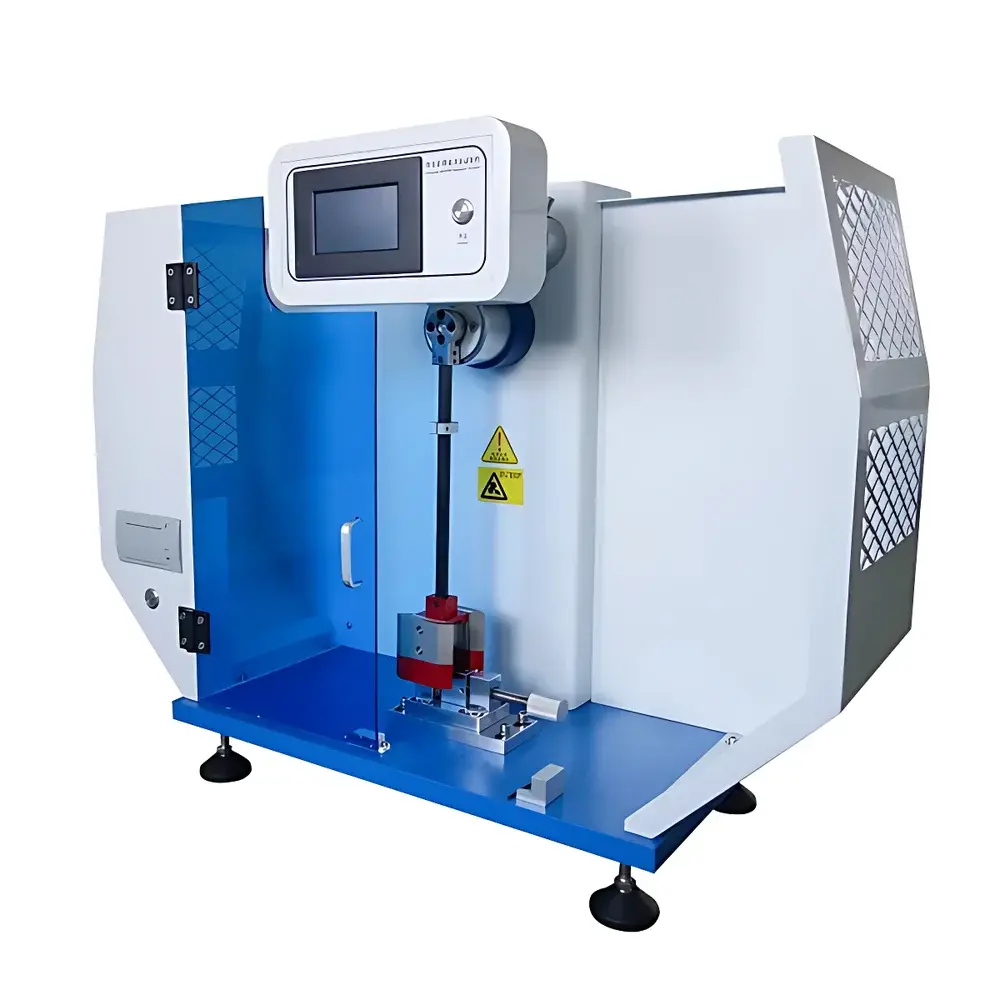
TYTESTER TianYuan TY-4021A Cantilever Beam Impact Tester
| Brand | TianYuan |
|---|---|
| Origin | Jiangsu, China |
| Manufacturer Type | Direct Manufacturer |
| Country of Origin | China |
| Model | TY-4021A |
| Impact Energies | 2.75 J, 5.5 J, 11 J, 22 J |
| Impact Velocity | 3.5 m/s |
| Pendulum Moment (Impact Constant) | 150° lift angle |
| Anvil-to-Striker Distance | 22 mm |
| Pendulum Pivot-to-Striker Distance | 335 mm |
| Striker Radius | R = 0.8 ± 0.2 mm |
| Display | Color TFT touchscreen (English/Chinese UI) |
| Angular Resolution | 0.01° (Omron rotary encoder) |
| Energy Resolution | 0.01 J |
| Data Storage | 24 test records with auto-averaging |
| Weight | 85 kg |
| Power Supply | AC 220 V ±10%, 50 Hz |
Overview
The TYTESTER TianYuan TY-4021A Cantilever Beam Impact Tester is a precision-engineered pendulum-type impact testing instrument designed for the quantitative determination of notched and unnotched Izod impact strength in rigid non-metallic materials. It operates on the principle of gravitational potential energy conversion: a calibrated pendulum is raised to a defined angular position (150°), released, and allowed to strike a vertically clamped specimen at a fixed velocity of 3.5 m/s. The energy absorbed by the specimen during fracture—calculated from the difference between initial and residual pendulum height—is reported as impact strength per unit thickness (J/m) or cross-sectional area (kJ/m²), in strict accordance with ISO 180:2000, ASTM D256–2010, GB/T 1843–2008, and JB/T 8761–1998. Its robust cast-iron base, vibration-damped carbon-fiber pendulum arm (patented design), and high-stiffness anvil assembly ensure minimal energy loss due to structural flexure or bearing friction—critical for achieving repeatability within ±1.5% across repeated measurements under GLP-compliant laboratory conditions.
Key Features
- Patented carbon-fiber pendulum arm: Maximizes mass concentration at the center of percussion while minimizing torsional compliance and post-impact oscillation—enabling true single-cycle impact without resonant interference.
- High-fidelity angular measurement: Factory-calibrated Omron rotary encoder (0.01° resolution) ensures traceable, drift-free energy calculation independent of mechanical wear.
- Dual-unit reporting capability: Real-time conversion between SI (J/m, kJ/m²) and legacy units (kg·cm/cm, ft·lb/in) supports global lab interoperability and regulatory submission requirements.
- Integrated thermal-stable striker geometry: Precision-ground striker with R = 0.8 ± 0.2 mm radius conforms to ISO/ASTM dimensional tolerances, eliminating edge-effect artifacts in brittle fracture analysis.
- Onboard data management: Stores up to 24 complete test records—including specimen ID, energy absorption, calculated impact strength, and timestamp—with automatic arithmetic mean computation and statistical deviation display.
- Regulatory-ready interface: Embedded thermal printer supports audit-trail generation; touchscreen firmware includes configurable user access levels and password-protected calibration mode—aligned with FDA 21 CFR Part 11 data integrity expectations for QC environments.
Sample Compatibility & Compliance
The TY-4021A accommodates standardized rectangular bars (typically 80 × 10 × 4 mm per ISO 180) made from thermoplastics (e.g., ABS, PC, PP), thermosets (epoxy, phenolic), fiber-reinforced composites (GFRP, CFRP), ceramics, and insulating polymers. Specimen clamping uses hardened steel jaws with parallel alignment verification (±0.1°) to prevent bending moment introduction. All mechanical dimensions—including 22 mm anvil-to-striker offset and 335 mm pivot-to-striker distance—are certified against national metrological standards (JJG 145–2019). The system meets essential safety requirements per IEC 61000-4-2 (ESD immunity) and carries CE marking for EMC and low-voltage directive compliance. Calibration certificates are issued with NIST-traceable reference specimens upon factory acceptance testing.
Software & Data Management
The embedded color touchscreen runs a deterministic real-time OS with dual-language UI (English/Chinese) and zero external dependency. Test parameters—energy range selection (2.75 J to 22 J), specimen thickness input, notch depth configuration—are entered via intuitive soft-keys. All raw encoder counts, calculated energies, and derived impact strengths are timestamped and stored in non-volatile memory. Export functionality supports USB flash drive dump of CSV-formatted datasets (including min/max/mean/stdev per batch) for LIMS integration. Audit logs record operator ID, calibration events, and firmware updates—retained for ≥12 months per internal QA protocol. Optional RS-232 or Ethernet modules enable remote monitoring and centralized database synchronization in multi-instrument labs.
Applications
This instrument serves routine quality control in polymer compounding facilities, R&D validation of new resin formulations, incoming inspection of composite preforms, and failure analysis of electrical insulation components. Typical use cases include comparative evaluation of plasticizer effects on PVC toughness, assessment of UV degradation-induced embrittlement in outdoor-grade polyolefins, qualification of recycled-content ABS for automotive interior trim, and verification of ceramic tile fracture resistance per EN 14411 Annex E. In academic settings, it supports graduate-level polymer physics experiments on temperature-dependent ductile-to-brittle transitions, validated via controlled environmental chamber coupling (optional accessory).
FAQ
What standards does the TY-4021A comply with?
ISO 180:2000, ASTM D256–2010, GB/T 1843–2008, and JB/T 8761–1998 — all verified through third-party type examination.
Can the instrument be calibrated in-house?
Yes — using certified reference specimens (traceable to NIM, China) and the built-in calibration mode; full procedure documented in the ISO/IEC 17025-aligned operator manual.
Is the carbon-fiber pendulum replaceable?
Yes — supplied as a field-serviceable module with pre-loaded dynamic balancing certification; replacement requires no recalibration of energy constants.
Does the system support GLP audit trails?
Yes — all test executions, parameter changes, and calibration actions are logged with immutable timestamps and operator IDs, satisfying ALCOA+ data integrity principles.
What maintenance intervals are recommended?
Biannual verification of striker radius and anvil parallelism; annual encoder linearity check using optical interferometry; lubrication-free bearing design eliminates routine greasing requirements.



