
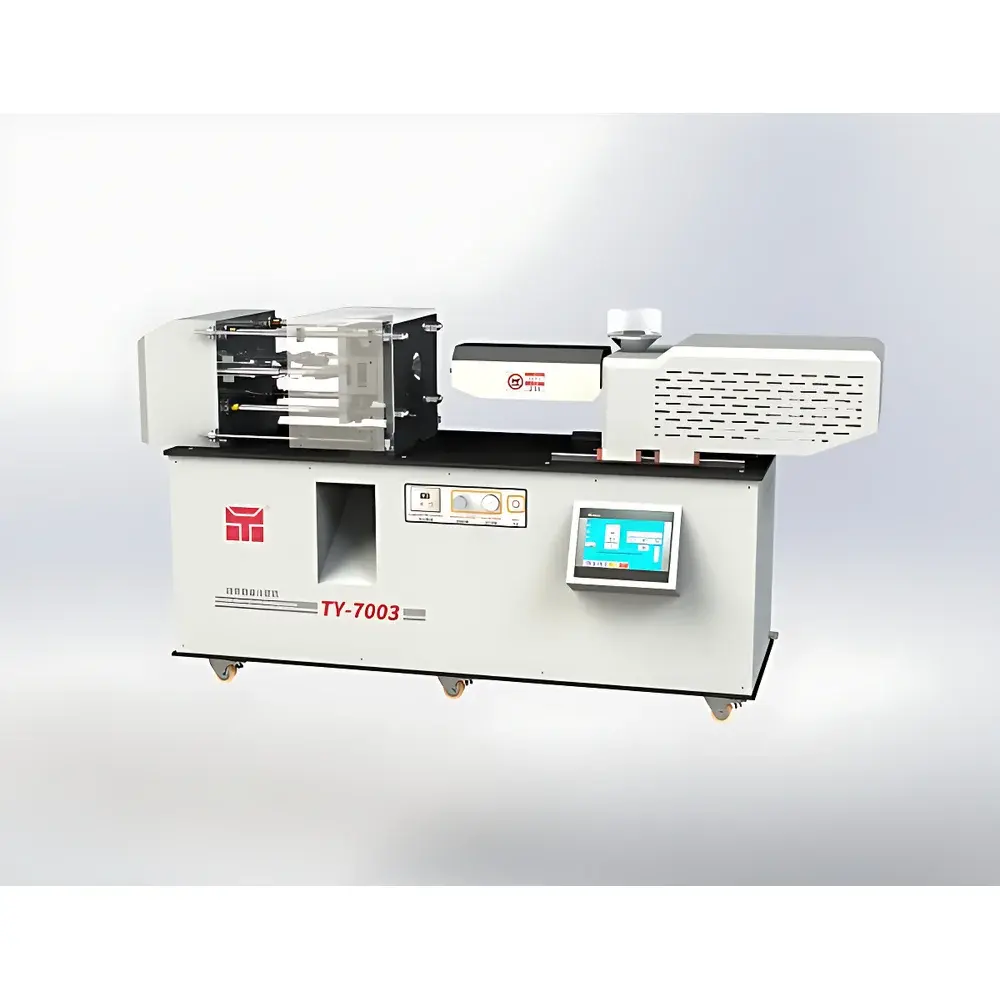
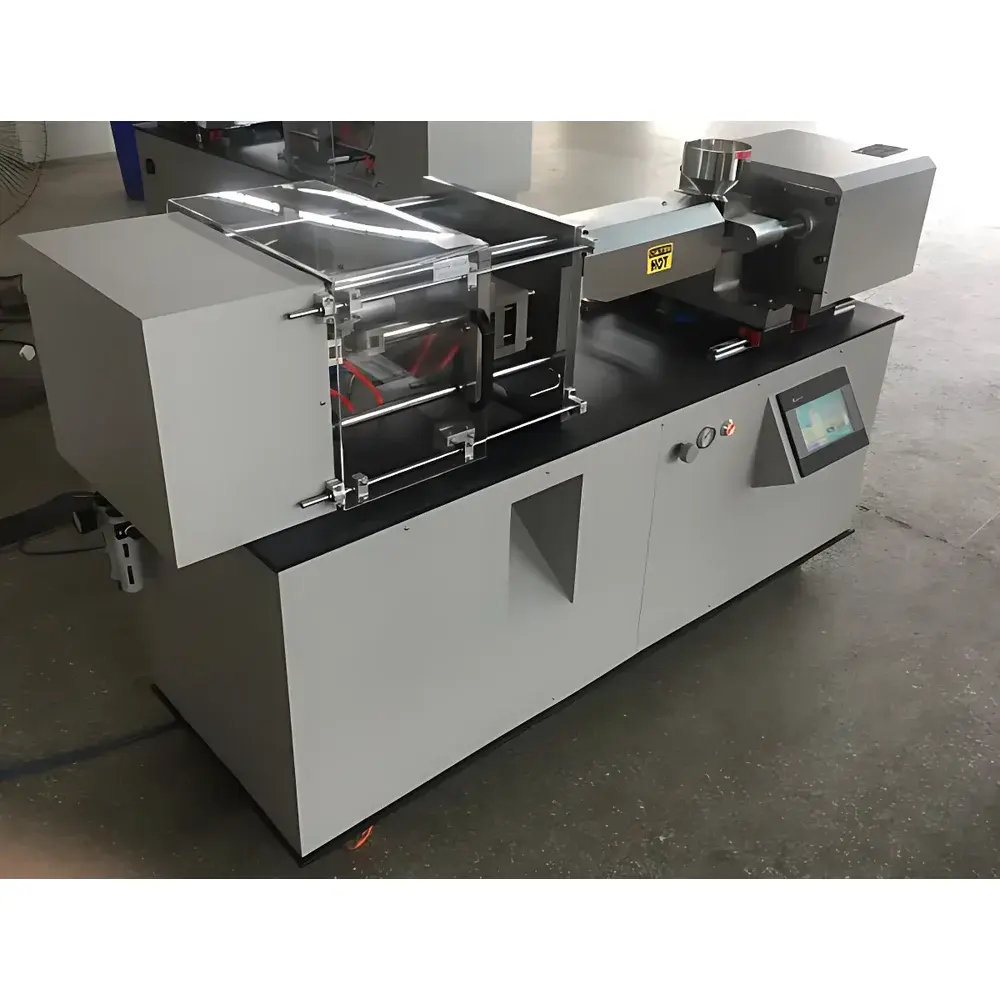
TianYuan TY-7003 Pneumatic Injection Molding Machine
| Brand | TianYuan |
|---|---|
| Origin | Jiangsu, China |
| Manufacturer Type | Direct Manufacturer |
| Region of Origin | Domestic (China) |
| Model | TY-7003 |
| Price Range | USD 7,000 – 14,000 |
| Supply Voltage | Single-phase AC 220 V ±10%, 50 Hz |
| Rated Power | 2200 W |
| Operating Pressure | ≥0.8 MPa |
| Screw Diameter | 20 mm |
| Maximum Shot Volume | 25 cm³ |
| Clamping Force | 20 kN (mechanical toggle lock) |
| Injection Force | 18 kN (up to 36 kN with force-multiplying system) |
| Mold Opening Stroke | ~70 mm (excluding mold thickness) |
| Barrel Zone Temperature Range | Up to 360 °C (3-zone heating) |
| Temperature Control Accuracy | ±0.5 °C (steady-state) |
| Feeding Torque | 105 N·m (servo motor + planetary gearbox) |
| Feeding Speed | 0.1–60 rpm (torque reduced to 50% above 30 rpm) |
| Shot Position Resolution | 0.1 mm |
| Platen Dimensions | 360 × 90 × 72 mm (L×W×H) |
| Tie-Bar Spacing | 280 × 186 mm (center-to-center) |
| Fixed Platen Ring OD | 50 mm |
| Machine Dimensions (L×W×H) | 1700 × 500 × 950 mm |
| Packing Dimensions (L×W×H) | 1750 × 720 × 1280 mm |
| Net/Gross Weight | 380 / 420 kg |
| Compatible Materials | PP, PE, PA, PVC, ABS, TPU, PLA, and other engineering thermoplastics |
| Core Components | Delta (Taiwan) PLC, Omron (Japan) solid-state relays, Sonko (Taiwan) planetary gearmotor |
Overview
The TianYuan TY-7003 Pneumatic Injection Molding Machine is a compact, benchtop-scale injection molding system engineered for academic laboratories, R&D centers, and quality control environments where space, energy infrastructure, and material economy are constrained. Unlike industrial-scale hydraulic or fully electric machines, the TY-7003 employs a hybrid actuation architecture: pneumatic pressure drives the injection and clamping functions, while a high-torque servo motor coupled with a planetary gearbox delivers precise, programmable plastication. This design eliminates hydraulic oil contamination risks, reduces electrical load requirements (operating on standard single-phase 220 V AC), and enables deployment in non-industrial facilities—such as university teaching labs or ISO-classified cleanrooms—without dedicated three-phase power or compressed air infrastructure beyond 0.8 MPa supply pressure. The machine implements classical screw-based plastication principles: solid polymer feedstock is conveyed, melted, homogenized, and pressurized within a three-zone heated barrel (zones arranged from nozzle to hopper), then injected into a cavity under controlled displacement and velocity profiles. Its modular mechanical toggle clamp ensures repeatable mold closure with minimal thermal drift, supporting rigorous material property testing per ASTM D638, ISO 527, or UL 94 protocols.
Key Features
- Compact footprint (1700 × 500 × 950 mm) and mobility-friendly construction—designed for lab integration without structural modification
- Pneumatic-hydraulic-free operation: no oil leakage, no cooling circuit dependency (optional water-cooling interface available)
- Delta PLC with color touchscreen HMI enabling one-touch cycle initiation, parameter logging, and real-time process monitoring
- Dual safety architecture: mechanical limit switches plus electronic overpressure/overtemperature interlocks compliant with IEC 60204-1
- High-resolution shot positioning (0.1 mm) and torque-controlled feeding (105 N·m peak, 50% retention up to 30 rpm) ensure batch-to-batch repeatability
- Three independent barrel zones (max 360 °C) with ±0.5 °C steady-state temperature stability—critical for processing heat-sensitive or high-melt-viscosity polymers
- Modular mold interface accommodating both manual-departure and auto-eject configurations; standard mold dimensions: 360 × 90 × 72 mm
Sample Compatibility & Compliance
The TY-7003 supports standardized test specimen production across major thermoplastic families—including polypropylene (PP), polyethylene (PE), polyamide (PA6/66), polyvinyl chloride (PVC), acrylonitrile butadiene styrene (ABS), thermoplastic polyurethane (TPU), and polylactic acid (PLA). Its 25 cm³ maximum shot volume and 20 kN clamping force meet dimensional and pressure requirements for ASTM D638 Type I tensile bars, ISO 178 flexural specimens, and UL 94 HB/V-2 flame-test plaques. All thermal, motion, and safety subsystems adhere to CE machinery directive (2006/42/EC) essential health and safety requirements. Temperature controllers are calibrated traceable to NIST standards; data acquisition timestamps comply with GLP audit trails when integrated with external logging software.
Software & Data Management
The embedded Delta DOP series HMI stores up to 100 process recipes locally, each containing zone temperatures, injection speed ramps, hold pressure profiles, cooling time, and mold open/close delays. Cycle data—including actual shot weight deviation, peak injection pressure, and melt temperature at nozzle—is logged per cycle with UTC timestamps. Export is supported via USB 2.0 to CSV format for post-processing in MATLAB, Python (Pandas), or statistical analysis platforms. While the base system does not include FDA 21 CFR Part 11-compliant electronic signatures, optional firmware upgrade enables user role-based access control, audit trail generation, and electronic record integrity verification—suitable for regulated QC labs operating under ISO 17025 or ICH Q7 guidelines.
Applications
- Rapid prototyping of small-batch polymer formulations for rheological screening and thermal degradation studies
- Teaching core injection molding principles—including melt flow index correlation, gate freeze-off timing, and weld line formation—in undergraduate polymer engineering labs
- Pre-certification sample preparation for third-party testing (e.g., SGS, TÜV, UL) prior to full-scale production validation
- Material supplier qualification: comparative evaluation of viscosity, shrinkage, and warpage behavior across resin grades under identical processing conditions
- Development of biodegradable polymer composites where low-shear, low-temperature processing minimizes thermal degradation
FAQ
Does the TY-7003 require three-phase industrial power?
No. It operates exclusively on single-phase AC 220 V ±10%, 50 Hz, with a rated current draw of 10 A.
Can it process high-viscosity engineering resins like PEEK or PSU?
Standard configuration supports up to 360 °C barrel temperature and sufficient injection force for most semi-crystalline and amorphous thermoplastics; however, PEEK and PSU require specialized high-temp barrels and hardened screws—available as factory-engineered options.
Is mold change time documented per ISO 20482?
Yes. Manual-departure mold exchange takes ≤3 seconds; auto-eject mold replacement requires ~20 minutes due to mechanical alignment and hydraulic (pneumatic) line reconnection—both values are validated per ISO 20482 Annex B.
What calibration documentation is provided?
Each unit ships with a factory calibration certificate covering temperature sensors (traceable to NIST SRM 1967), position encoders, and pressure transducers—valid for 12 months under normal lab use.
Is remote diagnostics supported?
The Delta PLC includes Ethernet port (Modbus TCP); OEM-level remote troubleshooting is available via secure VPN connection upon signed support agreement.






