
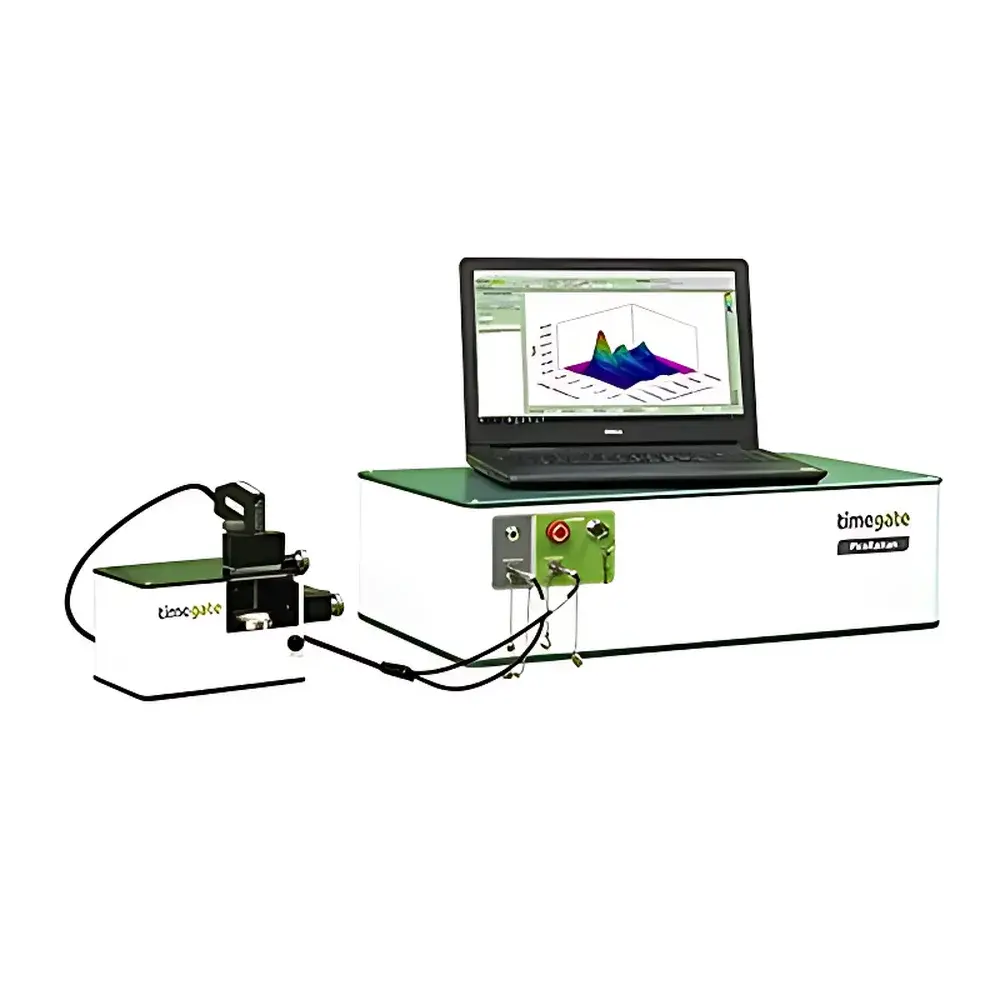
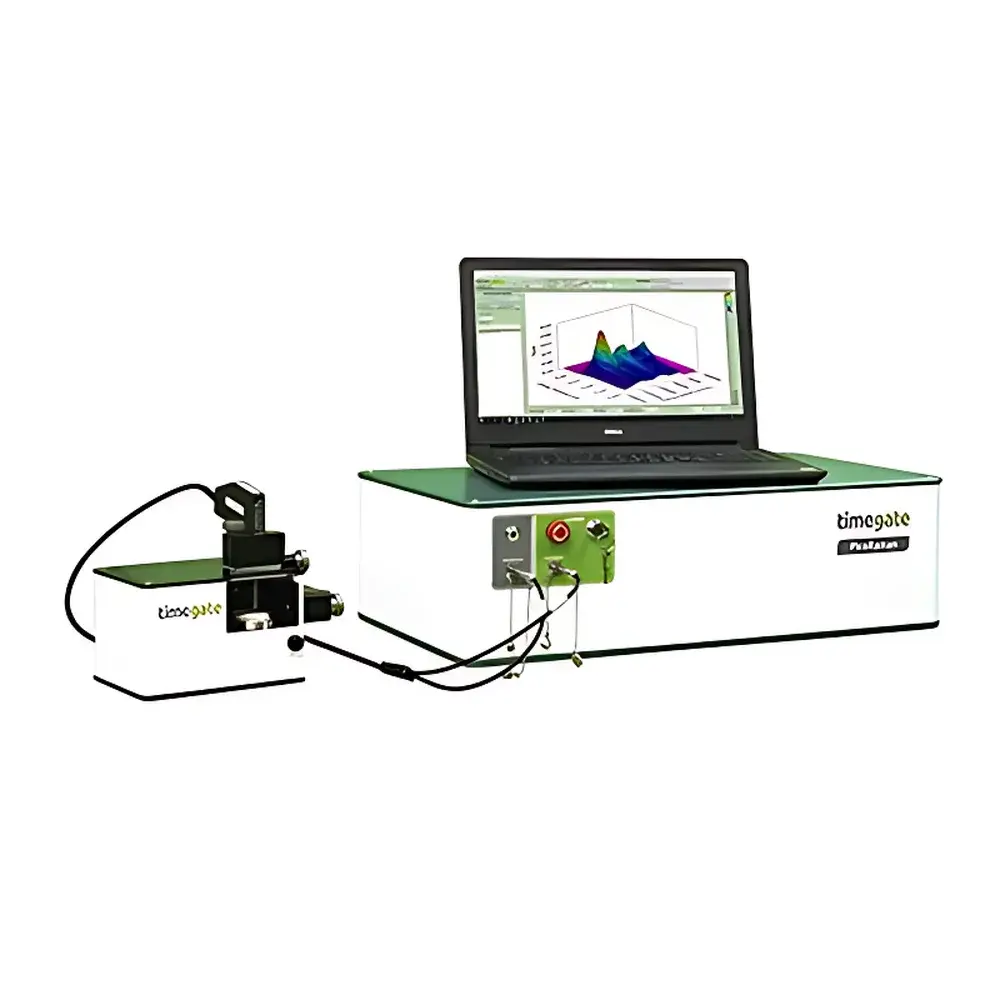
Timegate Pico Raman Picosecond Time-Gated Raman Spectrometer
| Brand | Timegate |
|---|---|
| Origin | Finland |
| Model | Pico Raman |
| Instrument Type | Grating-Based Raman Spectrometer |
| Spectral Range | –200 to 2000 cm⁻¹ |
| Spectral Resolution | 5 cm⁻¹ |
| Spatial Resolution | 2 µm |
| Minimum Wavenumber | –200 cm⁻¹ |
| Spectral Reproducibility | ≤ ±0.15 cm⁻¹ |
Overview
The Timegate Pico Raman is a commercially mature, picosecond time-gated Raman spectrometer engineered in Finland for high-fidelity molecular fingerprinting under optically challenging conditions. Unlike conventional continuous-wave (CW) Raman systems, the Pico Raman employs ultrafast time-gating—synchronizing sub-10 ps laser excitation pulses with gated detection windows—to temporally isolate the prompt Raman scattering signal from delayed photoluminescence and thermal blackbody radiation. This principle enables intrinsic fluorescence rejection without spectral subtraction, chemical quenching, or hardware filters—making it uniquely suited for strongly fluorescent solids (e.g., Y₃Fe₅O₁₂), nanomaterials, high-temperature in situ studies (>1500 °C), and biological samples with native autofluorescence. Its grating-based optical architecture ensures wavelength accuracy traceable to NIST-calibrated standards, while its modular design supports seamless integration into upright Olympus BX/CX-series microscopes for confocal micro-Raman mapping.
Key Features
- Picosecond time-gating capability with <10 ps laser pulse width and adjustable gate delay (0–5 ns) and width (50–500 ps)
- Native fluorescence suppression: eliminates spectral distortion from broadband luminescence without mathematical deconvolution or background modeling
- High-temperature compatibility: validated for in situ Raman monitoring of phase transitions in CaSiO₃ and CaCO₃ up to 1600 °C under inert or reactive atmospheres
- Micro-Raman configuration: fully compatible with Olympus upright microscopes; objective-dependent spot sizes (21 µm at 100×, 52 µm at 40×, down to 2 µm diffraction-limited spatial resolution)
- Integrated USB camera system: real-time sample visualization, region-of-interest targeting, and synchronized image–spectrum correlation
- Patented fiber-coupled probe interface: FC/PC connectors with 100 µm excitation fiber and 200 µm collection fiber; optimized for minimal modal noise and alignment stability
- Three-dimensional spectral acquisition: simultaneous recording of intensity, wavenumber (–200 to 2000 cm⁻¹), and time-delay axis—enabling kinetic Raman profiling
Sample Compatibility & Compliance
The Pico Raman accommodates diverse sample forms—including bulk crystals, thin films, powders, suspended nanoparticles, and hydrated biological specimens—without mandatory preprocessing. Its time-resolved detection meets critical requirements for GLP-compliant materials characterization and in-process monitoring in regulated environments. While not certified as a medical device, its spectral fidelity aligns with ASTM E1840-22 (Standard Guide for Raman Shift Standards) and ISO 8655-7 (volumetric calibration for spectroscopic reference materials). Data acquisition software supports audit-trail logging per FDA 21 CFR Part 11 when deployed on validated computing platforms. The system operates within Class 1 laser safety enclosure standards (IEC 60825-1:2014) when integrated with OEM microscope housings.
Software & Data Management
Acquisition and analysis are performed via Timegate’s proprietary TG-Spectra software, built on a Qt-based framework with Python API extension support. It provides real-time spectral preview, multi-channel time-delay stacking, and batch processing for hyperspectral Raman maps (up to 512 × 512 pixel grids). All raw data—including timestamped detector frames, gate parameters, and microscope stage coordinates—are stored in HDF5 format with embedded metadata (wavelength calibration coefficients, laser energy logs, temperature sensor readings). Export options include ASCII, CSV, and JCAMP-DX for third-party chemometric tools (e.g., MATLAB, Unscrambler X, Python scikit-learn). Software update history, user session logs, and parameter change tracking satisfy GxP documentation requirements when configured with network authentication and role-based access control.
Applications
- Materials Science: Phase identification and transformation kinetics in refractory oxides (e.g., YIG, CaSiO₃), carbon allotropes, and battery electrode materials under thermal stress
- Nanotechnology: Resolving true vibrational modes in quantum dots, metal–organic frameworks (MOFs), and plasmonic nanoparticles where CW-Raman yields only “hump-like” fluorescence artifacts
- Life Sciences: Label-free bacterial strain differentiation (e.g., E. coli) using time-gated surface-enhanced Raman spectroscopy (TG-SERS), achieving >10× signal-to-background improvement over CW-SERS
- Geosciences: In situ mineralogical mapping of fluid inclusions, metamorphic assemblages, and volcanic glass textures with micron-scale spatial registration
- Pharmaceutical Development: Polymorph screening of active pharmaceutical ingredients (APIs) in heterogeneous solid dispersions, avoiding fluorescence-induced misassignment
- Forensics & Polymers: Micro-regional analysis of paint layers, polymer blends, and illicit substance mixtures with unambiguous band assignment down to 55 cm⁻¹
FAQ
What distinguishes time-gated Raman from shifted-excitation or quenching-based fluorescence suppression methods?
Time gating physically excludes fluorescence photons based on their nanosecond-scale lifetime—no spectral overlap correction or empirical modeling is required. This preserves absolute intensity linearity and avoids artifacts introduced by subtraction algorithms.
Can the Pico Raman be used with non-Olympus microscopes?
Yes—the system uses standardized C-mount and SM1-thread mechanical interfaces; custom adapter plates are available for Nikon, Zeiss, and Leica upright platforms upon request.
Is spectral calibration traceable to international standards?
Yes—factory calibration uses NIST-traceable neon and argon emission lines; users may perform daily verification using the included silicon reference wafer (520.7 cm⁻¹).
Does the system support long-term kinetic measurements?
Yes—continuous acquisition mode records full spectra at up to 10 Hz, with time-stamped metadata enabling post-hoc correlation with external thermocouple or gas flow controllers.
What maintenance is required for stable picosecond timing performance?
The all-solid-state laser and gated detector require no consumables; annual timing jitter verification (<±2 ps) and optical alignment validation are recommended for metrology-grade applications.




