
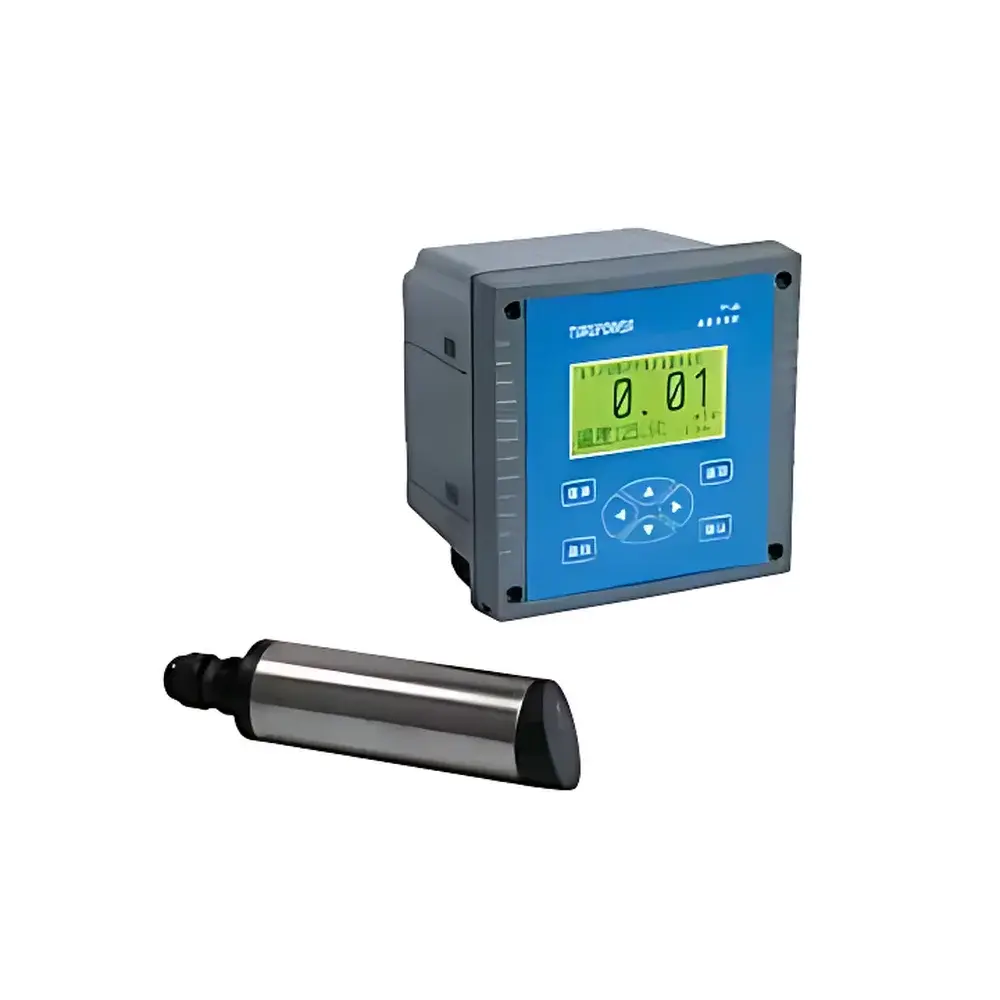
TimePower TP180 Submersible Online Turbidimeter
| Brand | TimePower |
|---|---|
| Origin | Beijing, China |
| Manufacturer Type | Manufacturer |
| Product Type | Online Turbidimeter |
| Model | TP180 |
| Measurement Range | 0.01–4000 NTU |
| Resolution | 0.01 NTU |
| Operating Temperature | 5–45 °C |
| Accuracy | ±2% FS |
| Protection Rating | IP65 |
| Output Signals | 0–10 mA / 0–20 mA / 4–20 mA (selectable, load <300 Ω) |
| Relay Outputs | 2 SPST, AC220V 3A / DC30V 3A |
| Power Supply | AC 85–265 V, 45–65 Hz |
| Power Consumption | ≤15 W |
| Dimensions (H×W×D) | 145 × 120 × 150 mm |
| Panel Cutout | 138 × 138 mm |
| Weight | 0.64 kg |
| Response Time (T90) | <1 min at 25 °C |
| Temperature Compensation Range | 0–60 °C |
| Sample Temperature Range | 5–60 °C |
| Storage Temperature | –25 to +55 °C (electrode must be stored >0 °C) |
| Humidity Limit | ≤90% RH (non-condensing) |
| Data Storage | Cyclic buffer with auto-overflow management |
| Repeatability | ≤1% FS |
Overview
The TimePower TP180 Submersible Online Turbidimeter is an industrial-grade optical sensor system engineered for continuous, real-time turbidity monitoring in aqueous process streams and environmental water bodies. It operates on the principle of nephelometric measurement—quantifying the intensity of light scattered at 90° by suspended particulates when a collimated infrared or white-light beam passes through the sample. Unlike single-angle scatter detection, the TP180 employs a dual-signal architecture that computes the ratio of scattered light to transmitted light, significantly improving linearity across its full 0.01–4000 NTU dynamic range and minimizing drift caused by lamp aging or window fouling. This optical design conforms to ISO 7027:2016 and ASTM D6508-20 standards for turbidity measurement in drinking water, wastewater, and industrial cooling circuits. The submersible probe is optimized for direct immersion in open channels, reservoirs, intake wells, or recirculating loops—eliminating the need for sample extraction, peristaltic pumping, or flow-cell conditioning.
Key Features
- Submersible probe design with IP65-rated electronics housing, enabling robust deployment in outdoor, humid, or splash-prone environments including water treatment plants, power station cooling towers, and municipal distribution networks.
- Dual-signal photometric architecture (scattered/transmitted light ratio) ensures stable calibration and extended maintenance intervals—typically >6 months between standard calibrations under normal operating conditions.
- High-resolution 128×64 dot-matrix LCD display with intuitive Chinese-language interface (firmware-localized for domestic operation); supports real-time NTU readout, status indicators, relay state visualization, and menu-driven calibration routines.
- Embedded microcontroller with 24-bit A/D conversion and galvanically isolated analog outputs (0–10 mA, 0–20 mA, or 4–20 mA) compatible with PLCs, SCADA systems, and DCS architectures without external signal conditioning.
- Two programmable SPST relays (AC220V/3A or DC30V/3A) configurable as high/low alarms, maintenance alerts, or control interlocks—each independently assignable to turbidity thresholds, rate-of-change events, or diagnostic faults.
- Onboard cyclic data logger retains up to 30 days of minute-interval measurements (configurable sampling interval); data persists through power loss with non-volatile memory rated for >10 years retention.
Sample Compatibility & Compliance
The TP180 is validated for use with potable water, surface water (rivers, lakes), swimming pool recirculation lines, boiler feedwater, and secondary effluent streams. Its optical path is insensitive to color interference up to 500 Pt-Co units and exhibits minimal sensitivity to bubble entrainment due to directional scattering geometry. The sensor complies with ISO 7027:2016 (infrared 860 nm light source), meets EPA Method 180.1 requirements for field-deployable turbidimeters, and satisfies GLP-aligned data integrity prerequisites—including timestamped calibration logs, operator ID tagging (via optional RS485 Modbus RTU integration), and audit-trail-capable configuration change records. While not FDA 21 CFR Part 11-certified out-of-the-box, the device supports traceable calibration workflows required under USP and pharmacopeial water quality specifications.
Software & Data Management
The TP180 operates autonomously without PC dependency but supports optional Modbus RTU communication over RS485 for integration into centralized monitoring platforms. Configuration, calibration, and alarm threshold settings are performed locally via membrane keypad navigation. All calibration events—including zero-point (deionized water) and span-point (formazin or AMCO AEPA standards) entries—are time-stamped and stored in non-volatile memory. The instrument maintains separate calibration coefficients for each of its seven selectable range modes (10, 100, 500, 1000, 5000, 10000, 20000 NTU), allowing field reconfiguration without hardware modification. Data export requires manual retrieval via serial interface; no cloud connectivity or proprietary software suite is provided—ensuring deterministic behavior in regulated industrial IT environments.
Applications
- Continuous compliance monitoring of finished drinking water at municipal treatment plant outlets per WHO Guidelines and national regulatory limits (e.g., ≤1 NTU).
- Early-warning detection of filter breakthrough or coagulant dosing anomalies in rapid sand or membrane filtration trains.
- Real-time surveillance of raw water intake turbidity to trigger upstream sedimentation adjustments or pre-chlorination protocols.
- Performance verification of tertiary polishing stages in municipal and industrial wastewater reclamation facilities.
- Monitoring of condenser cooling water in thermal power plants to prevent biofilm formation and heat exchanger fouling.
- Automated feedback control of flocculant dosing systems using proportional-integral (PI) logic derived from turbidity trends.
FAQ
What is the recommended calibration frequency for the TP180 in continuous operation?
Calibration should be performed at least once every 30 days under typical municipal water applications; more frequent calibration (weekly) is advised for high-turbidity wastewater or abrasive slurry environments.
Can the submersible probe be installed vertically in a pipe riser?
Yes—the probe is rated for static submersion up to 5 m depth and may be mounted vertically in low-velocity conduits using custom bracketing; flow velocity should remain below 1.5 m/s to avoid mechanical stress on the optical window.
Is temperature compensation automatic?
Yes—integrated NTC thermistor continuously measures sample temperature (5–60 °C) and applies polynomial correction per ISO 7027 Annex B, eliminating manual offset adjustments.
Does the instrument support HART or Profibus communication?
No—the TP180 provides only analog current output and Modbus RTU over RS485; HART or Profibus variants require third-party protocol converters.
How is sensor fouling mitigated during long-term deployment?
The optical window features hydrophobic coating and a self-cleaning geometry; optional ultrasonic transducer modules (sold separately) can be integrated for periodic acoustic cleaning cycles.



