
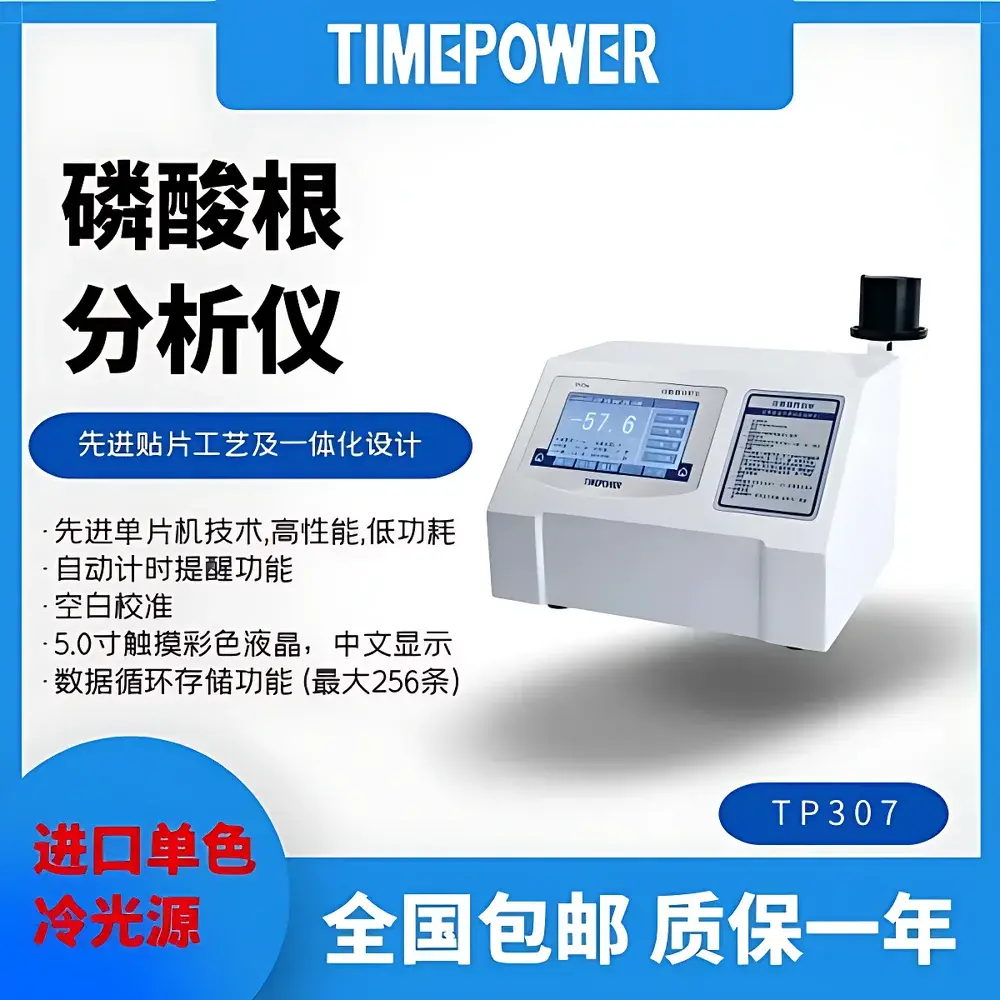
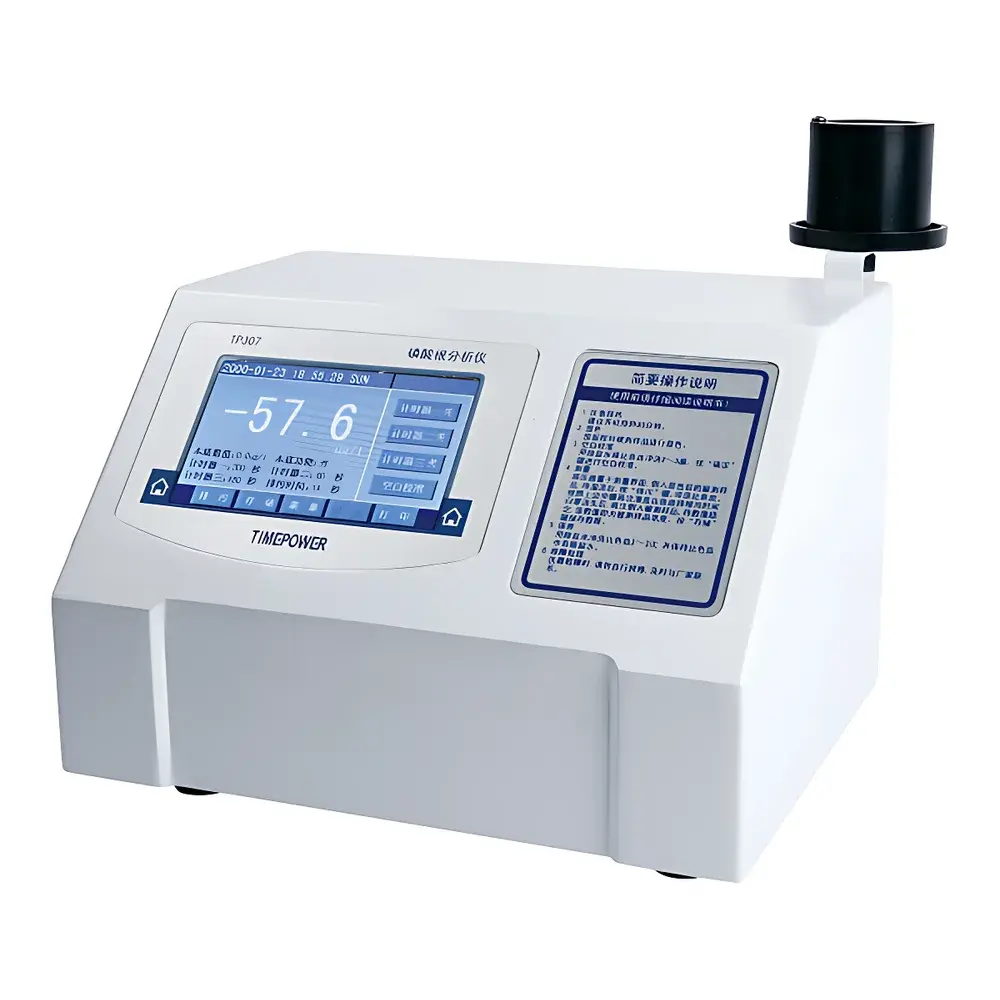
Timepower TP307 Phosphate Analyzer
| Brand | Timepower |
|---|---|
| Origin | Beijing, China |
| Manufacturer Type | Direct Manufacturer |
| Instrument Category | Domestic |
| Model | TP307 |
| Instrument Type | Benchtop |
| Measuring Range | 0–20 mg/L (optional 0–50 mg/L) |
| Detection Limit | 1 ppm (1 mg/L) |
| Response Time | 1 s |
| Measurement Accuracy | ±2% F.S. |
| Resolution | 0.01 mg/L |
| Repeatability | ≤1% |
| Stability | ±1% F.S./4 h |
| Operating Temperature | 5–45 °C |
| Operating Humidity | ≤90% RH (non-condensing) |
| Power Supply | AC 85–265 V, 45–65 Hz |
| Power Consumption | ≤30 W |
| Dimensions | 260 × 200 × 180 mm |
| Weight | 3.2 kg |
| Display | 5.0-inch color touchscreen LCD with Chinese interface |
Overview
The Timepower TP307 Phosphate Analyzer is a benchtop photometric analyzer engineered for precise, routine quantification of orthophosphate (PO₄³⁻) in ultra-pure and process water streams. It operates on the principle of molybdenum-vanadium acid colorimetry: in acidic medium, orthophosphate reacts with ammonium metavanadate and ammonium molybdate to form a yellow phosphomolybdovanadate complex. The absorbance of this chromophore at ~420 nm is measured via stable single-wavelength photometry, adhering strictly to the Lambert-Beer law—where absorbance (A) is linearly proportional to analyte concentration under fixed optical path length and incident light intensity. Designed specifically for high-reliability applications in thermal power generation—including condensate, boiler feedwater, and steam-cycle demineralized water—the TP307 delivers robust performance in environments demanding sub-mg/L phosphate control to prevent scale formation and corrosion in high-pressure steam systems.
Key Features
- Integrated benchtop architecture with surface-mount technology (SMT) PCBs ensuring long-term signal stability and resistance to electromagnetic interference.
- Dedicated cold-light LED source (imported single-wavelength, narrow-bandwidth) providing consistent spectral output, low thermal drift, and >50,000-hour operational lifetime.
- Automatic zero-point calibration function that compensates for electronic offset, detector baseline drift, and ambient light leakage—critical for maintaining accuracy across extended unattended operation.
- Onboard real-time clock with programmable timing alerts for scheduled calibration, sample injection, or maintenance prompts—enhancing operator compliance with QA/QC protocols.
- Non-volatile memory storage supporting up to 256 measurement records; overflow management automatically overwrites oldest entries without user intervention.
- 5.0-inch capacitive touchscreen display with intuitive Chinese-language UI, enabling direct parameter navigation, calibration logging, and historical data review without external software.
Sample Compatibility & Compliance
The TP307 is validated for use with Type I ultrapure water (ASTM D1193), including water generated by mixed-bed ion exchange systems. It accepts samples within pH 2.0–3.5 (pre-acidified per standard method ASTM D859 or ISO 6878) and accommodates flow-through or batch cuvette-based introduction. All wetted components are chemically inert (borosilicate glass cuvettes, PTFE tubing, and polypropylene reagent reservoirs) to prevent leaching or adsorption artifacts. While not certified to IEC 61326-1 (EMC) or IEC 61010-1 (safety) out-of-box, the instrument meets functional requirements for GLP-compliant laboratories when operated within specified environmental limits (5–45 °C, ≤90% RH non-condensing). Routine calibration traceability aligns with NIST-traceable phosphate standards (e.g., potassium dihydrogen phosphate, KHP).
Software & Data Management
Data acquisition and system control are fully embedded—no PC dependency required. Calibration curves (linear or two-point) are stored internally with timestamped metadata (date, operator ID, standard lot number). Each measurement record includes absorbance value, calculated concentration (mg/L), instrument status flags (e.g., “zero OK”, “lamp warm-up complete”), and environmental sensor readings (ambient temperature). Audit trail functionality logs all critical events: power cycles, calibration executions, range changes, and firmware updates. Export is supported via USB flash drive in CSV format for integration into LIMS or Excel-based trend analysis. The system supports 21 CFR Part 11–compliant workflows when paired with external identity-authenticated user management and electronic signature modules.
Applications
- Continuous monitoring of phosphate residuals in high-purity steam cycle water (ASME PTC 19.11, EPRI TR-102362 guidelines).
- QC verification of phosphate dosing in drum-type boiler treatment programs (e.g., coordinated phosphate-pH control).
- In-process testing of pharmaceutical water-for-injection (WFI) and purified water (USP , EU GMP Annex 1).
- Quality assurance of ultrapure water used in semiconductor rinse processes (SEMI F63).
- Environmental compliance testing of industrial effluent where phosphate discharge limits apply (e.g., EPA Method 365.4, ISO 15681-1).
FAQ
What is the recommended frequency for blank calibration?
Blank calibration must be performed daily prior to first measurement to correct for optical and electronic zero drift.
Can the TP307 measure samples outside the 0–20 mg/L range?
Yes—users may select the optional 0–50 mg/L range during setup; however, detection limit remains 1 mg/L, and linearity validation per ISO 8466-1 is required for each range.
Which reagents are required for operation?
Standard kit includes ammonium molybdate, ammonium metavanadate, and concentrated sulfuric acid; all must be analytical grade (≥99.9%) and stored in labeled HDPE or PP containers.
Is temperature compensation automatic?
No—temperature is monitored but not actively compensated; users must maintain sample temperature within 5–45 °C and allow thermal equilibration before measurement.
How is data integrity ensured during power interruption?
All calibration coefficients and measurement logs are written to non-volatile flash memory prior to power-down; no data loss occurs during unexpected AC loss.
Related Products







