
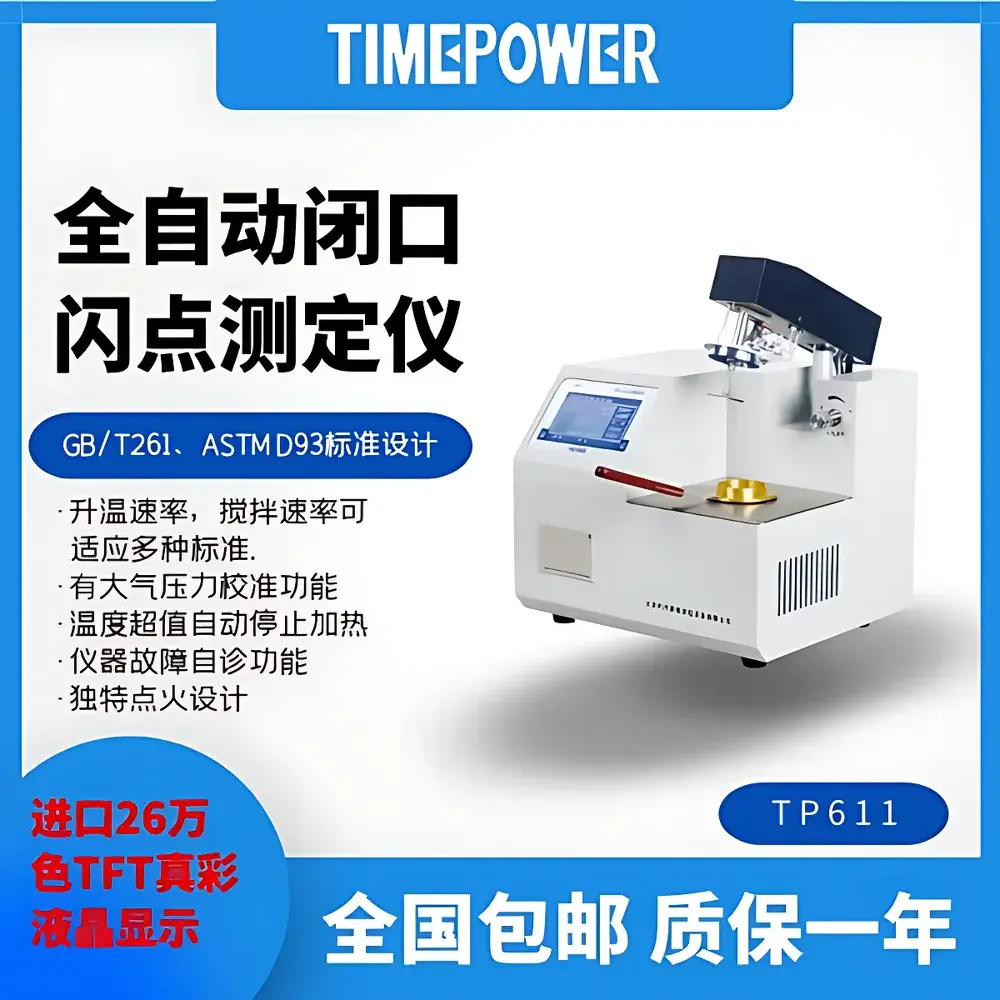
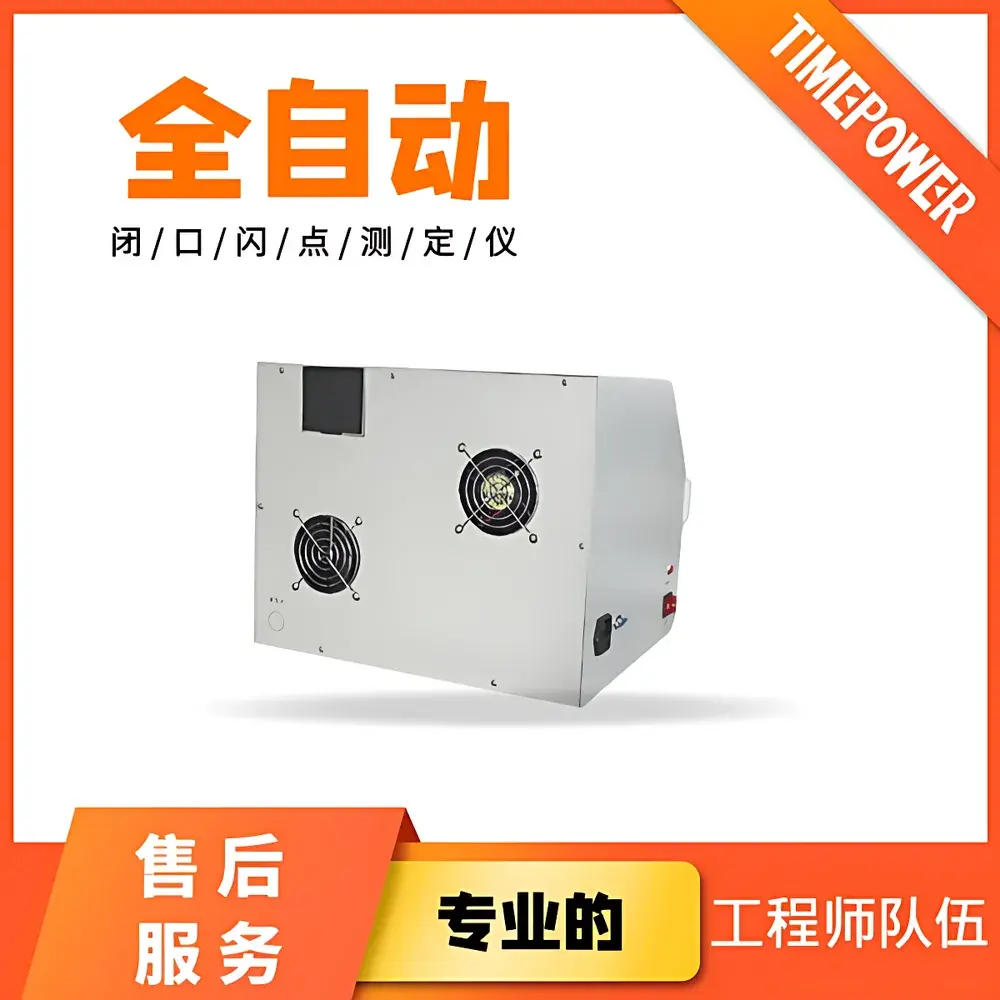
TimePower TP611/TP612 Automated Cleveland Open-Cup & Pensky-Martens Closed-Cup Flash Point Analyzer
| Brand | TimePower |
|---|---|
| Origin | Beijing, China |
| Manufacturer Type | OEM Manufacturer |
| Country of Origin | China |
| Model | TP611 (Open-Cup) / TP612 (Closed-Cup) |
| Detection Method | Cleveland Open-Cup (ASTM D92) and Pensky-Martens Closed-Cup (ASTM D93, GB/T 261) |
| Operation Mode | Fully Automatic |
| Temperature Range | 40–370 °C |
| Ignition Method | Motorized Electronic Igniter with Precise Positioning |
| Repeatability | ≤2 °C |
| Accuracy | ±1 °C for flash point <110 °C |
| Resolution | 0.1 °C |
| Ambient Operating Conditions | 5–40 °C, ≤85% RH (non-condensing) |
| Display | 5.0-inch capacitive touchscreen, Chinese UI |
| Cooling Method | Integrated High-Flow Air Cooling System |
| Printer | Thermal printer, 36-character line, Chinese character support |
| Power Supply | AC 220 V ±10%, 50 Hz ±10% |
| Power Consumption | ≤600 W |
| Dimensions (W×D×H) | 350 × 310 × 300 mm |
| Weight | 14.5 kg |
| Included Accessories | Standard test cup (ASTM E1–compliant), motorized ignition arm, LPG gas regulator assembly (for butane/propane), calibration certificate |
Overview
The TimePower TP611/TP612 Automated Flash Point Analyzer is a dual-mode laboratory instrument engineered for precise, repeatable determination of flash point temperatures in petroleum-based liquids—including lubricating oils, diesel fuels, transformer oils, residual fuels, and crude fractions—according to internationally recognized test protocols. It supports both Cleveland Open-Cup (ASTM D92, ISO 2592) and Pensky-Martens Closed-Cup (ASTM D93, ISO 2719, GB/T 261) methodologies within a single platform. The instrument operates on the fundamental principle that flash point is the lowest temperature at which vapors above a heated liquid sample ignite momentarily upon exposure to an external ignition source under standardized atmospheric conditions. By integrating closed-loop PID temperature control, real-time vapor concentration monitoring via optical flame detection, and programmable heating ramp profiles, the TP611/TP612 ensures strict compliance with thermal gradient requirements specified in ASTM and GB standards—particularly the 5–6 °C/min ramp rate for closed-cup testing and 14–17 °C/min for open-cup procedures.
Key Features
- Fully automated operation from sample loading to final report generation—no manual ignition, timing, or endpoint judgment required.
- Dual-test capability: One instrument performs both ASTM D93 (closed-cup) and ASTM D92 (open-cup) tests with tool-free cup exchange and auto-configured parameter recall.
- Precision temperature control system with platinum RTD sensor (Class A, IEC 60751) and digital feedback loop maintaining ±0.2 °C stability during critical flash detection window.
- Motorized ignition arm with micro-stepper positioning ensures consistent spark gap (1.5 ± 0.2 mm) and repeatable flame exposure duration (0.5 s ± 0.05 s).
- Integrated air-cooling module reduces cooldown time between tests by >40% versus passive cooling, enabling throughput of up to 8 samples per hour under standard operating conditions.
- 5.0-inch industrial-grade capacitive touchscreen with intuitive Chinese-language interface, supporting multi-level user access (operator, supervisor, administrator) with password protection.
- Comprehensive safety architecture: automatic gas shutoff upon flame detection failure, overtemperature cutoff (>380 °C), and LPG pressure monitoring with audible/visual alarm.
Sample Compatibility & Compliance
The TP611/TP612 is validated for use with transparent and opaque petroleum distillates, biodiesel blends (B5–B20), synthetic lubricants, and insulating oils meeting ASTM D877/D1816 specifications. It complies fully with GB/T 261–2021, ASTM D93–22, ASTM D92–21, ISO 2719:2016, and ISO 2592:2022. Instrument validation includes as-received calibration verification using certified reference materials (CRM) traceable to NIM (National Institute of Metrology, China) and NIST SRM 2722/2723. Data integrity meets GLP and GMP documentation requirements, with full audit trail logging of operator ID, test parameters, raw temperature/time data, and pass/fail status per run.
Software & Data Management
Embedded firmware supports local data storage of ≥1,000 test records with timestamp, ambient conditions, and operator ID. Export options include USB-stick transfer of CSV-formatted datasets compatible with LIMS integration (e.g., LabWare, Thermo Fisher SampleManager). Optional PC software (TimePower FlashLink v3.2) enables remote instrument control, method library management, statistical trend analysis (X-bar/R charts), and 21 CFR Part 11–compliant electronic signatures with role-based permissions and immutable audit logs.
Applications
- Quality control laboratories in refineries verifying conformance of finished fuels to specification limits (e.g., diesel flash point ≥55 °C per EN 590).
- Electrical utilities performing routine dielectric oil testing per IEC 60156 and ASTM D877 to assess contamination or thermal degradation.
- Third-party inspection agencies conducting customs clearance testing for imported petroleum products under China’s AQSIQ regulatory framework.
- R&D departments evaluating formulation stability of bio-based lubricants and low-sulfur marine fuels under accelerated aging protocols.
- Academic research labs studying vapor pressure–temperature relationships in hydrocarbon mixtures using flash point as a surrogate indicator of volatility hazard class.
FAQ
What standards does the TP611/TP612 support for closed-cup flash point testing?
ASTM D93, ISO 2719, GB/T 261, and IP 34.
Can the instrument be used for both new and in-service oil samples?
Yes—validated for virgin base stocks, formulated lubricants, and field-used transformer oils with suspended particulates or sludge, provided samples are pre-filtered to ≤10 µm per ASTM D6299 guidelines.
Is external gas supply mandatory for operation?
Yes—a regulated LPG (propane/butane) source is required for ignition; the unit includes a certified pressure regulator and leak-tested hose assembly.
Does the analyzer support multi-language interfaces beyond Chinese?
Currently Chinese-only; English firmware localization is available upon request for OEM integration projects.
How is calibration verified during routine operation?
Daily verification uses certified flash point standards (e.g., NIST SRM 2722, flash point 103.5 °C ± 0.5 °C); annual recalibration by authorized service center includes sensor drift assessment and thermal uniformity mapping.





