
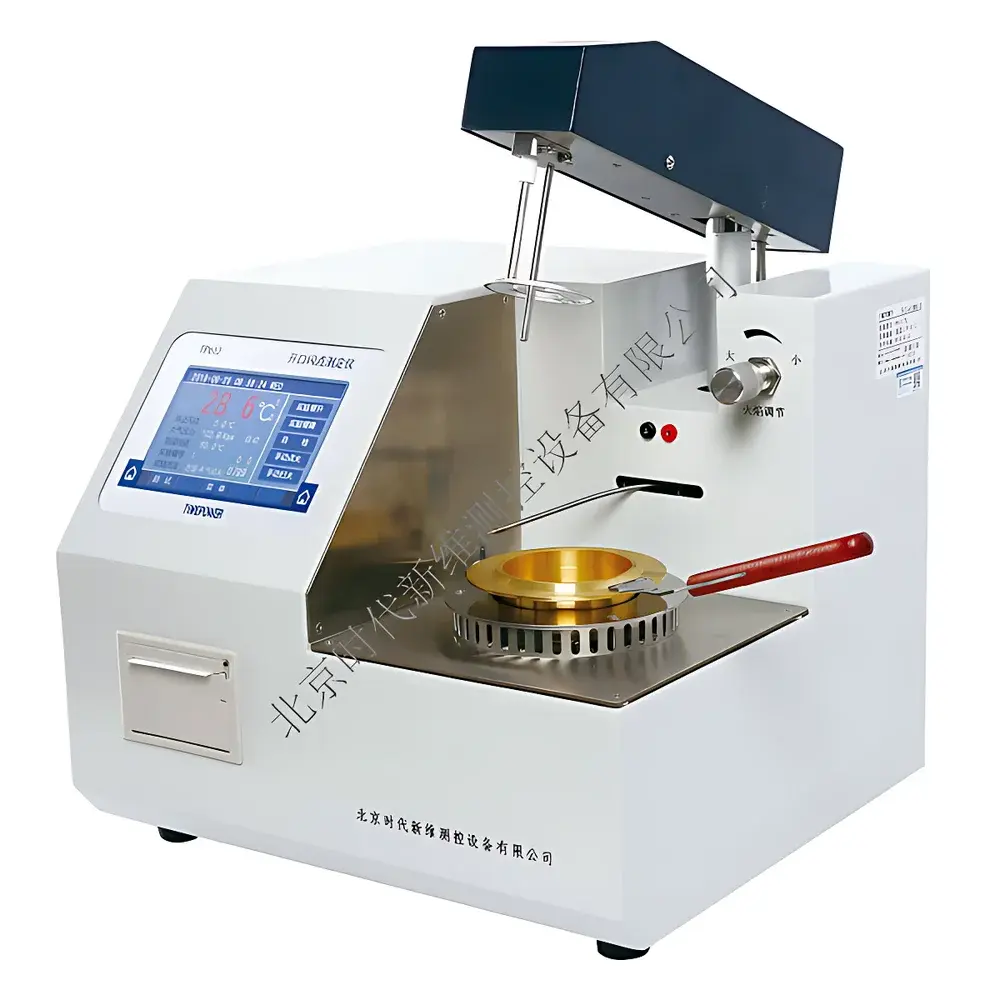
Timepower TP612 Automatic Cleveland Open-Cup Flash Point Tester
| Brand | Timepower |
|---|---|
| Origin | Beijing, China |
| Manufacturer | Timepower Instrument Co., Ltd. |
| Model | TP612 |
| Detection Method | Cleveland Open-Cup (COC) |
| Standards Compliance | GB/T 3536, ASTM D92 |
| Measurement Range | 79–370 °C |
| Accuracy | ±2 °C |
| Repeatability | ≤4 °C |
| Resolution | 0.1 °C |
| Temperature Sensor | Pt100 (stainless steel sheath) |
| Ignition Options | Adjustable gas flame scanning or electronic arc ignition |
| Atmospheric Pressure Compensation | Yes |
| Safety Features | Over-temperature cutoff, self-diagnostic system, automatic test arm retraction |
| Cooling Method | Integrated forced-air cooling |
| Display | 5.0-inch capacitive touch LCD (Chinese UI) |
| Printer | Thermal printer, 36-character Chinese/English output |
| Power Supply | AC 220 V ±10%, 50 Hz ±10% |
| Power Consumption | ≤600 W |
| Dimensions | 350 × 310 × 300 mm |
| Weight | 14.5 kg |
| Environmental Operating Conditions | 5–40 °C, RH ≤85% |
Overview
The Timepower TP612 Automatic Cleveland Open-Cup Flash Point Tester is a precision-engineered instrument designed for the standardized determination of the open-cup flash point of petroleum products, lubricants, biodiesel blends, and related hydrocarbon-based fluids. It operates in strict accordance with internationally recognized test methodologies—primarily ASTM D92 (Standard Test Method for Flash and Fire Points by Cleveland Open Cup Tester) and GB/T 3536 (Petroleum Products—Determination of Flash Point—Cleveland Open Cup Method). The device employs the classical Cleveland open-cup principle: a sample is heated at a controlled linear rate within a standardized brass test cup; vapors above the liquid surface mix with ambient air to form a flammable mixture, and the lowest temperature at which application of an ignition source results in momentary flash (i.e., flame propagation across the vapor layer) is recorded as the flash point. This parameter serves as a critical safety indicator for storage, transportation, handling, and classification under OSHA, GHS, and UN TDG hazard communication frameworks.
Key Features
- Fully automated operation sequence—including cup lifting, heating ramp control, ignition initiation, flash detection, data logging, thermal shutdown, and test arm retraction—minimizing operator intervention and inter-laboratory variability.
- Programmable heating rate conforming to ASTM D92 specifications (typically 5–6 °C/min during final approach), with real-time PID feedback from a calibrated Pt100 sensor (stainless steel sheathed, Class A tolerance).
- Dual-mode ignition system: user-selectable between propane-butane gas flame scanning (with integrated pressure-regulated cylinder interface) and contactless electronic arc ignition—enabling compliance with lab-specific gas handling policies or inert-atmosphere requirements.
- High-sensitivity ionization ring detector optimized for low-energy flash event recognition, delivering consistent response across the full 79–370 °C measurement range.
- Integrated atmospheric pressure compensation algorithm, allowing automatic correction of flash point values to standard reference pressure (101.3 kPa), essential for laboratories operating at non-sea-level elevations.
- Robust safety architecture featuring hardware-enforced over-temperature cutoff, continuous system diagnostics, and fail-safe mechanical retraction of the ignition arm upon flash detection or error condition.
- Onboard thermal management via high-efficiency forced-air cooling circuit, enabling rapid cooldown between sequential tests without external chillers or water circulation.
Sample Compatibility & Compliance
The TP612 is validated for use with a broad spectrum of petroleum-derived materials including base oils, transformer oils, hydraulic fluids, fuel oils (No. 2 through No. 6), cutback asphalts, and biofuel intermediates. It is not intended for highly volatile solvents (e.g., gasoline, acetone, or ether), which require closed-cup methods (ASTM D56, D3278, or ISO 2719). All operational parameters—including cup geometry, stirrer speed (if applicable), flame diameter, and approach rate—are traceably aligned with ASTM D92 Annex A1 and GB/T 3536 Clause 6. The instrument supports audit-ready documentation per GLP and internal quality protocols; though not natively 21 CFR Part 11 compliant, its thermal printer output (with timestamp, sample ID, operator ID, and ambient pressure) provides legally defensible hardcopy records for regulatory review.
Software & Data Management
The TP612 operates via embedded firmware with a localized Chinese-language interface on its 5.0-inch capacitive touchscreen. While no PC connectivity or proprietary software suite is included, all test results—including raw temperature vs. time profiles, detected flash point, atmospheric pressure reading, and pass/fail status—are stored internally and printed in real time using a 36-character thermal printer capable of bilingual (Chinese/English) alphanumeric output. Data export requires manual transcription or optional RS232-to-USB bridging (not supplied). For labs requiring digital archiving, integration with LIMS is feasible via ASCII-formatted serial output (custom configuration required).
Applications
- Quality assurance in refinery QC labs verifying flash point conformity against product specifications (e.g., ASTM D3487 for electrical insulating oils).
- Hazard classification support for SDS authoring under GHS Category 3 or 4 flammability criteria.
- Condition monitoring of in-service industrial oils where elevated flash point may indicate contamination with higher-boiling fractions or thermal degradation byproducts.
- R&D screening of alternative fuels and additive packages where volatility stability must be quantified across formulation iterations.
- Third-party testing services accredited to ISO/IEC 17025, performing flash point determinations for customs clearance, insurance risk assessment, or environmental permitting.
FAQ
What standards does the TP612 comply with?
It is fully compliant with ASTM D92 and GB/T 3536 for Cleveland open-cup flash point determination.
Can the instrument operate without an external gas supply?
Yes—users may select electronic arc ignition mode, eliminating dependence on propane/butane cylinders.
Is atmospheric pressure correction applied automatically?
Yes—the built-in barometric sensor feeds real-time pressure data into the flash point calculation algorithm.
What maintenance is required for long-term accuracy?
Regular cleaning of the test cup and ignition tip with solvent-resistant lint-free wipes; annual verification of Pt100 calibration against NIST-traceable reference standards is recommended.
Does the TP612 meet any cybersecurity or data integrity standards?
It contains no network interface or remote access capability; data integrity relies on printed output and internal non-volatile memory—suitable for environments governed by ISO 17025 but not FDA 21 CFR Part 11 without supplemental procedural controls.





