
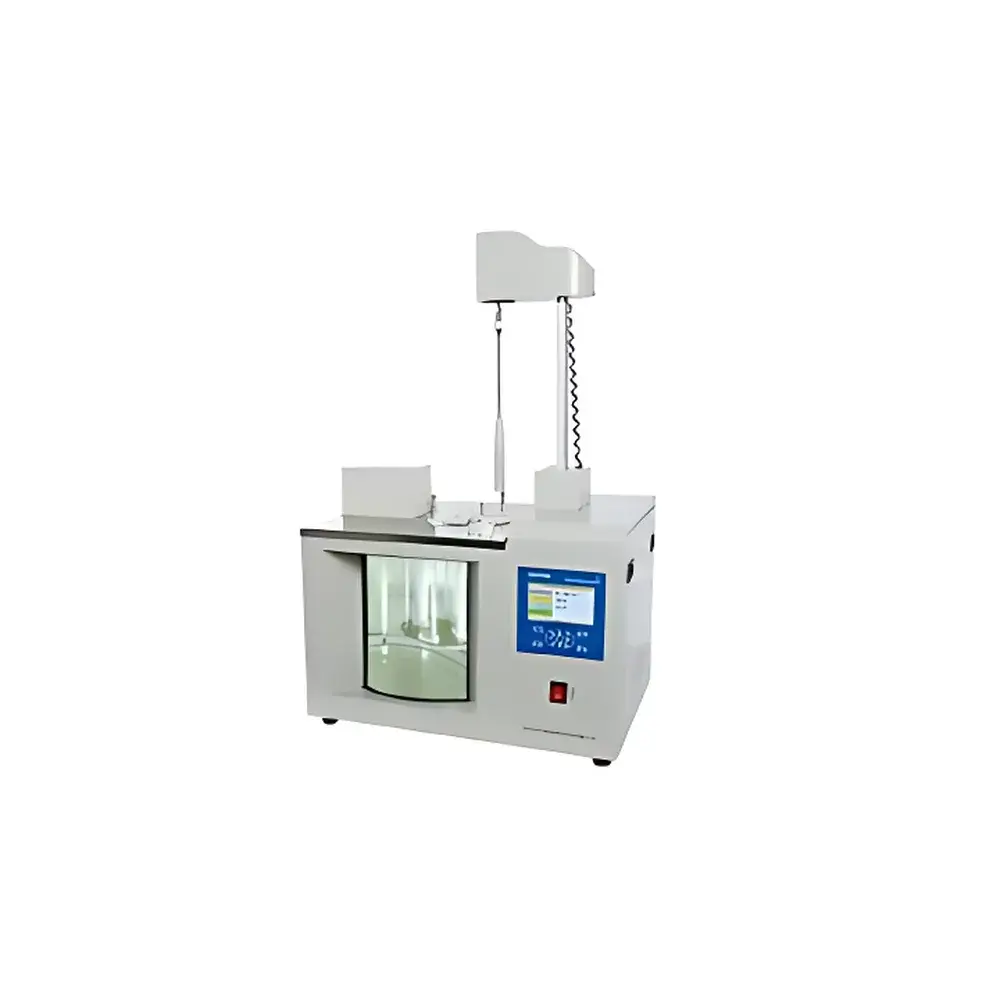
TimePower TP651 Petroleum Demulsibility Tester
| Brand | TimePower |
|---|---|
| Origin | Beijing, China |
| Manufacturer Type | Manufacturer |
| Origin Category | Domestic |
| Model | TP651 |
| Pricing | Upon Request |
Overview
The TimePower TP651 Petroleum Demulsibility Tester is an automated benchtop instrument engineered for precise evaluation of the demulsification behavior of petroleum products and synthetic lubricants under standardized thermal and mechanical agitation conditions. It operates in accordance with the fundamental principle of gravity-driven phase separation kinetics—measuring the time required for a defined oil–water emulsion to separate into distinct, visually discernible layers following controlled mechanical stirring. This measurement directly reflects the interfacial stability and surfactant sensitivity of the sample, making the TP651 essential for quality assurance in turbine oils, hydraulic fluids, transformer oils, and other critical industrial lubricants where water contamination poses risks to equipment integrity and operational reliability.
Key Features
- Microprocessor-controlled automation: Fully integrated sequence management for temperature stabilization, stirrer descent, 5-minute standardized agitation (per GB/T 7305), automatic stirrer retraction, and post-agitation separation timing.
- Precision thermostatic water bath: Temperature range 20–99 °C, accuracy ±0.5 °C, resolution 0.1 °C; maintains 54 °C ±1 °C (or 82 °C ±1 °C for high-viscosity samples) with low thermal drift and uniformity across the bath chamber.
- Electromechanical stirrer actuation: Linear electric push rod ensures smooth, repeatable vertical movement of the stirrer assembly; final positioning accuracy ≤0.5 mm above the bottom of the 100 mL calibrated cylinder (depth: 6 mm ±0.2 mm).
- Human-centered interface: 480×272-pixel color LCD display with full Chinese menu navigation, step-by-step wizard-guided operation, real-time status feedback, and intuitive confirmation-based workflow termination.
- Robust mechanical architecture: Integrated stainless-steel water bath tank, reinforced cylinder support cradle with positive-bottom seating alignment, and fail-safe行程 lock mechanism to prevent misalignment during agitation.
- Safety-compliant design: Dual-level thermal cutoff, dry-run protection for heater, insulated housing, and electrical compliance with IEC 61010-1 for laboratory equipment (220 V ±10%, 50 Hz, ≤1600 W).
Sample Compatibility & Compliance
The TP651 is validated for use with mineral-based and synthetic hydrocarbon lubricants, including but not limited to ISO VG 32–100 turbine oils, phosphate ester hydraulic fluids, and insulating oils per IEC 60296. It strictly implements the test methodology specified in GB/T 7305–2003 (equivalent to ASTM D1401–19a for general demulsibility assessment). While not certified to ISO/IEC 17025 as a standalone testing laboratory, the instrument’s repeatability (≤4 s variation between duplicate runs on homogeneous samples) supports internal method validation protocols aligned with GLP principles. Its operational envelope—ambient temperature 5–40 °C, relative humidity ≤80% RH—ensures stable performance in standard QC laboratories without climate control augmentation.
Software & Data Management
The TP651 operates via embedded firmware with no external PC dependency. All test parameters (setpoint temperature, agitation duration, operator ID input, and end-time stamp) are logged internally with non-volatile memory retention. Test records include start time, stabilization timestamp, agitation completion time, separation endpoint, and total demulsification time (in seconds), exportable via USB interface in CSV format for traceability. Audit trail functionality meets basic documentation requirements for ISO 9001 and internal QA systems; however, it does not implement FDA 21 CFR Part 11 electronic signature or encrypted user-role access controls. Data integrity is preserved through power-fail recovery and timestamped event logging.
Applications
- Quality release testing of new turbine and circulating oils prior to commissioning.
- Condition monitoring of in-service oils to detect additive depletion or oxidation-induced emulsification tendency.
- R&D evaluation of demulsifier package efficacy in formulated lubricants.
- Third-party verification for commercial contracts requiring conformance to GB/T 7305 or ASTM D1401 specifications.
- Teaching and method training in petroleum engineering laboratories where standardized hands-on demulsibility practice is required.
FAQ
What standards does the TP651 comply with?
It is designed and verified for GB/T 7305–2003; its agitation geometry, temperature control, and timing logic are functionally equivalent to ASTM D1401–19a.
Can the instrument be used for non-petroleum fluids such as bio-lubricants?
Yes—provided the fluid exhibits measurable phase separation under the specified test conditions and falls within the viscosity and density range compatible with the 100 mL cylinder geometry and stirrer torque profile.
Is calibration traceable to national standards?
Temperature sensor calibration is performed using NIST-traceable reference thermometers; users are advised to perform annual verification with certified RTD probes.
What maintenance is required for long-term reliability?
Monthly cleaning of the water bath and stirrer shaft with deionized water; biannual inspection of cylinder alignment,行程 lock engagement, and push rod lubrication.
Does the TP651 support multi-sample batch testing?
No—it is a single-cylinder, sequential-test platform; parallel testing requires multiple units or manual intervention between runs.
Related Products





