
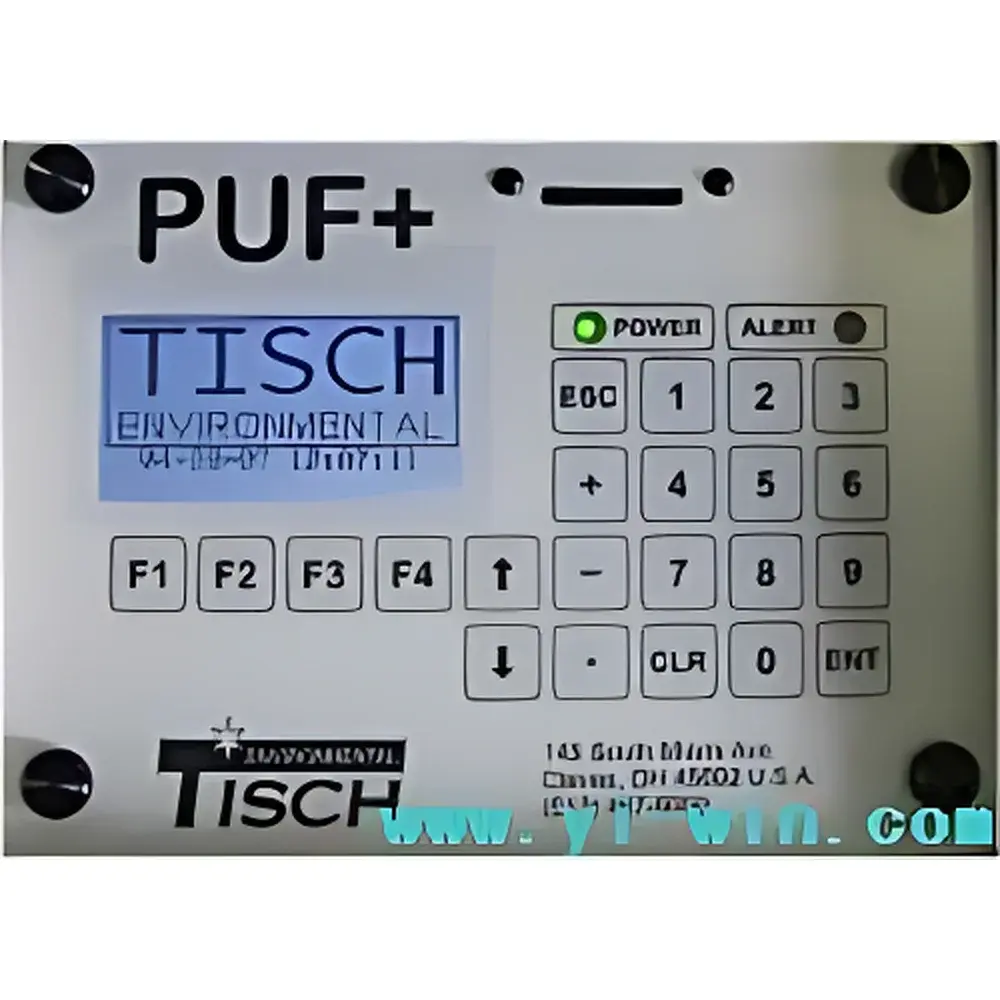
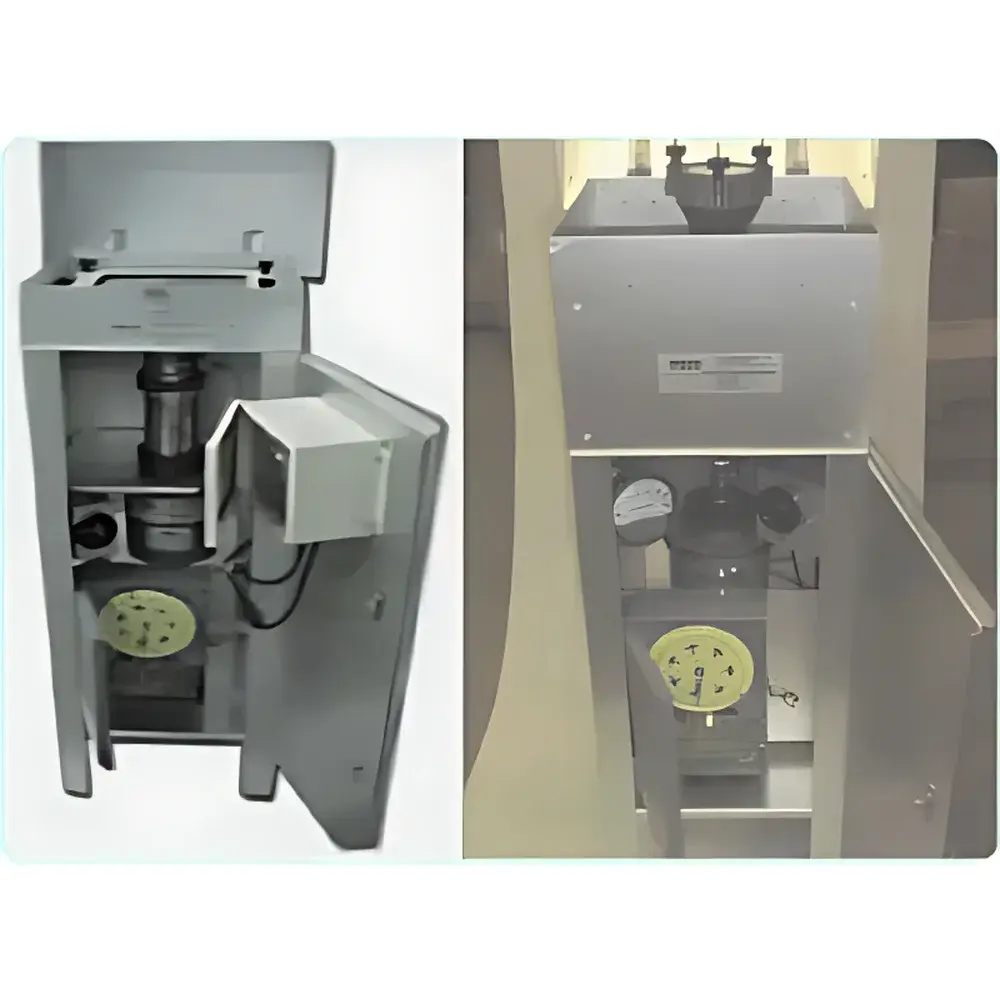
Tisch TE-1000 PUF Semi-Volatile Organic Compounds (SVOC) Sampling System
| Brand | Tisch |
|---|---|
| Origin | USA |
| Model | TE-1000 PUF |
| Flow Rate | 280 L/min (10 CFM) |
| Filter Medium | 4" Quartz Fiber Filter (TE-QMA4) |
| Sampling Modules | Dual-Stage Particulate & Gas Sampling Module (TE-1002) |
| Flow Control | Voltage-Regulated 2-Stage Vacuum Motor with Mechanical Timer (7-Day, TE-5007) |
| Pressure Gauge | 0–100" H₂O Magnehelic® (TE-1005) |
| Elapsed Time Indicator | TE-5010 |
| Motor | TE-116125 (220 V / 50 Hz, Start Current: 15 A, Running Current: 5 A) |
| Compliance | EPA Methods TO-4A, TO-9A, TO-13A |
| Sample Compatibility | LC-Ready SVOC Extracts (e.g., PCBs, PAHs, organochlorine pesticides) |
| Configuration | Integrated Field-Deployable Sampler with Anodized Aluminum Frame |
Overview
The Tisch TE-1000 PUF is a field-deployable, dual-stage high-volume air sampling system engineered for the quantitative collection of semi-volatile organic compounds (SVOCs) from ambient or source emission streams. It operates on the principle of simultaneous particulate-phase and vapor-phase capture: airborne particles are retained on a 4-inch quartz fiber filter (TE-QMA4), while gaseous SVOCs—such as polycyclic aromatic hydrocarbons (PAHs), polychlorinated biphenyls (PCBs), organochlorine pesticides, and brominated flame retardants—are adsorbed onto a polyurethane foam (PUF) plug downstream. This configuration adheres to the fundamental separation logic defined in U.S. EPA Compendium Methods TO-4A (for particle-bound organics), TO-9A (for vapor-phase SVOCs), and TO-13A (for integrated particulate/gas sampling). The system delivers a nominal flow rate of 280 L/min (10 CFM) under typical field conditions, ensuring sufficient mass loading for subsequent liquid chromatography (LC) or gas chromatography–mass spectrometry (GC–MS) analysis without breakthrough or artifact formation.
Key Features
- Robust anodized aluminum structural frame designed for outdoor deployment and long-term stability in variable environmental conditions.
- Two-stage vacuum motor (TE-116125) rated for continuous operation at 220 V / 50 Hz, with controlled startup current (15 A) and steady-state draw (5 A) to minimize thermal drift and power supply strain.
- Integrated voltage-regulated motor controller enabling precise flow rate adjustment and reproducible performance across seasonal temperature gradients.
- Dual-path sampling module (TE-1002) accommodating both the TE-QMA4 quartz filter and standardized PUF plugs in series, with leak-tight O-ring seals and NIST-traceable flow calibration ports.
- Magnehelic® pressure gauge (TE-1005, 0–100″ H₂O range) providing real-time differential pressure monitoring across the filter/PUF stack—critical for detecting clogging or media saturation.
- Seven-day mechanical interval timer (TE-5007) and elapsed time indicator (TE-5010) supporting unattended multi-day campaigns with audit-ready runtime logging.
- Modular packaging: main sampler (70 lbs, 45.5″ × 22.5″ × 20″) and auxiliary components (9 lbs, 19″ × 14″ × 14″) optimized for logistics and field reassembly.
Sample Compatibility & Compliance
The TE-1000 PUF is validated for use in regulatory monitoring programs requiring adherence to U.S. EPA Method TO-4A (determination of particle-phase organics via GC–MS), TO-9A (vapor-phase SVOCs using PUF/XAD-2 sorbent trains), and TO-13A (integrated particulate and vapor phase sampling for total deposition flux estimation). Extracts obtained from the quartz filter and PUF media are fully compatible with reversed-phase liquid chromatography (LC) methods—including EPA Method 1613 (chlorinated dioxins/furans) and Method 8270 (SVOCs by GC–MS)—without matrix interference or solvent incompatibility. All wetted components comply with ASTM D1357 (standard practice for sampling atmospheric particulate matter) and ISO 12103-1 (test dust specifications for filter integrity validation). The system supports GLP-compliant data generation when paired with documented calibration records and chain-of-custody protocols.
Software & Data Management
While the TE-1000 PUF is a hardware-centric analog system, its operational parameters are fully traceable and auditable per FDA 21 CFR Part 11 requirements when integrated into a laboratory’s electronic record management system. The elapsed time indicator (TE-5010) provides tamper-resistant runtime logs; pressure gauge readings support daily QC checks; and the calibrated flow valve enables post-sampling volumetric correction using gravimetric or bubble-meter verification. Laboratories routinely pair the TE-1000 with Tisch’s optional digital flow calibrator (TE-1020) and integrate raw time/pressure/flow data into LIMS platforms via CSV export. All calibration certificates—including motor performance curves and Magnehelic® unit certification—are supplied with NIST-traceable documentation.
Applications
- Ambient air monitoring networks assessing urban and rural SVOC background concentrations (e.g., EPA National Air Toxics Trends Stations).
- Source testing at industrial facilities emitting combustion byproducts, pesticide application sites, or e-waste recycling operations.
- Indoor air quality investigations targeting legacy contaminants such as DDT, chlordane, or decabromodiphenyl ether (deca-BDE).
- Research studies quantifying atmospheric deposition fluxes of persistent organic pollutants (POPs) using PUF disk passive samplers calibrated against active TE-1000 reference data.
- Method development laboratories validating extraction efficiency, breakthrough volumes, and sorbent aging effects for novel SVOC analytes.
FAQ
What distinguishes the TE-1000 PUF from low-volume PUF samplers?
The TE-1000 operates at high volume (280 L/min), enabling statistically robust mass collection over short durations (e.g., 24–168 hr), whereas low-volume samplers (< 10 L/min) require weeks to achieve comparable analyte mass—increasing risk of degradation and ambient interference.
Can the TE-1000 be configured for PM2.5-specific SVOC sampling?
Yes—the TE-1008-9-2.5 PUF PM2.5 Sampling Kit integrates a WINS impactor and cyclone assembly upstream of the quartz/PUF stage, allowing size-fractionated collection aligned with EPA Method IO-3.1.
Is the TE-1000 compatible with 110 V / 60 Hz power systems?
The standard TE-116125 motor is rated for 220 V / 50 Hz; however, Tisch offers a dedicated 110 V / 60 Hz motor variant (TE-116125-110) upon request—requiring no hardware modification to the sampler frame.
How frequently must the Magnehelic® gauge be recalibrated?
Per Tisch Engineering guidelines, annual recalibration against a certified manometer is recommended; field zero-checks should be performed prior to each sampling campaign using atmospheric venting.
Does Tisch provide method-specific SOPs for EPA TO-13A implementation?
Yes—Tisch supplies a comprehensive Application Note (AN-TE1000-TO13A) covering filter/PUF preconditioning, blank control protocols, field spike recovery procedures, and volumetric correction algorithms compliant with QA/QC requirements in Appendix A of TO-13A.







